My ExportersIndia

For Buyer

For Seller

For Help

Our Products

Our offered Product range includes Mild Steel Skirting Mounted Work Bench, For Laboratory, Canopy Hoods, Auxiliary Air Fume Hood, Walk in Fume Hood and Stainless Steel Low Bench Fume Hood.

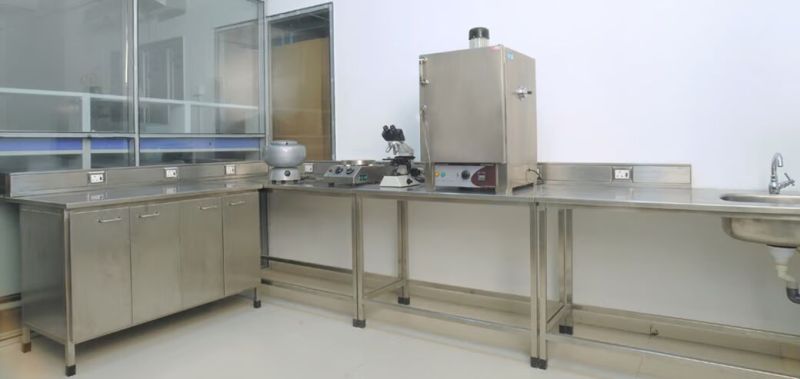
Mild Steel Skirting Mounted Work Bench, For Laboratory

  • Number Of Flower Skirting Mounted Work Bench
  • Material Mild Steel
  • Application Laboratory
  • Base Design Skirting Or Plinth-mounted
  • Installation Environment Dust Free
  • Storage Space Substantial Under-bench Storage
  • Construction Sturdy
  • Optimization Workspace Efficiency
Skirting or plinth-mounted workbenches are a modern alternative to pedestal-mounted ones, distinguished by their base design. Unlike pedestal-mounted tables, which stand on separate pedestals or stands, skirting-type benches are directly installed onto a skirting or plinth. Skirting or plinth type work stations are used in the lab where there are less chances of floor spillages. This type of table is installed mainly in dust free environment where cleaning under the cabinets is not required. Plinth-mounted lab tables offer substantial under-bench storage space compared to pedestal or C-frame workbenches. This mounting style integrates seamlessly with existing cabinetry or workspaces, providing a cohesive and efficient laboratory layout. Aakar skirting mounted caseworks are Known for their sturdy construction. These workbenches can support heavy equipment and instruments used in laboratory settings, ensuring stability and reliability. Skirting or plinth-mounted workbenches are chosen for their practical design and ability to optimize workspace efficiency while meeting the specific needs of modern laboratory environments.
View Complete Details

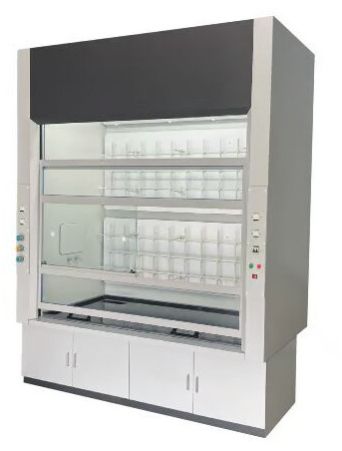
Stainless Steel Low Bench Fume Hood

  • Number Of Flower Low Bench Fume Hood
  • Material Stainless Steel
  • Application Vapors, Gases In Laboratories
  • Height Lower Than Standard Fume Hoods
  • Safety Features Sash Alarms, Airflow Monitor
  • Accessories Electrical Outlets, Gas Taps
A "low bench fume hood " typically refers to a type of laboratory equipment designed to contain and exhaust fumes, vapors, and gases generated during chemical processes. This type of fume hood is installed at a lower height compared to standard fume hoods, making it suitable for use in spaces with limited ceiling height or where accessibility is a concern. Taller assemblies are being practiced in low bench fume hood. The ventilation system includes centrifugal blower with suitable airflow rate (typically measured in cubic feet per minute, or CFM), and any scrubbing systems. If needed Fume hoods have safety features such as sash alarms, airflow monitors, and fire suppression systems. Fume hoods are equipped with certain accessories like electrical outlets, gas taps, airflow monitors, and lighting options.
View Complete Details

Walk In Fume Hood

  • Country of Origin India
  • Number Of Flower Walk-in Fume Hood
  • Application High Volume Reactions
Walk-in fume hoods are basically floor mounted units where the floor itself is considered as a working surface. Walk-in fume hood is used for tall assemblies or large apparatus like kilo scale High volume reactions etc. Sometimes it may be used as for a storage of containers that is prone to some hazard, but may not fit in to defined storage cabinet. Generally, it has horizontal sliding sash, although some models are equipped with telescopic vertical sliding sashes. For safety reasons, horizontal sliding sashes are always recommended in walk-in fume hoods. The term walk-in is hinted that a person can walk-in to the hood. In fact, the word walk-in fume hood is misleading. So far, the safety precaution is concerned in the laboratory, the hood must never be entered during the experiment or fume generation inside the enclosure. Because of large opening area at front fascia, it is advised not to use floor mounted fume hoods for experiments that generate highly toxic fumes or poisonous gas. It is recommended that only one sash be fully opened during hood operation.
View Complete Details

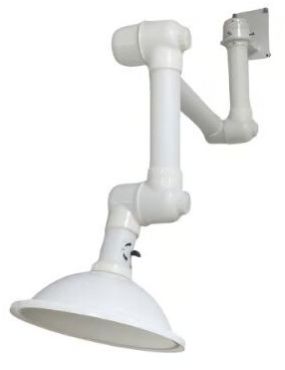
PP Laboratory Spot Extractor

  • Country of Origin India
  • Number Of Flower Fume Extractor
  • Material Polypropylene Or Aluminium
  • Models Available Ceiling Mounted And Wall Mounted
  • Optimum Adjustment 300 To 450mm Above Fume Release Point
It is a local fume extraction unit. It is also known as elephant trunking fume extractor. This is used for the lighter fumes or gas generated in small volume during experiment carried out on table in laboratory. This cannot be used for medium to high volume fumes. There are two types of models available: Ceiling mounted and wall mounted. MOC of spot extractor is polypropylene or aluminium. It is articulated at three points. One arm is mounted on ceiling or on wall as per the requirement and other arm had circular dome hood at the end with damper. It is flexible and its arms move in all directions. This is connected with centrifugal blower to achieve required suction. For optimum performance, spot extractor should be adjusted 300mm to 450 mm above the fume release point.
View Complete Details

Canopy Hoods

  • Number Of Flower Canopy Hood
  • Size Big Size
  • Flexibility Without Flexibility
  • Mounting Wall Or Ceiling
  • Connection Centrifugal Blower
  • Suction Required Suction
This is a big size local spot extractor without flexibility. Laboratory canopy hood is like a chimney. It is open from all sides and bottom. It is mounted on wall or ceiling as per the space available and connected with centrifugal blower to achieve required suction. It is available in PP-FRP, powder coated steel and SS as per the need. Please note that this not an alternative of laboratory fume hood. This is also used for lighter fumes and cannot be used for medium to high volume fumes.
View Complete Details

Auxiliary Air Fume Hood

  • Country of Origin India
  • Material Mild Steel
  • Usage In In Air Conditioned Lab
  • Availability In Stock
Auxiliary fume hood is used in air-conditioned lab. Standard fume hood draw air from the room. Auxiliary fume hood minimizes the consumption of conditioned air for exhaust. In this hood, auxiliary air is brought from outside and introduced at the face of fume hood which shall be utilized for exhaust. This auxiliary air works as make up air. Also, auxiliary air creates air curtain in front of fume hood face so that the conditioned air is prevented entering the hood. However, complete prevention of entering conditioned room air in to the fume hood is not possible. There are chances of escaping auxiliary air inside the room hence, it is necessary that auxiliary air must be preconditioned and pre-filtered before it is brought to the fume hood. Auxiliary fume hood system should provide safe capture and efficient displacement of the fumes during exhaust functioning. The right auxiliary fume hood system will have proper balance of supplementary air, room air and exhaust air. Please do not pressurize the hood with supplementary air that will create turbulence and may deflect the flow of fumes.
View Complete Details

Radioisotope Fume Hood

  • Country of Origin India
  • Material Stainless Steel
  • Application Beta And Gamma Radiation
  • Availability In Stock
A specific kind of containment tool used in labs handling radioactive materials is the radioisotope fume hood. A radioisotope fume hood 's main function is to give lab workers and researchers who work with radioactive materials a safe place to operate. These hoods are made to trap and release radioactive dust, vapors, and particles into the atmosphere that are produced during procedures or tests. Specialized airflow systems in these fume hoods are intended to efficiently absorb and confine radioactive pollutants. To avoid exposure, the airflow is usually directed toward the exhaust system and away from the user. Additionally, extra shielding is incorporated into radioisotope fume hoods to reduce laboratory personnel 's exposure to radiation. This can include lead shielding in essential sections or thicker construction materials to reduce radiation. Before the exhaust air is released into the atmosphere, radioisotope fume hoods frequently use HEPA (High-Efficiency Particulate Air) filters or other specialized filter media to remove pollutants and radioactive particles. These filters are made to stop the release of even minuscule particles by capturing them. In order to guarantee adequate airflow and containment, radioisotope fume hoods are equipped with safety measures like airflow alarms, automated sash closures, and monitoring systems. When choosing and utilizing radioisotope fume hoods, adherence to pertinent safety standards and regulationssuch as those established by agencies like the International Atomic Energy Agency (IAEA) or the Nuclear Regulatory Commission (NRC)is crucial to guaranteeing the security of lab workers and following local laws. Installation of ropers and routine maintenance are essential to their performance. The safety of radioisotope fume hoods is enhanced by the frequent use of HEPA (High-Efficiency Particulate).
View Complete Details
Tell Us What are you looking for? Will call you back

Contact Us