Section 1 : General
Sec. 1.1 Scope- This standard describes bolted, sleeve-type couplings, reducing or transition couplings, and flanged coupling adapters used to join plain-end steel and ductile-iron pipe. They may be manufactured from carbon steel, stainless steel, ductile iron, or malleable iron, and are intended for use in systems conveying water. This standard describes nominal pipe sizes from V2 in. (]3 mm)' through 114 in. (3, 600 m)
Sec. 1.2 Purpose- The purpose of this standard is to provide the minimum requirements 19r bolted, sleeve-type couplings for plain-end pipe, including requirements for materials, design, testing and inspection, installation, and shipping
Sec. 1.3 Application- This standard can be referenced in specifications for bolted, sleeve-typo couplings for plain-end pipe. The stipulations of this standard apply when this document has been referenced and then only to bolted, sleeve-type couplings for plain-end pipe.
Section 2: Definitions
The following definitions shall apply in this standard (refer to Figures 1 and 2):
- Actual outside diameter: The pipe outside diameter (including any coating)
- Angular deflection: The angle between the longitudinal axes of the pipes being joined by the coupling.
- Center sleeve (center ring, middle ring): A cylinder of sufficient length to fully enclose both pipe ends.
- Constructor: The party that provides the work and materials for placement or instalIation.
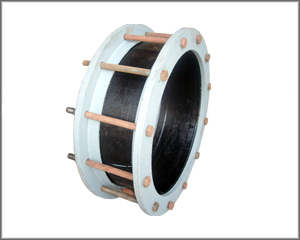
- Coupling: An assembly consisting of a center sleeve, gaskets, and end rings connected with bolts and nuts or other type of threaded fasteners. Tightening the fasteners transfers the load through the end rings and compresses the gaskets into the space between the inside of the center sleeve and the outside surface of" the pipe ends.
- Design pressure: See rated pressure.
- End ring (follower ring): A ring that provides a means of compressing the coupling gasketts).
- Flanged coupling adapter: A coupling used to connect plain-end pipe to a flange. It consists of a flange, center sleeve, gasket, and an end ring connected with bolts and nuts or other threaded fasteners.
- Gasket: An elastomeric ring that provides the pressure seal of the coupling.
- Manufacturer: The party that manufactures, fabricates, or produces the materials or products.
- Nominal pipe size: The commercial designation or dimension by which the pipe is identified. The designation may not be the same as the actual inside diameter.
- Purchaser: The person, company, or organization that purchases any materials or work to be performed.
- Rated pressure: The maximum internal hydrostatic pressure to which the coupling is to be subjected under normal operating conditions. In addition, transient and test pressures should be considered in design by the purchaser.
- Reducing coupling: A coupling that uses end rings of different sizes and a center sleeve with ends of proper inside diameter to join pipes of different outside diameters. The center sleeve may be a single piece or several pieces sized to accommodate the different pipe diameters.
- Transient pressure: Surge or other pressures that exceed normal operating conditions and are of short duration.
- Transition coupling: A coupling used to join pipe of the same nominal size. but of differing outside diameters. Differences in pipe outside diameters are accomrno- dated by specially sized gaskets and, when necessary, specially sized end rings.
- Insulating coupling: A coupling used to break electrical continuity between two pipes. This is normally done by means of special insulating gaskets.
 ANANT ENGINEERING & FABRICATORS (ANANT ENGINEERING & FABRICATORS)
 MIDC., Plot No. D/37, - 414 111 , ., Karjat, Ahilya Nagar, Maharashtra - 414111, India
 Share us via







 Write a Review