


Welcome to GEUM TECH
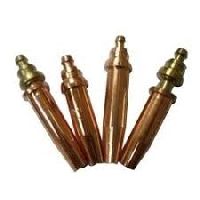
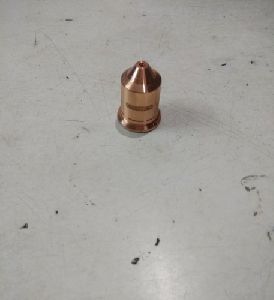
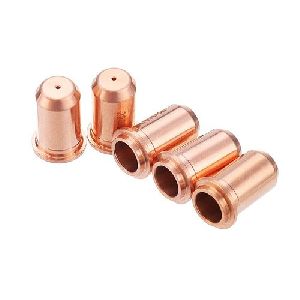
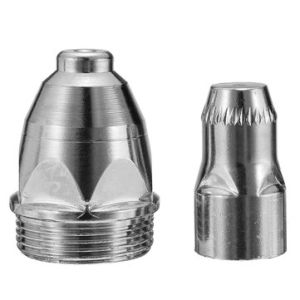
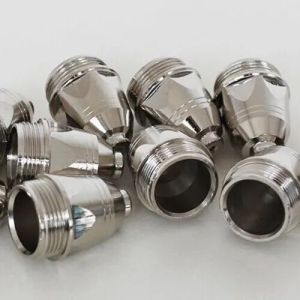
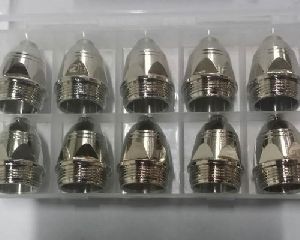
Manufacturer / Exporter / Supplier Of Oxy-fuel welding nozzle, Laser Cutting Nozzle, Plasma Cutting Nozzle., Metallizing Nozzle
 Gimhaesi, South Korea
 Write a Review
Welcome to GEUM TECH
Manufacturer / Exporter / Supplier Of Oxy-fuel welding nozzle, Laser Cutting Nozzle, Plasma Cutting Nozzle., Metallizing Nozzle

Metallizing is the general name for the technique of coating metal on the surface of objects. Metallic coatings may be decorative, protective or functional. Techniques for metallization started as early as mirror making. In 1835, justus von liebig discovered the process of coating a glass surface with metallic silver, making the glass mirror one of the earliest items being metallized. Plating other non-metallic objects grew rapidly with introduction of abs plastic. Because a non-metallic object tends to be a poor electrical conductor, the object's surface must be made conductive before plating can be performed. The plastic part is first etched chemically by a suitable process, such as dipping in a hot chromic acid-sulfuric acid mixture. The etched surface is sensitised and activated by first dipping in tin(ii) chloride solution, then palladium chloride solution. The processed surface is then coated with electroless copper or nickel before further plating. This process gives useful (about 1 to 6 kgfcm or 10 to 60 ncm or 5 to 35 lbfin) adhesion force, but is much weaker than actual metal-to-metal adhesion strength.

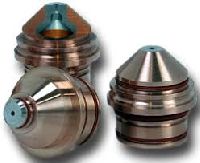
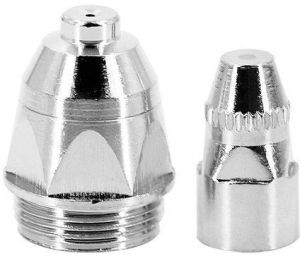
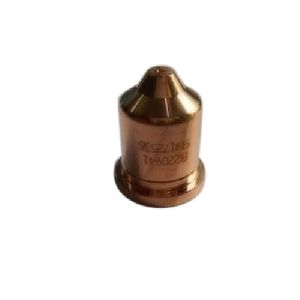
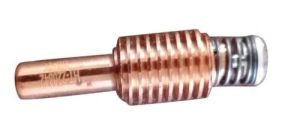
Plasma cutting is a process that cuts through electrically conductive materials by means of an accelerated jet of hot plasma. Typical materials cut by this process include steel, aluminum, brass and copper though other conductive metals may be cut as well. Plasma cutting is often used in fabrication and welding shops, automotive repair and restoration, industrial construction, salvage and scrapping operations. Due to the high speed, precision cuts, combined with low cost of operation, plasma cutting sees a widespread usage from large scale industrial cnc applications down to small hobbyist shops. He basic plasma cutting process involves creating an electrical channel of superheated, electrically ionized gas i.e. Plasma from the plasma cutter itself, through the work piece to be cut, thus forming a completed electric circuit back to the plasma cutter via a grounding clamp. This is accomplished by a compressed gas (oxygen, air, inert and others depending on material being cut) which is blown through a focused nozzle at high speed toward the work piece. An electrical arc is then formed within the gas, between an electrode near or integrated into the gas nozzle and the work piece itself. The electrical arc ionizes some of the gas, thereby creating an electrically conductive channel of plasma. As electricity from the cutter torch travels down this plasma it delivers sufficient heat to melt through the work piece. At the same time, much of the high velocity plasma and compressed gas blow the hot molten metal away, thereby separating i.e. Cutting through the work piece.

Laser cutting is a technology that uses a laser to cut materials, and is typically used for industrial manufacturing applications, but is also starting to be used by schools, small businesses, and hobbyists. Laser cutting works by directing the output of a high-power laser most commonly through optics. The laser optics and cnc (computer numerical control) are used to direct the material or the laser beam generated. A typical commercial laser for cutting materials would involve a motion control system to follow a cnc or g-code of the pattern to be cut onto the material. The focused laser beam is directed at the material, which then either melts, burns, vaporizes away, or is blown away by a jet of gas, leaving an edge with a high-quality surface finish. Industrial laser cutters are used to cut flat-sheet material as well as structural and piping materials. Generation of the laser beam involves stimulating a lasing material by electrical discharges or lamps within a closed container. As the lasing material is stimulated, the beam is reflected internally by means of a partial mirror, until it achieves sufficient energy to escape as a stream of monochromatic coherent light. Mirrors or fiber optics are typically used to direct the coherent light to a lens, which focuses the light at the work zone. The narrowest part of the focused beam is generally less than 0.0125 inches (0.32 mm). In diameter. Depending upon material thickness, kerf widths as small as 0.004 inches (0.10 mm) are possible. In order to be able to start cutting from somewhere other than the edge, a pierce is done before every cut. Piercing usually involves a high-power pulsed laser beam which slowly makes a hole in the material, taking around 5–15 seconds for 0.5-inch-thick (13 mm) stainless steel, for example.

Oxy-fuel welding (commonly called oxyacetylene welding, oxy welding, or gas welding in the u.s.) and oxy-fuel cutting are processes that use fuel gases and oxygen to weld and cut metals, respectively. French engineers edmond fouché and charles picard became the first to develop oxygen-acetylene welding in 1903. Pure oxygen, instead of air, is used to increase the flame temperature to allow localized melting of the workpiece material (e.g. Steel) in a room environment. A common propaneair flame burns at about 2, 250 k (1, 980 °c; 3, 590 °f), a propaneoxygen flame burns at about 2, 526 k (2, 253 °c; 4, 087 °f), an oxyhydrogen flame burns at 2, 800 °c (5, 070 °f), and an acetyleneoxygen flame burns at about 3, 773 k (3, 500 °c; 6, 332 °f). Oxy-fuel is one of the oldest welding processes, besides forge welding. In recent decades it has been obsolesced in most all industrial uses due to various arc welding methods offering more consistent mechanical weld properties and faster application. Gas welding is still used for metal-based artwork and in smaller home based shops, as well as situations where accessing electricity (e.g., via an extension cord or portable generator) would present difficulties. In oxy-fuel welding, a welding torch is used to weld metals. Welding metal results when two pieces are heated to a temperature that produces a shared pool of molten metal. The molten pool is generally supplied with additional metal called filler. Filler material depends upon the metals to be welded. In oxy-fuel cutting, a torch is used to heat metal to its kindling temperature. A stream of oxygen is then trained on the metal, burning it into a metal oxide that flows out of the kerf as slag.
Share your thoughts with other customers for GEUM TECH
Add Review HyeonmanKwag (GEUM TECH)718-24, Bunseong-ro, Gimhae-si, Gyeongsangnam-do, Korea, Gimhaesi, South Korea
 Share us via