Write a Review
Our Products
We offer a complete product range of Nigella Sativa, Saraca Asoca, Acacia Farnesiana, Erythrina Indica and Vetiveria Zizanioides
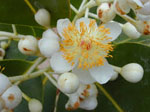
The flower is 25 millimetres (0.98in) wide and occurs inracemoseorpaniculateinflorescencesconsisting of 4 to 15 flowers. Flowering can occur year-round, but usually two distinct flowering periods are observed, in late spring and in late autumn. The fruit (the ballnut) is a round, greendrupereaching 2 to 4 centimetres (0.79 to 1.57in) in diameter and having a single large seed. When ripe, the fruit is wrinkled and its color varies from yellow to brownish-red.
Besides being a popular ornamental plant, its wood is hard and strong and has been used in construction or boatbuilding. Traditional Pacific Islanders usedCalophyllumwood to construct thekeelof theircanoeswhile the boat sides were made frombreadfruit(Artocarpus altilis) wood.
Theseedsyield a thick, dark greentamanu oilfor medicinal use or hair grease. Active ingredients in the oil are believed to regenerate tissue, so is sought after bycosmeticsmanufacturers as an ingredient in skin cremes. The nuts should be well dried before cracking, after which the oil-laden kernel should be further dried.
The leaves are also used for skin care and also soaked in water and used for eye
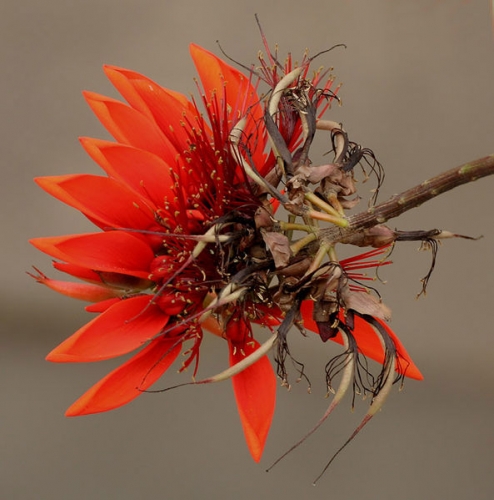
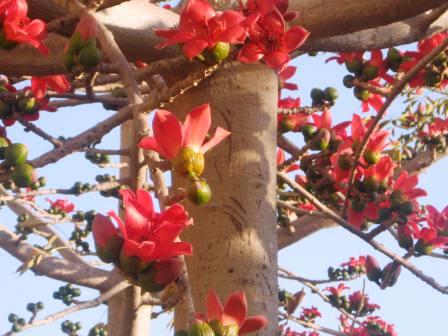
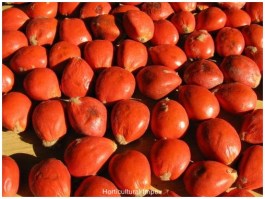
Erythrina indica is a moderate - sized tree of rapid growth. it is a broad and spreading tree attains a height of 6-9mt. it has mmany stout branches that are armed with black tigers claw spines. There are curved claw spines on the long stalks too. The leaves are compound, with three diamond shaped leaflets, each about 6inches long. Flowers are bright searlet in dense racemes, 2-3inches long in dense terminal clusters. Flowering occurs little during the summer too. Pods torulose, cylindrical, 6 - 15 in long and constricted between reddish brown seed. Seeds are 1 8 in numbers.
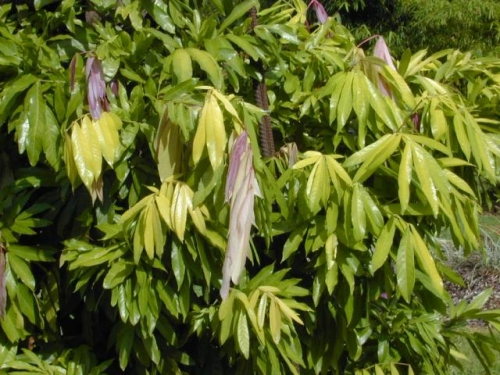
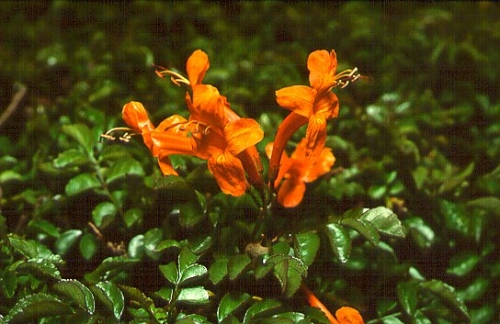
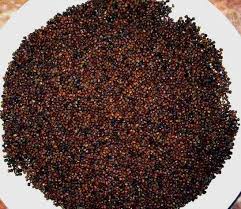
Saraca asoca is a small evergreen tree, 15-20ft. high, found wild along streams or in the shade of evergreen forests. It occurs almost throughout Indian up to an altitude of 750m in the central and the eastern Himalaysa and the Khasi, Garo and Lushai hills; it is also found in the Andaman Islands. Leaves paripinnate, 15-20cm long, leaflets 6-12oblong or oblong-lanceolate, 7.5-22.5cm x 1.25cm, rigidly sub-coriaceous; flowers orange or orange-yellow, eventually turning vermillion, very fragrant, in dense axillary corymbs; pods flat, leathery, 10-25cm x 3.5-5cm, seeds 4-8, ellipsoid-oblong, 38cm, compressed.
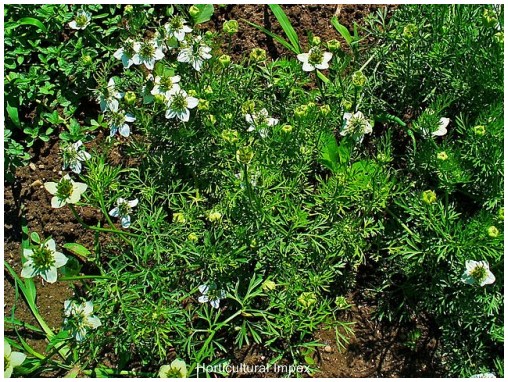
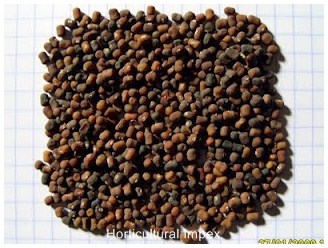
Nigella sativa a small herb, 12-18 inch high, native of Levant, said to be cultivated or occasionally found as a of cultivation in Punjab, Himachal Pradesh, Bihar and Assam. Leaves 2-3 pinnatisect, 2.5 - 5.0 cm long, cut into linear - lanceolate segments; flowers pale blue, 20 - 2.5cm across, without an involucre, on solitary long peduncles; seeds trigonous, black, rugulose tubercular
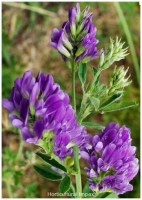
Medicago sativa an erect, much - branched perennia, l herb, 0.3 - 1.0 m. high. Leaves pinnately trifoliate; leaflets obovate-oblong, dentate towards apex; flowers purple or violet, in dense axillary racemes; pod slightly pubescent with 2 - 3 spirals; seeds 6 to 8, yellow to brown, kidney-shaped.
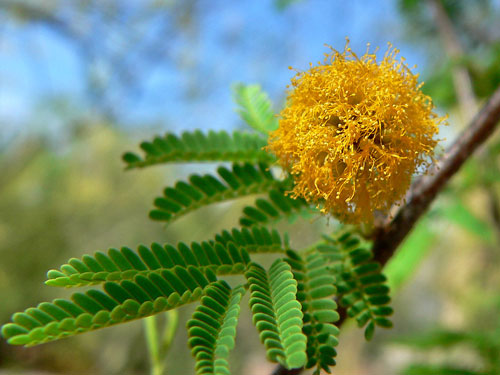
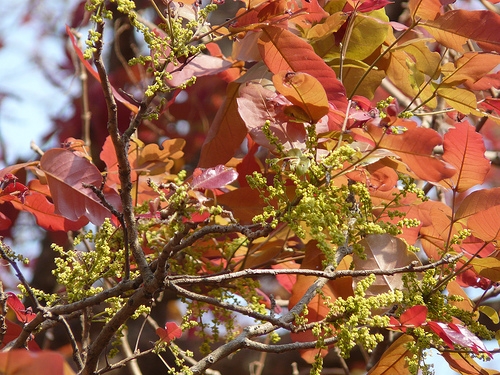
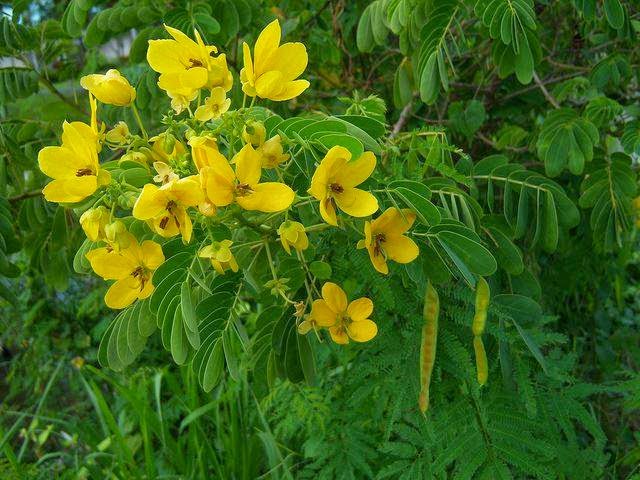
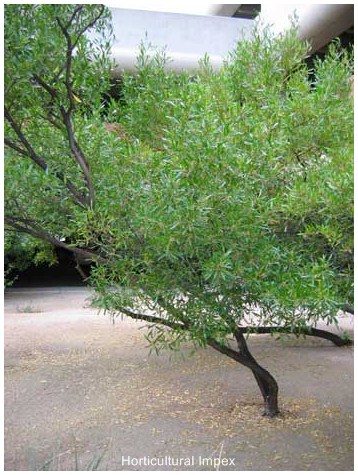
Acacia farnesiana is a thorny bush or small tree reaching at height of 9mt. height, native to tropical America, and cosmopolitan in the tropics. The flowers are hermaphrodite have both male and female organs. It can fix Nitrogen. Flowers processing done through distillation by which a perfume called Cassie. It has become naturalized in almost all parts of India. Leaves bi pinnate with stipular spines; flowers bright yellow, fragrant, in axillary heads; pods 5.0-7.5cm long, dull brown. The best soil for its cultivation is light (sandy), medium (loamy) and heavy (clay) soils, but it prefers mainly well-drained soil. It can tolerate drought.
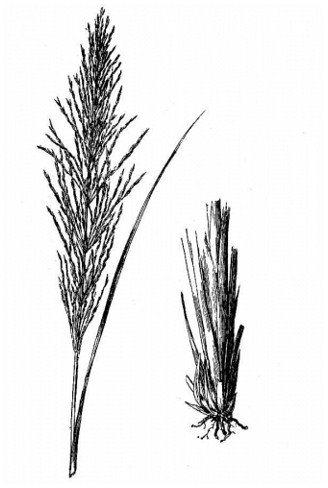
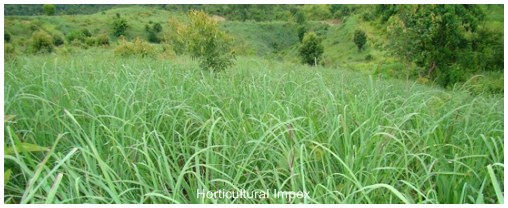
Vetiveria zizanioides a densely tufted grass, found throughout the plains and lower hills of India, particularly on the river banks and in rich marshy soil, ascending to an altitude of c. 1200 m. Clums arising from an aromatic rhizome, stout, up to and over 2m. tall, in dense tufts, with stout spongy aromatic roots; leaves narrow, erect, keeled, glaborous, margins scabrid; inflorescence a panicle (15-40cm long) of numerous slender racemes in whorls on a central axis; spiklets grey green or purplish, 4-6mm long, in pair more or less alike in shape and size, different in sex, 2-flowered, lower floret reduced to a lemma, upper bisexual in the sessile, male in the pedicelled spiklet, glumes armed with short, tubercle-based spines, lemmas awnless, palea minute.
 Harsh Kumar (Horticultural Impex)
 05, Panditwari, PO: Prem Nagar Dehradun - 248 007 Uttarakhand (INDIA). - 248007
 Share us via