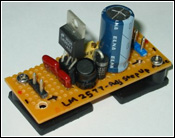
| A linear regulated power supply regulates the output voltage by dropping excess voltage in a series dissipative component. They use a moderately complex regulator circuit to achieve very low load and line regulation. Linear regulated power supplies also have very little ripple and very little output noise. For critical electronics applications a linear regulator may be used to set the voltage to a precise value, stabilized against fluctuations in input voltage and load. | | | | Features - Output voltage can be adjusted over a range
- Low noise amplifiers
- Used for applications requiring pulsed output
| | | ONLINE UPS & OFFLINE UPS | | LINE INTERACTIVE UPS | | SERVO CONTROLLED VOLTAGE STABILIZER | | CONSTANT VOLTAGE TRANSFORMER | | SPIKE BUSTERS | | BATTERY CHARGER | | POWER SUPPLY (LINEAR & SMPS) | | CONTROL INSTRUMENTS | | CUSTOM BUILT PRODUCTS | |
 Write a Review
 Mikrozone Technologies Pvt. Ltd (Mikrozone Technologies Pvt. Ltd)
 New no: 7, Old no: 5, 1st floor, East Spurtank Road, Chetpet., Chennai, Tamil Nadu - 600031, India
 Share us via