
Company Information
 Member Since 15 Years
 Nature of Business Retailer
 GST No. 27AAIPB6904A1Z9
Ask for more detail from the seller
Contact Supplier
Study of conditions necessary for the stable equilibrium of floating bodies is important for the design of floating bodies such as ships, rafts and pontoons. In order to familiarize students with the laws of floatation, it is essential to demonstrate the various principles of hydrostatics including the importance of relative positions of the center of buoyancy and the center of gravity and the metacentric height of the floating body.
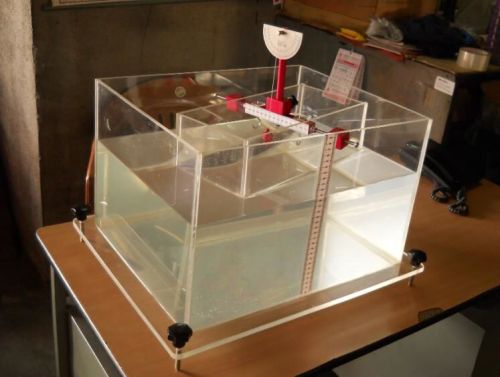
The Sci-techStability of a Floating Body ApparatusModel FM 11 is a bench top unit designed to demonstrate the conditions for the stable, unstable and neutral equilibrium. The position of metacenter and hence the metacentric height can be varied by changing the weight distribution to obtain stable or unstable equilibrium conditions. The apparatus consists of a rectangular plastic pontoon. The center of gravity of the pontoon can be varied by changing the position of the adjustable sliding weight on a vertical mast.
Various degrees of heel can be obtained by sliding a weight along a lateral slide rod. Thus different stability conditions can be obtained be varying the positions of weights on the vertical and lateral slides. The angle of heel can be read using a plumb bob and the scale marked on the lateral slide. The Sci-techStability of a Floating Body ApparatusModel FM 11 is important equipment for the marine, navel architecture, civil, hydraulic and mechanical engineering laboratories of educational institutions.
The complete unit is manufactured from corrosion resistant material. The experiments can be conducted by filling the volumetric tank of the FM100 Hydraulic Bench or any other available standard hydraulic bench models.
OPTION:
‘Sci-Cal’ Computer based learning software is included to enable students understand and conduct experiments, tabulate results and plot graphs. The Sci-techStability of a Floating Body Apparatus is an important experimental set-up for any Fluid Mechanics and Hydraulics Laboratory of an educational institution.
List of experiments:
1. Familiarization with the laws of floatation and principle of working of floating bodies.
2. Determination of center of gravity of a pontoon.
3. Determination of center of buoyancy of a pontoon.
4. Determination of angle of heel of a pontoon.
5. Determination of metacenter and metacentric height of a pontoon.
6. Study of stable, unstable and neutral equilibrium conditions
of a pontoon by varying metacentric height.
7. Comparison of experimental results with theoretical calculations.
Specifications:
1. Pontoon, rectangular, plastic, length : 325mm, width : 200mm, overall height : 450mm.
2. Angle of heel scale : +/- 300.
3. Vertical sliding weight : 0.6Kg.
4. Lateral sliding weight : 0.2Kg.
5. Vertical mast height : 400mm with scale.
6. Lateral slide rod with scale.
Options:
1. Other types of floating bodies to meet specific requirements of users (for example a ship model) can be supplied on request.
2. A plastic basin of 50 liter capacity can be supplied on request. This is required in cases where volumetric tank of the hydraulic bench is not available for conducting experiments.
1. ‘Sci-Cal’ Computer based learning software is included to enable students understand and conduct experiments, tabulate results and plot graphs.



Connect with us





 For Buyer
  For Seller
  Help
Help 

 Dahisar, Mumbai, Maharashtra
 Send Enquiry