Write a Review
Our Products
Leading Manufacturer, Supplier & Retailer of Original Stained-Glasses, Clear Float Glasses, Tinted Float Glasses, Figured Wired Glasses and Bent Toughened Glasses.
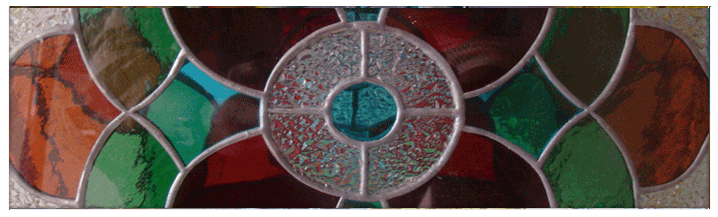
Stained glass is an art form in which colored glass is cut into shapes and placed into a mosaic to form a picture. The glass is held in place by metal strips soldered together to gives the stained glass strength and stability.
Stained glass is most commonly seen in church windows, where it typically depicts saints or scenes from the Bible, but stained glass windows do not necessarily have to depict a scene at all. They can simply be a brightly colored geometric design. The famous Rose Window of Notre Dame is made up of many small pictures that together form a geometric pattern, which creates the overall impression - one must study the window in detail to see that it is indeed a collection of small pictures. The Rose Window's name refers not to the scenes themselves but to the wooden or stone structure that supports the glass, which is radial and composed of many small, petal-like openings into which the glass is set. Often, fine details of the scene are painted on the colored glass, which is then heated to bond the paint to the glass, and thereby 'stained'
The glass used in stained glass is colored in the manufacturing process by the addition of salts that cause it to take on particular colors. Then the glass is made into sheets, from which individual pieces can be cut with glass cutting tools. The glass sheets can be made in a variety of textures, and the uneven or pebbly surface of some stained glass sheets gives the resultant picture a jeweled look when light passes through it.
Although stained glass windows, whether for church or home, are the most common form of stained glass artwork, it is also used for decorator features. The famous lamps of Louis Tiffany are examples of stained glass artworks that are much admired and imitated today. Tiffany added opaque or milky glass to the stained glass palette, which greatly increased the effects that could be achieved. Today, stained glass art is a popular hobby, and many people enjoy cutting and fitting together pieces of colored glass to form attractive pictures both large and small. When a piece of stained glass art is small and meant to be displayed in the window where it catches the sun, it is often called a suncatcher.
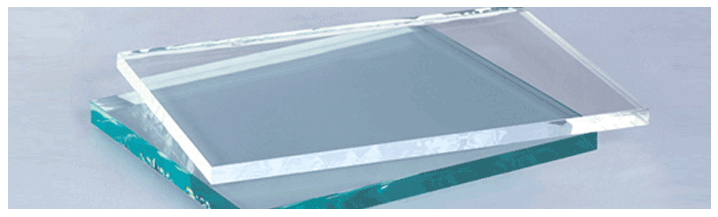
Clear-Float-GlassesFloat glass is a sheet of glass made by floating molten glass on a bed of molten metal, typically tin, although lead and various low melting point alloys were used in the past. This method gives the sheet uniform thickness and very flat surfaces. Modern windows are made from float glass. Most float glass is soda-lime glass, but relatively minor quantities of specialty borosilicate and flat panel display glass are also produced using the float glass process. The float glass process is also known as the Pilkington process, named after the British glass manufacturer Pilkington, which pioneered the technique
Float glass uses common glass making raw materials, typically consisting of sand, soda ash (sodium carbonate), dolomite, limestone, and salt cake (sodium sulfate). Other materials may be used as colourants, refining agents or to adjust the physical and chemical properties of the glass. The raw materials are mixed in a batch mixing process, then fed together with suitable cullet (waste glass), in a controlled ratio, into a furnace where it is heated to approximately 1500C. Common flat glass furnaces are 9 m wide, 45 m long, and contain more than 1200 tons of glass. Once molten, the temperature of the glass is stabilised to approximately 1200C to ensure a homogeneous specific gravity
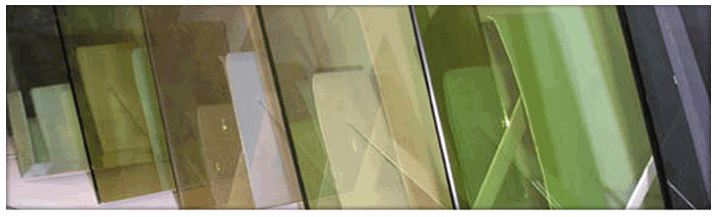
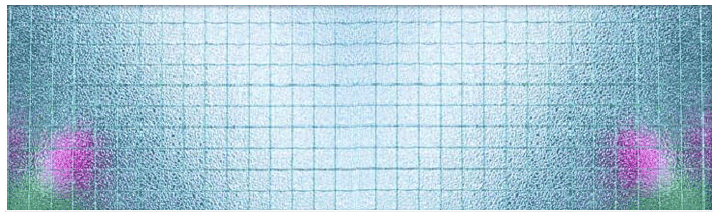
Patterned glass is a kind of decorative translucent glass with embossed patterns on one or both surfaces. Pattern Glass or Decorative Glass or Rolled Glass is generally used where privacy or obscurity is desired but light transmission is still important. With the special property of decoration, patterned glass can allow light to pass through, at the same time, it can also prevent clear view. Usually it transmits only slightly less light than clear glass.Patterned glass is not-perfectly-smooth structure with different patterns impressed on it. The depth, size and shape of the patterns largely determine the magnitude and direction of reflection.Basically patterned glass has a pattern impressed on one side of the glass which prevents someone from seeing though it, for privacy. Pattern glass can also be ordered in various tints as well. A common application of this sort is when used in privacy walls to separate one room from another.
Production of Figured-Wired-Glasses
Patterned glass is made with a rolled glass process. All rolled patterned glass begins as a batch of materials, including silica sand, soda, and lime. These materials are melted together in a tank, and then the molten glass mixture is fed onto a machine slab. The glass flows under a refractory gate which controls glass volume and speed then moves between two counter-rotating, water-cooled rollers. One of these rollers is embossed, imprinting a distinct pattern onto the soft surface of the glass while the other roller is smooth.
Applications of Figured-Wired-Glasses:
Rolled glasses are used in commercial, residential, and specialty applications. End uses include shower doors and tub enclosures including frameless shower doors interior partitions, translucent door and window treatments, foyers and vestibules, patio furniture, shelving, decorative furniture, and lighting fixtures. Comprehensive range of soft natural colours compliments and harmonizes with modern building materials to provide an exciting and different look to new and existing buildings. Pattern glasses are available in large amount of patterns. Patterned glass is most often found in bathroom windows.
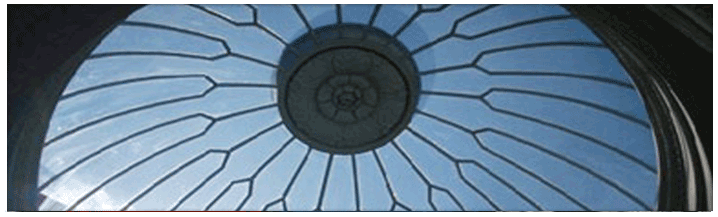
Bent glass is normal glass curved by a special process. Bent or curved glass is a great alternative to the conservative rectangular design of buildings as it is available in a wide range of sizes, allowing the creation of unique and unconventional shapes. Bent glass enhances aesthetics of architectural structures.
Any form of bent glass starts with flat glass and is typically produced in a horizontal mould by slowly heating the glass to approximately 600C. The heat makes the glass soften sufficiently, transforming flat glass into various shapes of the mould. The glass gradually takes the shape of the mould and is afterwards slowly air cooled to avoid any internal stress. The mould is very important because it alone determines what the glass would look like. The mould determines the quality and the angle of the curve.
Bent glass offers significant advantages over normal glass: the thickness of the glass can be significantly reduced and this obviously reduces the overall weight of the structure and thus its cost. The extra rigidity of bent glass allows for greater freedom in the architectural design, where more space can be covered with glass. This is an especially important advantage when it comes to designing skylights. The lighter the structures and frameworks are, the less material that is required, and lower the cost.
THE ADVANTAGES OF BENT GLASS:
Facades
Shop fronts
Panoramic lifts
Showcases
Shower doors and enclosures
Curtain walls
Refrigerator cabinets
Elevator glass panels
Partitions
Domes
Barrel Vaults
Revolving doors
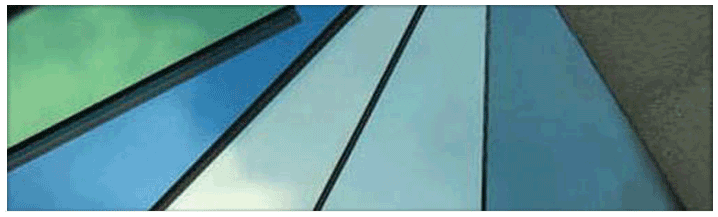
In the awe-inspiring world of glass, reflective glass occupies a significant position. Besides the basic functionality of sun control, it contributes to architectural aesthetics and even energy conservation. Reflective glass helps a building achieve a high standard of visual appeal besides reflecting a greater amount of heat than normal tinted float glass, making it less prone to thermal breakage.Reflective glass is essentially ordinary float glass with a metallic coating that cuts off solar heat. This special metallic coating also provides a one-way mirror effect, preventing visibility from the outside and thus preserving privacy. Reflective glass is used primarily for structural faade glazing. Application of Reflective-Glasses Application in Exteriors: At shop fronts and commercial frontages, where vision is important, particularly at night time (panoramic restaurants, air traffic control towers, petrol station windows) etc. Application in Interiors: For high quality picture framing, display cabinets and interior display windows, for dividing screens in cinema projection rooms, television studios, machine control rooms etc.
 K.R. Paranjothi (Sil Mirror Private Limited)
 623, 3rd Block, 50th Cross, Rajajinagar, , Bengaluru, Karnataka - 560053
 Share us via