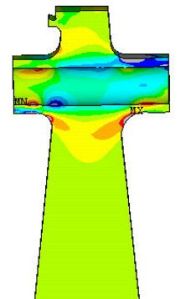
Crash test simulation in ANSYS , particularly using explicit dynamics solvers like LS-DYNA , enables engineers to virtually replicate real-world vehicle collision scenarios with high accuracy. These simulations capture extremely fast, nonlinear events that occur within milliseconds, such as large deformations, material failure, contact interactions, and energy transfer. During a crash, the vehicle’s kinetic energy is progressively converted into internal energy through plastic deformation of components, which is critical for absorbing impact forces and protecting occupants. By defining detailed material models (including metals, composites, and foams), contact conditions, and boundary constraints, engineers can evaluate how different parts of a vehicle respond under various crash conditions like frontal, side, or rear impacts. The simulation provides insights into stress distribution, intrusion levels, deceleration forces, and potential injury risks. This virtual approach significantly reduces the need for expensive and time-consuming physical crash tests, allowing multiple design iterations to be tested quickly and efficiently. Furthermore, crash simulations help optimize structural integrity, improve energy absorption zones (crumple zones), and ensure compliance with global safety standards. Engineers can identify weak points early in the design phase and make data-driven improvements, ultimately enhancing vehicle safety while reducing development costs and time-to-market.




 Porur, Chennai, Tamil Nadu
  GST : 33AAWCS0561P2ZN

 Write a Review