Our Products
Our Complete range of products are Dissolved Air Flotation, Sequencing Batch Reactor, Submerged Aerobic Fixed Film BIO Reactor, Ozonator and Clari Floculation.
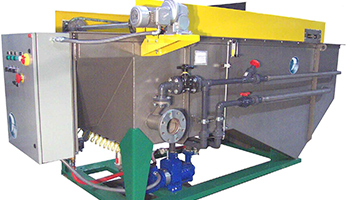
Dissolved air flotation (DAF) is a water treatment process that clarifies wastewaters (or other waters) by the removal of suspended matter such as oil or solids. The removal is achieved by dissolving air in the water or wastewater under pressure and then releasing the air at atmospheric pressure in a flotation tank basin. The released air forms tiny bubbles which adhere to the suspended matter causing the suspended matter to float to the surface of the water where it may then be removed by a skimming device.
Dissolved air flotation is very widely used in treating the industrial wastewater effluents from oil refineries, petrochemical and chemical plants, natural gas processing plants, paper mills, general water treatment and similar industrial facilities. A very similar process known as induced gas flotation is also used for wastewater treatment. Froth flotation is commonly used in the processing of mineral ores.
In the oil industry, dissolved gas flotation (DGF) units do not use air as the flotation medium due to the explosion risk. Nitrogen gas is used instead to create the bubbles.
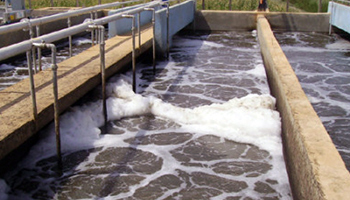
The Sequencing Batch Reactor (SBR) is a derivative of activated sludge process designed to operate under non-steady state conditions. Like extended aeration or other activated sludge process it involves the biological process, microorganisms and mechanical aeration system for aeration along with air distributors and diffusers. However the major difference in involved is in operation of treatment which is carried out in batches in cyclic manner. In SBR configuration all related processes of Aeration, Settling, Decanting are carried out in same basin and eventually this reduces construction cost which is very essential in larger systems. The most important component of SBR process is decanting system. The various type of decanters are used for process like Floating gravity type, rake arm type, floating funnel type and slotted pipe type decanters. The process is operated in batch manner and hence it is vary suitable for industrial wastewater and high flow domestic wastewater. The added advantages are it provides BNR ( biological nutrients removal) and completely digested sludge which makes sludge treatment process easier.
SBR is modern wastewater treatment system which involves use of automation in operation. The control of cyclic batch operation is programmed in PLC or SCADA. The instruments involved in process helps to transmit appropriate signal and control the system. The automation of system reduces the number of operator skill and attention requirement and hence improves output quality of treated effluent.
Sparkle offers unique design of sequential batch reactor decanting system which involves simple automation and gravity based decanting system. The power requirement for decanting operation is eliminated in this design.
Advantages: economical construction due to single tank design. The system can absorb higher shock loads. Provides 95-98% removal in BOD.
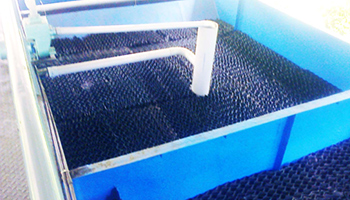
Submerged Aerobic Fixed Film Reactor (SAFF) is a cost-effective method of waste water treatment and sewage sanitation that is primarily used in residential and commercial complexes. SAFF process is attached growth type aerobic biological process which uses corrugated inert UV stabilized PVC media. Unlike other aerobic processes of suspended growth principally it provides higher mechanical surface area due to corrugation on media surface. This higher surface area helps biomass microbes for rapid digestion of biomass.
In the wastewater industry, SAFF Technology is used commonly for commercial and residential sewage sanitation / waste water treatment, particularly for small to medium range flow requirements. The air for process is supplied through mechanical aeration system arrangement which consist of blower and diffusers. The structured SAFF media arranged in reactor is fixed with bottom support arrangement.
Advantage of SAFF process
Due to above advantages the SAFF process is used commonly in package systems where compactness of treatment is key factor.
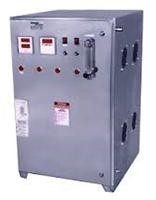
Ozone is an unstable molecule which readily gives up one atom of oxygen providing a powerful oxidizing agent which is toxic to most waterborne organisms. It is a very strong, disinfectant that is widely used. It is a very good disinfectant. Ozone is made by passing oxygen through ultraviolet light or a "cold" electrical discharge. To use ozone as a disinfectant, it must be created on-site and dosed in to the water. As compared to chlorine the issue of odour and smell is lesser. Ozone though is a very good disinfectant does not leave any disinfectant in residual water. This may be termed as advantage as well as disadvantage. It is applied as an anti-microbiological agent for the treatment, storage, and processing of foods.
 Gautam (Sparkle Clean Tech Pvt. Ltd.)
 #89 Gautam Complex, Sector - 11, C.B.D Belapur, Navi -, CBD Belapur, Navi Mumbai, Maharashtra - 400614, India
 Share us via







 Write a Review