
 GST : 09AAWCA1337R1ZT
 Write a Review
Our Product / Services
Our offered Product range includes Haccp Certification Service and Halal Certification Service.
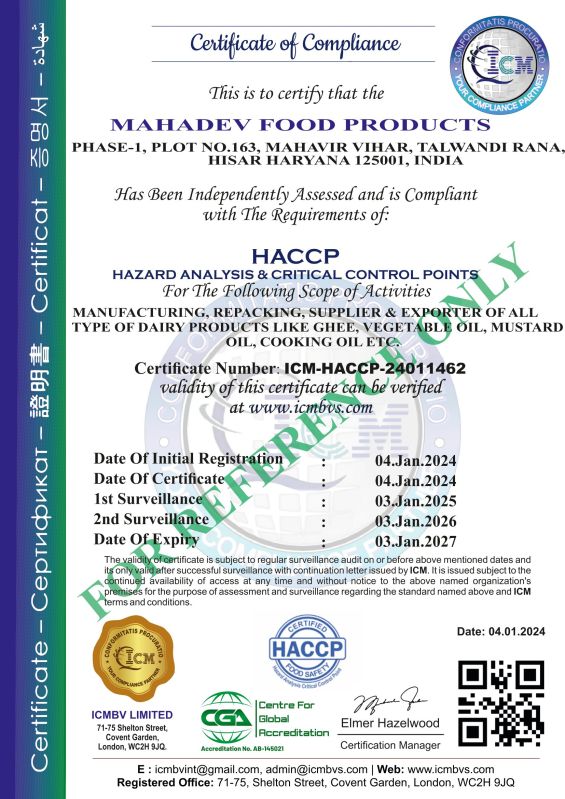
HACCPHazard Analysis Critical Control Points (HACCP) is a system which provides the framework for monitoring the total food system, from harvesting to consumption, to reduce the risk of foodborne illness. The system is designed to identify and control potential problems before they occur. In its Model Food Code, the Food and Drug Administration has recommended the HACCP system “because it is a system of preventive controls that is the most effective and efficient way to assure that food products are safe ” (1999 FDA Model Food Code) . The application of HACCP is based on technical and scientific principles that assure safe food.haccp terminology
Critical Control Point (CCP) – A procedure/practice (control) in food handling/preparation that will reduce, eliminate or prevent hazards. It is a “kill” step that kills microorganisms or a control step that prevents or slows their growth.
Hazard – Unacceptable contamination, microbial growth, persistence of toxins or survival of microorganisms that are of a concern to food safety.
Monitoring – Checking to determine if the criteria established by the critical control point(s) (CCP) have been achieved.
Risk – Probability that a condition(s) will lead to a hazard.
Severity – Seriousness of the consequences of the results of a hazard.
ractical haccp principles
Practical HACCP principles adapt the seven HACCP steps into a form that is easily applied in a non commercial setting. The seven steps deal with the issues of thorough cooking and cooling which are the major causes of foodborne illness.
In order for this simplified, focused application of HACCP principles to be effective in reducing the risk of foodborne illness, Standard Operating Procedures (SOP’s) of personal hygiene, basic sanitation and food storage must be developed and adhered to. The SOP’s should be developed, taking into consideration the types of foods that will be prepared during the foods labs, the number of students involved in the food preparation activity and the type of equipment to be used. The SOP’s can be listed in the form of a checklist, which can be checked off as each item is accomplished.formal haccp seven steps
1. Conduct a hazardous analysis.The purpose of a hazardous analysis is to develop a list of hazards which are likely to cause injury or illness if they are not controlled. Points to be considered in this analysis can include: skill level of employees; transport of food; serving elderly, sick, very young children, immune-compromised; volume cooling; thawing of potentially hazardous foods; high degree of food handling and contact; adequacy of preparation and holding equipment available; storage, and method of preparation. The next step is to determine if the factors may influence the likely occurrence and severity of the hazard being controlled. Finally, the hazards associated with each step in the flow of food should be listed along with the measures necessary to control the hazard.
Halal Certification
Halal Certification is predominantly obtained for food and food-related products, and it is essential in Islamic countries. The term "Halal" is derived from the Quran, which means "permitted" or "lawful." Therefore, according to Islamic law, the Shariah, the Certification is used for Food and other consumables permissible for consumption. Halal Certification emphasizes cleanliness in all aspects of a person's life, and Halal foods ensure that the Food consumed by individuals is clean, hygienic, and does not harm their health or well-being. The Certification guarantees that the food product is safe for consumption. With the increasing awareness of Halal foods, more businesses are seeking Halal Certification for their products, restaurants, premises, etc.
Halal Certification in India
In India, a Halal Certificate is a document issued by a Halal certification body or authority confirming that a product or service complies with Islamic dietary laws and guidelines and is permissible or "Halal" for consumption by Muslims.
Halal Certification in India is significant for food and beverage products, pharmaceuticals, and personal care products. Still, it can also apply to other non-food products or services. Businesses seeking Halal Certification in India must comply with the relevant standards and guidelines set forth by the certification body or authority and undergo a rigorous inspection and audit process to ensure compliance.
Types of Halal Certification
The type of Halal Certification varies depending on the nature of the business. Typically, restaurants, hotels, slaughterhouses, and packaging and labeling materials seek Halal Certification to ensure they meet the requirements of Muslim consumers. However, Halal Certification is not limited to food production alone. Other products, such as non-alcoholic beverages, raw materials for food processing, pharmaceutical and healthcare products, traditional herbal products, cosmetics, personal care products, cleaning products, and everyday consumer goods, can also obtain Halal Certification.
Halal Certification Bodies offer Certification under various schemes, including the Food, and Catering Scheme, Restaurant Scheme, Industrial Scheme, Abattoir Scheme, Warehouse or Storage Scheme, and Product Endorsement Scheme.
Advantages of expanding your business, the Halal way
The benefits of obtaining a Halal Certificate in India are numerous. Here are some of the key benefits:
 Mr. Vaibhav Pushkarna (ANALYTICALL QUALITY SOLUTIONS PRIVATE LIMITED)
 Corp Office: F-10, 1st Floor, D Mall Shakti Khand-Ii, Indirapuram, Ghaziabad, Uttar Pradesh - 201014
 Share us via