Write a Review
Our Products
We offer the best product range of Welding Flux and Root Flux.
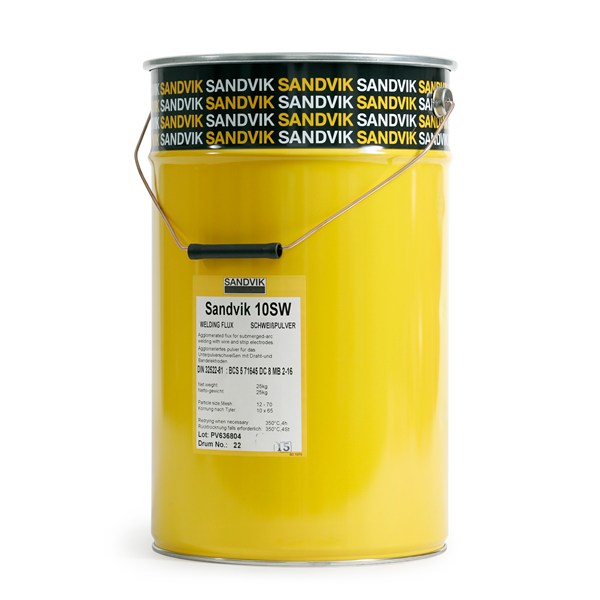
Welding flux for a variety of welding methods and a wide range of applications.
The Sandvik program includes flux for:
Previous designation Material Safety Data Sheets (MSDS)
When choosing a welding flux for a given combination of strip/wire electrode and parent metal, the welding parameters also have to be considered to obtain the desired composition of the weld metal.
| Flux | Characteristics1) | Applications |
|---|---|---|
| Sandvik 10S | Slightly Cr compensated Basicity 1.0 |
General purpose flux for both strip and wire electrodes of CrNi and CrNiMo steels, stabilized or non-stabilized. Good slag removal. Gives about 2% lower ferrite content than 10SW. |
| Sandvik 10SW | Cr compensated Basicity 1.0 |
General purpose flux for both strip and wire electrodes of CrNi and CrNiMo steels, stabilized or non-stabilized. Good slag removal. Gives about 2% higher ferrite content than 10S. |
| Sandvik 15W | Non-Cr compensated Basicity 1.7 |
Special purpose flux for wire electrodes of Cr-Ni and CrNiMo steels, stabilized or non-stabilized as well as duplex, super-duplex and fully austenitic grades, e.g. 20.25.5.LCu. Good slag removal. Gives good impact properties. The Nb burn-off is very small when using stabilized electrodes, such as 19.9.Nb. |
| Sandvik 31S | Non-Cr compensated Basicity 1.1 |
Single purpose flux for both strip and wire electrodes of 25.22.2.LMn, intended for urea applications. Good slag removal. |
| Sandvik 50SW | Non-Cr compensated Basicity 2.4 |
General flux for strip and wire electrodes of nickel alloys. Good slag removal. |
| Sandvik 52W2) | Non-Cr compensated Basicity 1.4 |
Flux for wire electrodes of nickel alloys as well as fully austenitic CrNi, e.g. 25.20.C, or CrNiMo grades, e.g. 27.31.4.LCu. Good slag removal. |
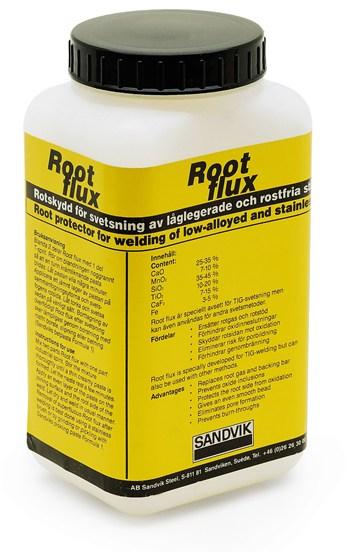
Sandviks root flux is used for root protection when joining tubes and pipes where it is impractical to use a shielding gas or access is limited. However, the root flux does not give the same degree of protection. It can, therefore, only be used when the parent metal has enough margin of corrosion resistance for the actual application.
The use of root flux reduces the risk of porosity, surface oxides and burn through and is always better than no root protection.
Root flux is a powder, which is mixed with water or methanol to form a paste. It is brushed on to the root side, about 20 mm (0.787 in.) on each side of the joint. During welding the paste reacts with the heat of welding, forming a thin protective slag.
The slag is washed away by the process medium when the pipe is taken into service.
The root flux, which can be used for root passes made by the MMA, TIG or MIG welding methods, is available in plastic bottles containing 0.5 kg (1.1 lbs), sufficient for about 50 m (164 ft) of root weld.
 Apex’s Engineering Solutions (Apex’s Engineering Solutions)
 Block AE 32, Old No-17, 7th street, 10th Main road, Anna Nagar, , Chennai, Tamil Nadu - 600040
 Share us via