Write a Review
Our Products
Our product range contains a wide range of Tensile Testing Machine and Universal Testing Machine
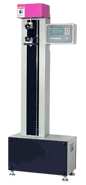
Tensile strength is the stress at which a material breaks or permanently deforms. There are three definitions of tensile strength, yield strength, ultimate strength and breaking strength. Tensile tests are usually carded out on wire, strip or machined samples with either circular or rectangular cross section. Test pieces are screwed into or gripped in jaws and stretched by moving the grips apart at a constant rate while measuring the load and the grip separation. This data is plotted as load vs extension and then converted to engineering stress (load/original area) vs engineering strain (fractional change in length over the test section assuming the deformation is uniform). In special circumstances, the actual stress and strain may be calculated if the true cross section is measured during the test.
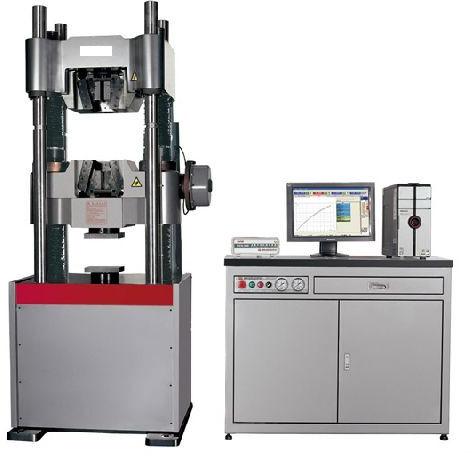
A universal testing machine is used to test the tensile stress and compressive strength of materials. It is named after the fact that it can perform many standard tensile and compression tests on materials, components, and structures. This is very true, but perhaps overly simplistic. Well try to explain some more capabilities of these machines in this post.
Before we begin, we need to discuss terminology. Were amazed at the variety of terms in the industry that are used to refer to a UTM. Most common are tensile tester, compression tester and bend tester. There are also UTMs that have been stripped of capabilities or marketed to a specific sector which have led to the development of specialized names such as texture analyzer for food, top load compression tester for packaging and pipe, and peel tester for adhesives, tapes, and labels. Today, a UTM can perform all of these tests and more. A UTM is a great multi-purpose instrument for an R&D lab or QC department. In laymans terms, here are a few examples of what a UTM can do:
 Arkes (Arkes)
 No:108,Poomagal4th Street,Ekkattuthangal,, Ekkaduthangal, Chennai, Tamil Nadu, India
 Share us via