Write a Review
Our Products
We are leaders in the market for providing best range of Cow Brush, COW DUNG SCRAPER, COW HEAD LOCK, COW CUBICLES and Milk Parlour
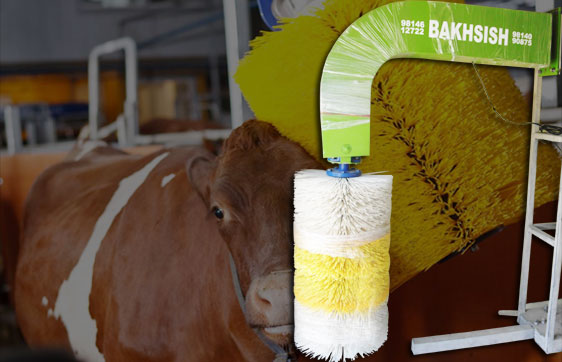
The Bakhsish Industry swinging cow brush is designed to improve cow health, comfort and welfare. The brush starts to rotate on contact at an animal friendly speed. It swings freely in all directions, smoothly up, over and alongside the cow. The bristles have the right length and hardness to stimulate the blood circulation whilst helping the cow to keep clean and calm.
The swinging cow brush takes minimal barn space to operate in. Pre-mounted so it is easy to install, the cylindrical brush is suitable for wall or post installation. If it is installed in the right space in a loose housing barn, it helps the flow of cow traffic by guiding cows from the feeding area to the resting area.
Quick and easy to install
Technical data
Benefits :
Floor surface
The quality of the floors has a big influence on the visibility of heat detection signs. With a non-slippery surface, cows are much more likely to exhibit the activity signs of estrus.
Floor Hygiene
The hygiene of barn floors has considerable impact on animal health. Problem floors impact the hoof, the udder and milk quality. The design of floors is therefore very important for long-term, consistently profitable, milk production. The floor is the part of the barn with which the animals are in closest contact. Manure produces an unfavorable environment for hooves by macerating digital skin and horn tissue. It also provides a growth medium for contagious agents.
Core benefits
Features
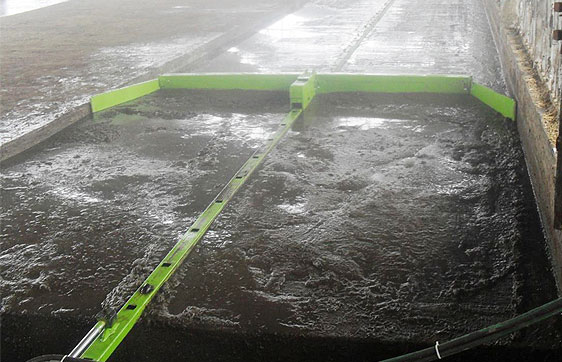
Bakhsish Industry Cow Dung Scraper is developed for optimum cow safety. It has a smooth, low design and is equipped with a rubber strip to ease the wear on a concrete floor. scraper DML and cow safety system complement each other perfectly.
Advantages
Cow safety system controls and supervises the scraper for you automatically stopping if it detects unfamiliar obstacles like an injured cow lying down. The system stops, checks twice if the obstacle still remains and if so, the scraper changes to another non-cleaned alley. The system also has automatic start and stop, plus a free choice of parking site without using a position indicator in the alleys.
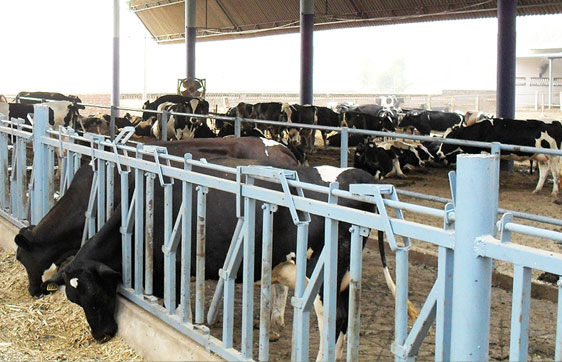
Use headlocks in free stall barnsDairy cows need many routine treatments and check-ups to stay productive and healthy. In conventional barns (tie-stall & stanchion), this intensive management is relatively easy. In freestall barns, with cows on the loose, it can become a challenge to find individual cows and treat them. Installing and using headlocks (self-locking headgates) can be a profitable way to solve this problem!
Animal handlingWith intensive management, each cow may need individual attention for important check-ups or treatments up to 50 times per lactation cycle. Headlocks make it easy to identify animals and make it possible to carry out the work safely and efficiently. Without headlocks, animals are on the loose, and need to be located and identified. The animals then need to be separated from their group and moved to a central pen. After the treatment or checkup is finished, the animals need to be re-sorted and moved back to their original pens. When there are headlocks in the animals regular pens, the animals can restrain themselves, they are presented for easy identification and they do not need to be moved away from their pens. Headlocks can save a total of about 133 hrs/yr in a herd of 125 cows and replacements by reducing this kind of routine animal handling.
Feed intake and milk production
Some studies have been interpreted to mean that cows eat less feed when using headlocks as compared to postand- rail feed barriers. However, other research suggests that what may look like decreased feed intake actually is decreased feedout loss, since cows restrained in headlocks are less able to toss and drop feed into the scrape alley.
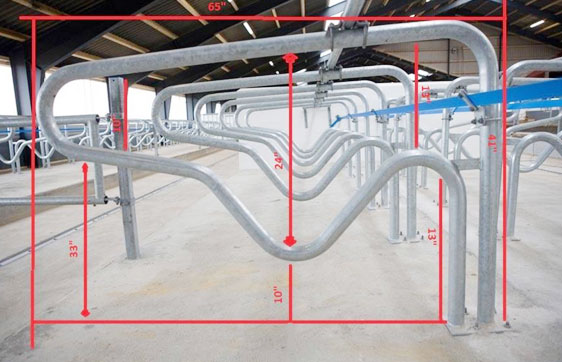
Cubicle design an in-depth look at cow comfortThe vast majority of the nation's dairy cows are now housed in cubicles, a space-saving system which allows more animals to be housed in a given area than if they were in loose yards.
But there is more to cubicles than merely parking cows in ordered lines - a whole science has grown up around their construction, their design and their dimensions.
 Mr. Jatinderpal Singh (Bakhsish Industry)
 Khamanon Road Bye Pass, Near F.C.I. Godown,
Bassi Pathanan
Distt. () ., Fatehgarh Sahib, Punjab, India
Khamanon Road Bye Pass, Near F.C.I. Godown,
Bassi Pathanan
Distt. () ., Fatehgarh Sahib, Punjab, India Share us via