Standard coupling nuts have internal threads on both ends that connect two male fasteners. They are commonly used to join threaded rod to create longer rod lengths.
Steel is strong and durable but less corrosion resistant than stainless steel. To improve its resistance to corrosion, it may receive additional finishes and coatings.
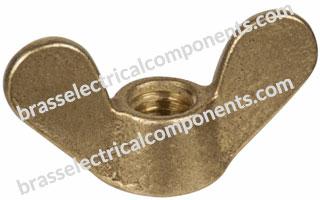
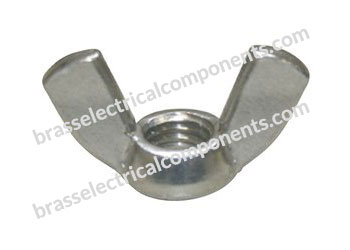
Standard wing nuts have two wings that protrude from the head, which allow for easy gripping and turning by hand. They are used in applications where frequent installation and removal of parts and assemblies are required.
Brass is an alloy of copper and zinc that is durable, nonmagnetic and conductive.
DIN 315 Wing Nuts are used when a part is frequently assembled and disassembled at a place where torque greater than that achieved with finger pressure is not needed.
The malleable style nut has been the most common type wing nut used in Europe for many years.
Also known as a butterfly nut.
Standard wing nuts have two wings that protrude from the head, which allow for easy gripping and turning by hand.
Stainless steel is a strong, corrosion-resistant alloy with excellent resistance to heat.
Also used in high-stress, outdoor and corrosive applications.
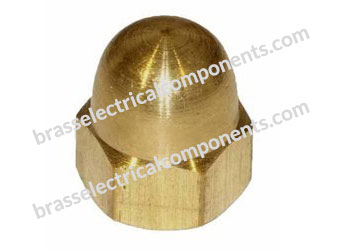
Standard acorn nuts have a domed top that covers protruding threads on the end opposite the head. They are commonly used for aesthetic and decorative purposes in general purpose fastening applications.
Brass is an alloy of copper and zinc that is durable, nonmagnetic and conductive.
Steel is strong and durable but less corrosion resistant than stainless steel. To improve its resistance to corrosion, it may receive additional finishes and coatings.
Flanged press fit threaded inserts have a flange on one end, which prevents direct contact between the workpiece material and the screw or bolt used in the insert.
Brass is an alloy of copper and zinc that is durable, nonmagnetic and conductive.
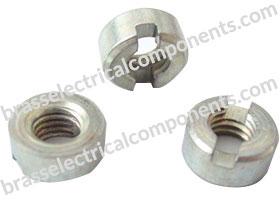
DIN 546 Slotted Round nuts are unsuitable when a specific preload is required because the torque cant be fine-tuned.
Additionally, such nuts require an additional component and alignment time.
Also known as External groove slotted nuts.
They have one washer bearing face and depending upon the size, they can have between 2 to 8 equally spaced external slots.
Typically used as all metal prevailing torque type nuts, where the axial slots are used to create a section that can deform the thread by pressing the top parts down.
Very useful in applications where there is a degree of vibration that would loosen regular nuts that have not had their threads locked by another mechanism.