-
Spectral range
400 - 1700 nm
-
Spectral resolution
< 2.5 nm
-
Objectives
20x, 50x, 60x, 100x
-
Cameras
CCD, EMCCD, ZephIR InGaAs
-
Excitation wavelengths
532, 730, 785, 808 nm
-
Microscope
Upright, Inverted
-
Spatial resolution
Sub-micron
-
Darkfield module available
Oil or dry
-
Epifluorescence filter available
Triple filter fluo
-
Illumination lamp
HBO, XBO 100
-
Z-stage resolution
1 µm
-
Maximum scanning speed
150 ms
-
Wavelength absolute accuracy
0.25 nm
-
VIdeo mode
Megapixel colour camera for sample visualisation
-
Software
Computer with PHySpecâ„¢ control and analysis software included
-
Electroluminescence module available
EL probes station
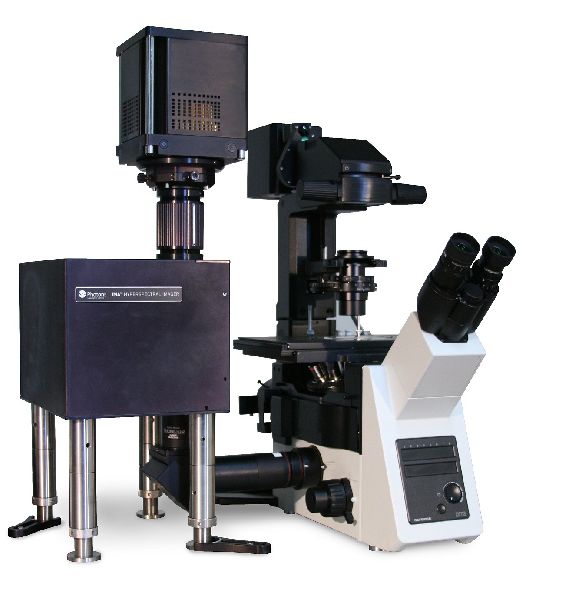
Photon etc. Offers complex material analysis (gaas, sic, cdte, cis, cigs) using hyperspectral imaging of diffuse reflectance, photoluminescence and electroluminescence. Our technology is based on high throughput global imaging filters, faster and more efficient than spectrograph based hyperspectral systems.Imaging from 400 to 1000 nm with a bandwidth of 2.5 nm or from 900 to 1700 nm with a bandwidth of 4 nm, photon etc.s ima is capable of measuring optoelectrical properties such as voltage open circuit and external quantum efficiency and allows precise detection and characterization of defects in materials. Researchers and qc analysts will greatly benefit from this innovation.Also, nir hyperspectral microscopy is ideal for the spatial and spectral identification and measurement of fluorophores that emit in the second biological window.With the possible integration of a darkfield illumination module, it becomes an exceptional tool to detect the composition and the location of nanomaterials embedded in cells. Applications: characterization of solar cells; quality control of semiconductor devices; map of composition, defects, stress, constraint, etc.; monitor spectral information; changes in intensity of single emitters; shifts in wavelength; spectral bandwidth variations. An example: single wall nanotubes (swnts) emission bands are narrow ( 20 nm) and each band corresponds to unique (n, m) species (chiralities). With ir hyperspectral microscopy, it is possible to separate these species, with single swnt spatial resolution on surfaces, in live cells (in vivo), and in vitro.In vivo applications: imaging of multiplexed emitters; long-term sensing;

 Montreal, Canada
 Write a Review
 Jacob Yvon Leroux (Photon Etc.)
 Share us via








