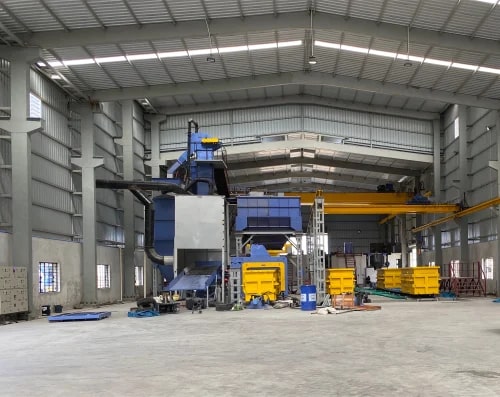
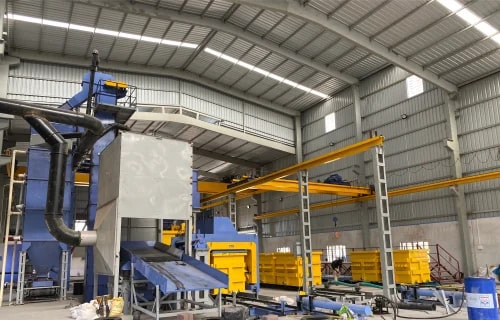
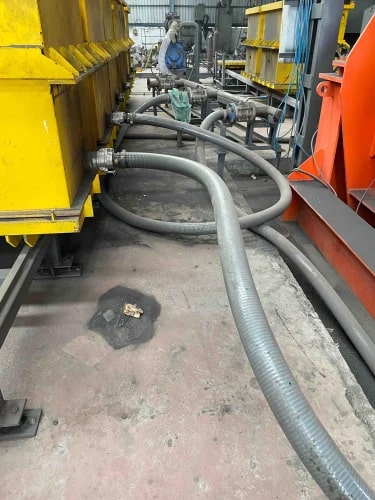
What Is The Lost Foam Casting:Lost foam casting is a type of evaporative pattern casting. This method is quite similar to investment casting which uses wax instead of foam in the pattern making process.
The foam pattern was first used in metal working in 1958. Although this mold casting technique is not as popular as other methods such as sand mold casting or permanent casting, it maintains outstanding advantages, especially in casting complicated and precise molds.
Unlike traditional methods which include the pattern withdrawn process before casting and require skillfulness in the pattern removal step, with respect to the lost foam method, the pattern is evaporated when the molten metal is poured into helping to reduce these considerations.
The Lost Foam Casting Process:
- The lost foam casting technology included 5 steps: designing the pattern; applying insulation painting; placing the pattern into the sand flask; pouring the molten metal; and collecting the castings. Firstly, a pattern is designed from polystyrene foam. This type of foam plays an important role in this casting method. It is a good thermal insulator and chemical resistance, enable working normally at the temperature below 75DegreeC. Depending on difficulty and details of the product, the foam pattern can be made from different manners. For highly detailed casting patterns, the foam pattern is partly made and glued together. For the small volume, foundries often make patterns by hand-cut or machined from a solid foam block. If the pattern is simple enough, a hot wire foam cutter can be applied. In case the volume is large, the pattern can be mass-produced by a process similar to injection molding. Polystyrene beads are injected in a pre-heated aluminum mold at low pressure. After that steam is applied leading to polystyrene expands more to fill the empty cavity and then form the pattern or a section. The final pattern is approximately 97.5% air and 2.5% polystyrene.
Casting Process:
- Once the pattern is formed, it is coated with insulation paint, placed in a flask and surrounded in un-bonded sand and compacted. The covering paint works to increase the durability of the mold surface, protect from erosion, and broken. Whereas, the flask is designed suitably for this method so that when the molten metal is poured into the mold, the gas generated by foam burning is withdrawn completely. After molten metal is poured into the foam pattern, the foam pattern is burned out and the casting is formed.
Advantages Of The Lost Foam Casting Process:- Lost foam casting maintains excellent advantages in comparison with other metal casting methods.
- It is able to cast very complicated castings.
- It is advantageous for guaranteeing high precision and smooth surface finish.
- Casting by the lost foam technique guarantees nearly no errors or defects.
- Generally, this method is also more economic than investment casting because it involves a few steps. Applying the lost foam process, the foundries can save a lot of labor and production costs.
Disadvantages Of The Lost Foam Casting Process:- Except from numerous advantages, there are two main limitations of the lost foam casting technology.
- Firstly, the pattern costs can be high for low volume applications.
- Another disadvantage is the patterns are damaged or distorted easily because of its low strength.

 GST : 24AAKCC2639J1ZK
 5.0/5
5.0/5
 Mr. Anand Nathji (Castofoam India Private Limited)
 C-34, 3rd Floor, Aishwaraya Flat, Bopal Ghuma Road, Ahmedabad, Gujarat - 380058, India
 Share us via