Write a Review
Our Products
We offer a complete product range of Shell Tube Heat Exchanger, Shell and Tube Heat Exchanger, Kettle Type Heat Exchanger, Double Pipe Heat Exchanger and U Tubes Heat Exchanger
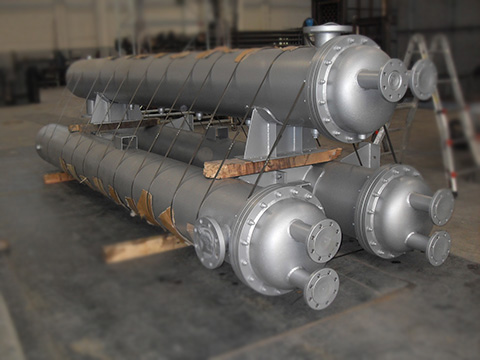
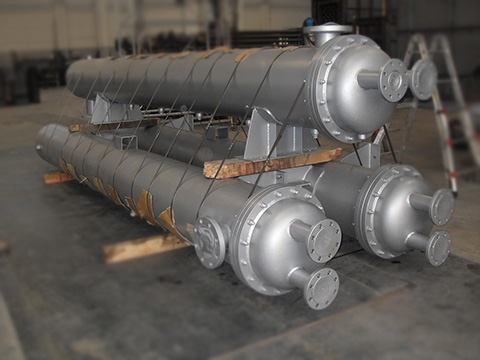
Shell and Tube Heat Exchanger is most common type of heat exchanger in oil refineries and other large chemical processes, and is suited for higher-pressure applications. Shell Tubes Heat Exchanger are classified into fixed and Floating type Heat Exchangers. Shell and tube heat exchangers consist of a series of tubes. One set of these tubes contains the fluid that must be either heated or cooled. The second fluid runs over the tubes that are being heated or cooled so that it can either provide the heat or absorb the heat required. In this type, the tube sheets are completely welded to the shell and acted as shell flanges. Fixed type Heat Exchangers are used there are absolutely no chances for inter mixing of two fluids. The Floating type Heat Exchangers has the advantages of removability of tube bundle and access for cleaning both inner and outer side of tubes and shell.
Shell Tube Heat Exchanger is widely used in variety of application as a cooling solution. Common amoung them is for cooling of Hydraulic Fluid and oil in engines, transmissions and hydraulic power packs. With right coimbination of materials they can also be used to cool or heat other mediums, such swimming pool water or charge air. One of the big advantages of using a shell and tube heat exchanger is that they are often easy to service, particularly with models where a floating tube bundle (where the tube plates are not welded to the outer shell) is available. Can also be used on fixed tube sheet heat exchangers.

In this kettle reboiler type / kettle type heatexchangers, steam flows through the tube bundle and exits as condensate. The liquid from the bottom of the tower, commonly called the bottoms, flows through the shell side. There is a retaining wall or overflow weir separating the tube bundle from the reboiler section where the residual reboiled liquid (called the bottoms product) is withdrawn, so that tube bundle is kept covered with liquid.Kettle reboilers are reliable in that they can handle high vaporization of up to 80 percent and are easy to maintain.
Kettle reboilers are very simple and reliable. They may require pumping of the column bottoms liquid into the kettle, there may be sufficient liquid head to deliver the liquid into the reboiler.
In a typical classical distillation column, all the vapor driving the separation comes from the reboiler. The reboiler receives a liquid stream from the column bottom and may partially or completely vaporize that stream. Steam usually provides heat required for the vaporization. Reboilers are heat exchangers typically used to provide heat to the bottom of industrial distillation columns. They boil the liquid from the bottom of a distillation column to generate vapors which are returned to the column to drive the distillation separation. Proper reboiler operation is effective distillation.
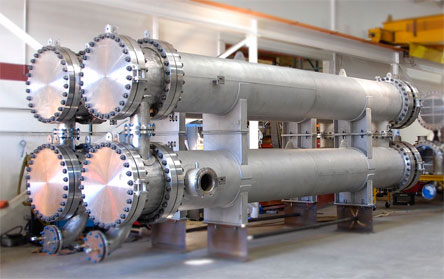
Double Pipe Heat Exchanger are operating in true counterflow, they can operate with a temperature cross, that is, where the cold side outlet temperature is higher than the hot side outlet temperature. The term 'hairpin heat exchanger' is also used for a heat exchanger of the configuration in the diagram. A hairpin heat exchanger may have only one inside pipe, it may have multiple inside tubes, but it will always have the doubling back feature shown. Some heat exchanger manufacturers advertise the availability of finned tubes in a hairpin / double pipe heat exchanger. These would always be longitudinal fins, rather than the more common radial fins used in a crossflow finned tube heat exchanger.
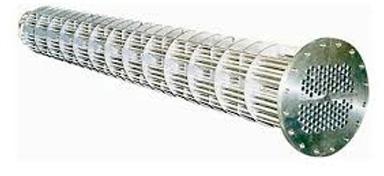
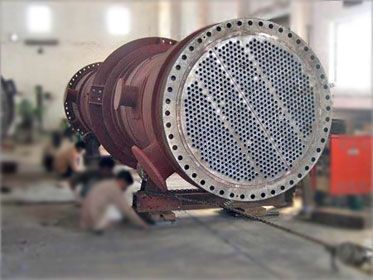
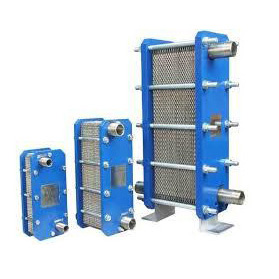
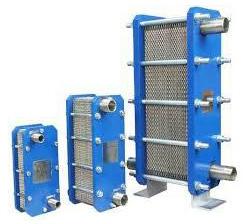
Plate Heat Exchanger comprises of corrugated thin Titanium or SS plates which are sealed by integrally fitted gaskets. These gaskets act as reliable seals between the plates nd create alternative flow channels where hot fluid circulates on one side and cold fluid on the other hence maximizing the heat transfer surface.
The plates are held together in compression by long threaded studs on the outside of the tube bundle that pass through the end covers to which they are fixed by using spring washers and nuts. There are also plate carriers fitted to the top of the bundles that align the plates at assembly of the tube bundles.
Plate heat exchangers transfer heat more efficiently due to the intricate plate design. They are very efficient, light and compact and can be easily dismantled for maintenance.
We can offer a wide range of standard heat exchanges of varied heat transfer area to meet the individual needs. The customer will have to provide us details such as fluid mediums to be heated and cooled, temperature and pressure range etc. This will help us to determine the size, number, material, chevron angle of plates and material of gaskets and other important characterstics which will further help us to provide the most suitable heat exchanger for the given application.
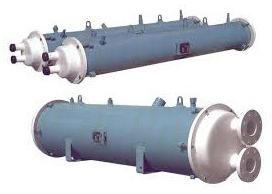
The water-antifreeze mixture runs through the heat exchanger dumping heat, but remaining separate from corrosive salts and chemicals found in the water the boat is floating in. If the ocean water eventually corrodes and ruins the heat exchanger it can be replaced at a fraction of the cost of replacing the engine. To protect the marine heat exchanger from corrosive salts, a sacrificial zinc anode is screwed into the heat exchanger. This anode must be periodically replaced as part of regular maintenance. Because the water the boat floats in may be contaminated with floating particles such as wood or styrofoam balls the well designed boat will have a filter to remove these particles before they are moved toward the heat exchanger.
Because the cooling water (which is chemically treated fresh water) is at a temperature of 70-80 degrees C, it would not be possible to flash off any water vapour unless the pressure in the heat exhanger vessel was dropped. To alleviate this problem, a brine-air ejector venturi is used to create a vacuum inside the vessel. Partial evaporation is achieved and the vapour passes through a demister before reaching the condenser section. Sea water is pumped through the condenser section to cool the vapour sufficiently to precipitate it. The distillate gathers in a tray, from where it is pumped to the storage tanks.
Marine heat exchanger is the most common way to cool a boat's engine, using the lake, river / ocean water in which the boat floats. Since this water may be corrosive the engine may be cooled by a sealed mixture of distilled water and antifreeze. Heat from the water-antifreeze mixture is then transferred to the ocean (or lake or river) water which flows into a heat exchanger.
A water-jacketed exhaust manifold is necessary on marine engines to reduce the temperature of the engine-room air space and the exhaust pipe. If the exhaust manifold is in the sea-water circuit it should be installed with the sea-water inlet at the back and the outlet at the front on the top to ensure that it operates completely full of sea-water.
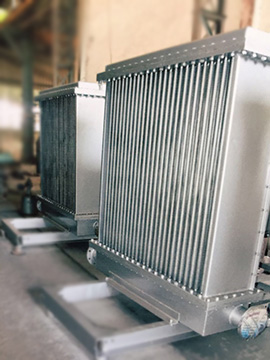
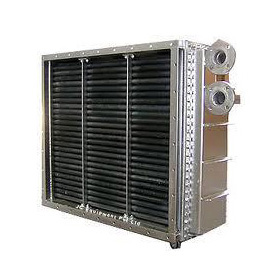
CATS manufactures ammonia air cooled condensers for the industrial refrigeration industry. Air cooled condensing with ammonia eliminates costly water usage, water treatment, and sewerage associated with evaporative condensers. ACVA condensers are available in almost any configuration and footprint thanks to our parametric design system. Standard features include aluminum tubes and fins with corrosion resistant galvanized steel housing. CATS patented Bimetallic Couplers (BiM) eliminate the need for flange union connections traditionally used to transition on aluminum coils to transition from aluminum to steel pipework. Low speed, fully guarded fans insure quiet operation.
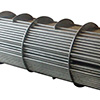
we can build "U" tube bundles, straight tube "floating" tube bundles, or we can retube fixed tubesheet heat exchangers when the bundles is not removable and multitherm is not locked into any one material. Some bundles tend to be build with copper tubes and steel tubesheets. Heat-exchanger system consisting of a bundle of U tubes surrounded by a shell (outer vessel), one fluid flows through the tubes, and the other fluid flows through the shell, around tubes.Multitherm can duplicate any existing bundle to include dimensions, materials and performance.
Two and four pass designs are common because the fluid can enter and exit on the same side. This makes construction much simpler.There are often baffles directing flow through the shell side so the fluid does not take a short cut through the shell side leaving ineffective low flow volumes. These are generally attached to the tube bundle rather than the shell in order that the bundle is still removable for maintenance. Counter current heat exchangers are most efficient and they allow the highest log mean temperature difference between the hot and cold streams.
 G N SINGH (COMP AIR TREATMENT SYSTEM P LTD)
 246-A, 2nd Floor, Atlantis K-10 - Tower, Subhanpura, Vadodara, Gujarat - 390007, India
 Share us via