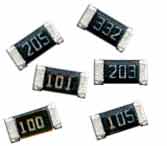
The drive for miniaturizing electronic devices has resulted in todays extensive use of surface-mount electronic components. An important aspect in electronics design and the choice of materials is a products durability and lifetime. For surface-mount resistors and other components producing heat it is a well-known problem that temperature cycling can lead to cracks propagating through the solder joints, resulting in premature failure. electronics in general there is a strong interest in changing the soldering material from lead- or tin-based solder alloys to other mixtures. This multiphysics example models the heat transport and structural stresses and deformations resulting from the temperature distribution using the Heat Transfer in Solids and Solid Mechanics interfaces.
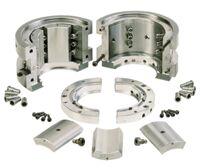
Tilted pad thrust bearings are used in rotating machineries with high thrust loading. The thrust load is transferred from a sliding part to a stationary part through hydrodynamic oil films. The tilted pad thrust bearing consists of a series of flat surfaces sliding over stationary tilted pads. The space between the flat surface and the tilted pad is filled by a lubricant that is drawn in due to the sliding motion of the flat surface. The pressure developed in the lubricant in between the sliding surface and the tilted pad counteracts the external load applied to the sliding surface and thus prevents contact between the two surfaces. Integration of the pressure values on the surface of the tilted pad gives the total load on the tilted pad. This total load is used to analyze elastic deformation of the tilted pad. In this model, Reynolds equation is used to calculate the pressure in the film and structural analysis is performed to find the elastic deformation of the tilted pad.
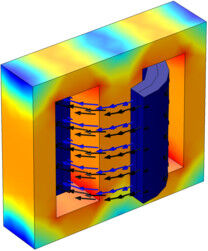
This is the transient model of a single phase E-core transformer using a Multi-Turn Coil Domain. The model includes the effect of a nonlinear B-H curve in the core and shows how to connect the transformer model to the external circuits using Electric Circuit interface. The simulation is performed for two different cases; the first one with a unity turn ratio and second one with a turn ratio of one thousand.