Write a Review
Our Products
We are leaders in the market for providing best range of SPECIALTY SPIRAL WOUND GASKETS, Kammpro - HTG, Kammpro ACHE, DELTAONE Style SWR and DELTAONE Style SWRI Gaskets
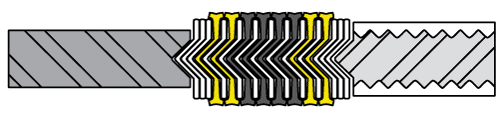
DELTAONE Inhibitor gasket provides corrosion resistance in the most extreme conditions. It combines a HTG filler configuration with highest purity graphite, and a Kammpro inner ring laminated with soft PTFE material. The design of the Inhibitor gasket utilizes the Kammpro inner ring to provide the primary sealing interface. The inner ring material and its covering layer are inert in terms of corrosion through contact with dissimilar materials. This fire safe design incorporates the sealing integrity of highest purity graphite in conjunction with mica on the ID and OD, preventing the entrance of further corrosive conditions to the media.
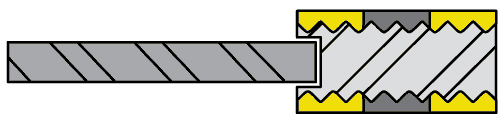
Kammpro - HTG is recognized as a problem solver for heat exchangers, large vessels and equipment that experience high operating temperature. It utilizes a section of high performance mica/phyllosilicate that protects the graphite and shields it from contact of oxidizers. Kammpro HTG represents the best technology available in regards to torque retention and seal ability at elevated temperatures.
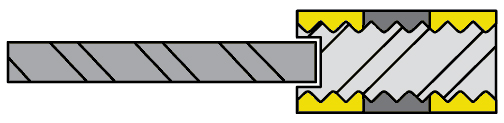
Kammpro ACHE is specially designed to replace traditional solid metal "washer" type gaskets typically used in air cooled heat exchangers. The design takes advantage of the serrated profile with graphite facing to bite against the finish of the header plate and fill in the voids, creating a superior level of tightness. The Kammpro-ACHE has proven to be a very viable solution to emission concerns found where optimal conditions for metal-to-metal sealing are not realized.
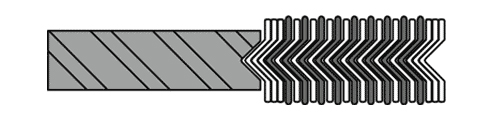
Style WR gaskets consist of a winding with a solid metal outer guide ring. These gaskets can be used on plain flat face flanges and on raised face flanges. The outer guide ring serves to center the gasket properly in the flange joint, acts as an anti-blowout device, provides radial support for the Spiral Wound components, and acts as a compression gauge to prevent the Spiral Wound component from being crushed. Normally the outer guide rings are furnished in mild steel, but can be supplied in other metal when required by operating conditions.
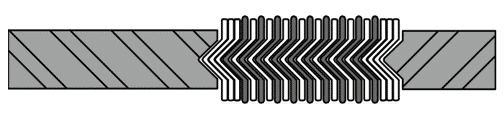
Style WRI is identical to style WR, with the addition of an inner ring. The inner ring also serves several functions. Primarily, it provides radial support for the gasket on the I.D. to help prevent the occurrences of buckling or imploding. Its I.D. is normally sized slightly larger than the I.D. of the flange bore, minimizing turbulence in process flow. The inner rings are normally supplied in the same material as the spiral wound component. DELTAONE normally manufactures standard Style WR and WRI spiral wound gaskets to ASME B16.20, designed to suit ASME B16.5 and ASME B16.47 flanges.
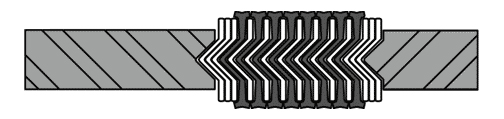
Style WRI-LC gaskets provide a seal at relatively lower seating stress. This means that our design requires less bolt load to seat, yet still has the recovery like a standard spiral wound. The SWRI-LC gasket is typical to 150# and 300# class flanges, where users have a concern with insufficient potential of pre-load. But, the density of the SWRI-LC gasket can be varied to meet virtually any requirement. Electronic controls on DELTAONE' SpiraSeal machines assure high quality precision welding with equal spacing, the correct number of metal plies on the gasket inside periphery, proper ratio of metal to filler, proper number of metal plies on the outside and spot welds on the O.D.
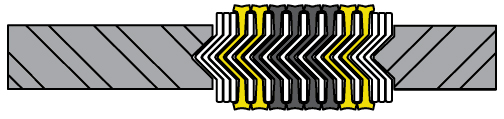
The labyrinth design of the spiral wound provides for enhanced oxidation protection. While Inconel X-750 is commonly selected as the winding metal, any alloy can be selected.
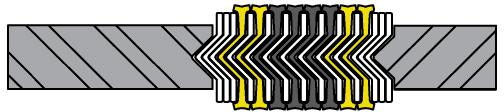
DELTAONE high temperature gaskets represent the ultimate solution for industrial bolted joints that are exposed to extreme temperature. The HTG design combines the superior sealing performance of a premium oxidation inhibited grade flexible graphite with an exceptional oxidation barrier in micaphyllosilicate.
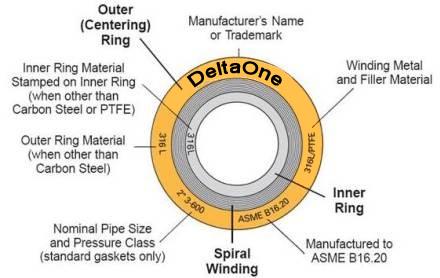
Deltaone spiral wound gaskets are available in a variety of styles to suit the particular flange facing being utilized on the flanges.
A winding is made of alternate plies of a metal wire and a soft non-metallic filler. The metal wire in the gasket is preformed into a "chevron" configuration, allowing superior resiliency and self-adjustment when compared to conventional gaskets. The Style W is just a sealing component (winding) only, which is normally used on tongue and groove joints, male and female facings and groove to flat flange facings.
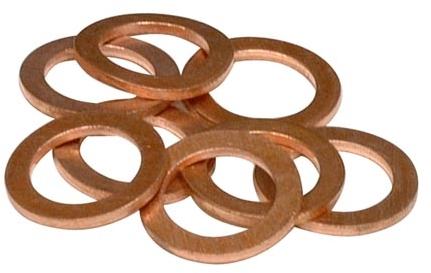
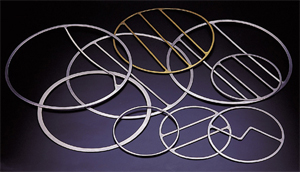
Metallic gaskets can come in different styles like; double jacket, single jacket, or solid metal. Soft compressible filler material can be flexible graphite, ptfe, or non-asbestos compressed sheet type. The design of a metal jacketed gasket also may require different shapes and the styles mentioned above can be made to a variety.
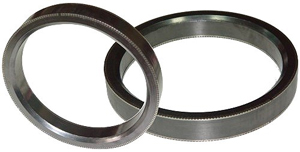
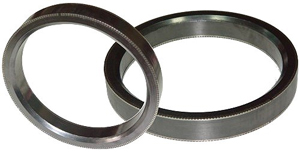
Expanded Graphite Gasket is known as Flexible Graphite Gasket. According to different operating conditions, gaskets can be covered with single or double eyelets, or without eyelet. We also provide nuclear grade graphite gasket, sulphur content less than 600ppm. Superior performance. Graphite gaskets is widely used for pipe flange, pump, valve joint.
Types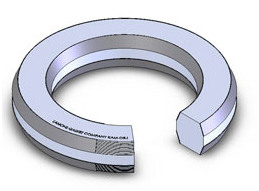
The Kammprofile-Octagonal RTJ is sized to the standard octagonal API 6A or ASME B16.20 dimensions but with the addition of the Kammprofile design applied to the sealing areas and faced with oxidation inhibited flexible graphite. This design is ideal for applications where cracking or embitterment has been experienced in ring joint groove. It is available in a large variety of metal material and it can be fabricated as custom engineered designs.
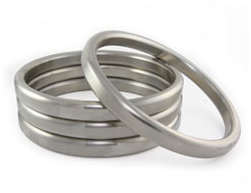
DELTAONE manufactures and supplies a large variety of ring joint gaskets. The RTJ standard size gaskets are manufactured in accordance to API-6A and ASME B16.20 specifications.
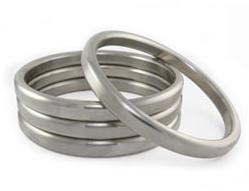
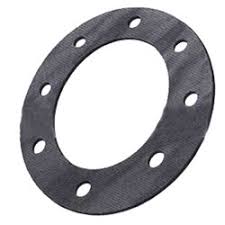
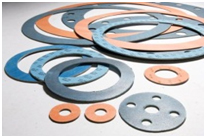

In the single-jacketed overlap construction the maximum flange width is approximately 1/4". this type of gasket is used when total enclosure of the soft filler material is required and when the flange width makes it impractical to use a double-jacketed gasket.
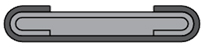
The double-jacketed, double-shelled gasket is similar to the double-jacketed gasket except that instead of using a shell and a washer, two shells are used in the fabrication of the gasket. It has the advantage of a double lap at both the I.D. and the O.D. of the gasket, adding greater stability to the gasket. The construction will withstand higher compressive loads. Double-shell gaskets are normally restricted to use in high pressure applications.
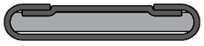
Double-jacketed gaskets are probably the most commonly used style of gaskets in heat exchanger applications. They are available in virtually any material that is commercially available in 26-gauge sheet. They are also extensively used in standard flanges where the service is not critical. Since most double-jacketed gaskets are custom made, there is virtually no limit to size, shape or configuration in which these gaskets can be made. In some cases nubbins are provided on heat exchanger designs to provide an intermediate seal. This nubbin is normally 1/64" high by 1/8" wide. Experience has indicated, however, that there is little advantage to this particular design. The primary seal is still dependent on the inner lap of the gasket doing the brute work and the secondary seal, when applicable, would be provided by the outer lap.

The majority of applications for single-jacketed gaskets are normally 1/4" or less in radial width. This type of gasket is widely used in air tool applications and engine applications where space is limited, gasket seating surfaces are narrow and relatively low compressive forces are available for seating the gasket.

Double-jacketed gaskets are probably the most commonly used style of gaskets in heat exchanger applications. They are available in virtually any material that is commercially available in 26-gauge sheet. They are also extensively used in standard flanges where the service is not critical. Since most double-jacketed gaskets are custom made, there is virtually no limit to size, shape or configuration in which these gaskets can be made. In some cases nubbins are provided on heat exchanger designs to provide an intermediate seal. This nubbin is normally 1/64" high by 1/8" wide. Experience has indicated, however, that there is little advantage to this particular design. The primary seal is still dependent on the inner lap of the gasket doing the brute work and the secondary seal, when applicable, would be provided by the outer lap.
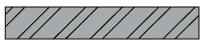
Flat metal gaskets are best suited for applications such as valve bonnets, ammonia fittings, heat exchangers, hydraulic presses, tongue-and-groove joints. They can be used when compressibility is not required to compensate for flange surface finish, warpage or misalignment and where sufficient clamping force is available to seat the particular metal selected. They must be sealed by the flow of the gasket metal into the imperfections on the gasket seating surfaces of the flange. This requires heavy compressive forces. The hardness of gasket metal must be less than the hardness of the flanges to prevent damage to the gasket seating surface of the flange.

The DELTAONE CMG family of products are considered the standard in respect to corrugated metal gasket technology. An excellent choice for 150 and 300 class ASME flanges where available bolt loading is minimal. The substrate geometry promotes recovery and resilience through thermal cycles and extended service life. CMGs can be direct replacements for spiral wound gaskets and can eliminate inward buckling issues while creating a seal at moderate flange stresses. Available in a wide range of substrate alloys and covering layer options, CMG style flange gaskets can be utilized to solve many common flange problems. CMG substrate geometries are engineered to achieve maximum recovery characteristics. A specific pitch, core thickness and wall angle is engineered to maximize the seal's ability to overcome relaxation through joint relaxation, pressure and thermal cycles.

CMG-GR Corrugated Metal Graphite (CMG) is a high performance gasket for standard flange or heat exchanger applications. The CMG molds in place by filling in irregularities of the spaces creating a superior seal. It maintains the seal even in harsh environments including hydrocarbons and steam applications. The gasket is ideal where low bolt load are present or where high gasket stresses are available. The thin profile is beneficial in areas where flange separation is limited. The heavy 22 gauge core and 1/8" pitch frequency results in superior recovery and crush resistance in the most demanding applications.
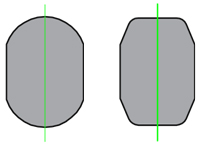
API ring Joint gaskets come in two basic types, an oval cross section and an octagonal cross section. These basic shapes are used in pressures up to 10, 000 DELTAONE. The dimensions are standardized and require specially grooved flanges. The octagonal cross section has a higher sealing efficiency than the oval and would be the preferred gasket. However, only the oval cross section can be used in the old type round bottom groove. The newer flat bottom groove design will accept either the oval or the octagonal cross section. The sealing surfaces on the ring joint grooves must be smoothly finished to 63 micro inches and to be free of objectionable ridges, tool or chatter marks. They seal by an initial line contact or a edging action as the compressive forces are applied.
The hardness of the ring should always be less than the hardness of the flanges to prevent flange deformation. Dimensions for API ring joint gaskets and grooves are covered in ASME B16.20 and API6A DELTAONE stocks a wide range of sizes and materials ready for immediate shipment from R11 to R105. Stock materials include large variety of metals.
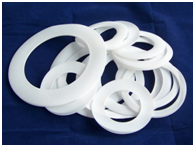
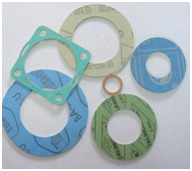
The hardness of the ring should always be less than the hardness of the flanges to prevent flange deformation. Dimensions for API ring joint gaskets and grooves are covered in ASME B16.20 and API6A DELTAONE stocks a wide range of sizes and materials ready for immediate shipment from R11 to R105. Stock materials include large variety of metals.
 Vinoth Kumar (Deltaone Engineering)
 Plot # 259, Burma Colony, Perungudi,Chennai-600096, Tamil Nadu, India
 Share us via