
 Write a Review
Our Products
Our product range contains a wide range of Impact Roller, Self-Training Carrying Idler, Troughing Carrying Idler, Flat Return Idler and GARLAND IDLER
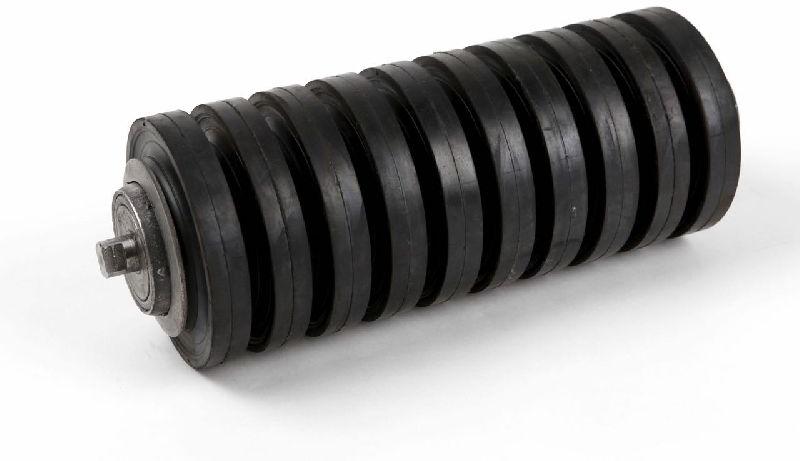
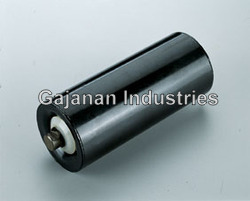
Impact rollers are used as carrying rollers instead of normal steel rollers at a loading point. On steel roller there are rubber rings assembled, side by side, to absorb the weight and impact of material falling onto the belt. At the same time impact rollers reduce the shock and vibration through the steel structure.
Features & Values:
Self-Training Carrying Idler are installed between the normal idlers to adjust the transverse displacement caused by unevenly loading, wet condition of bottom of belt side and bad training of belt. When the carring belt moves against the guide rollers on either side, owing to difference of friction force between both sides, the upper stand is swiveled to center the belt. Then zigzag movement and abnormal damage of belt can be eff-cierntly prevented. Generally, it is installed 5m from the front(end) pulley and 10m from the others.

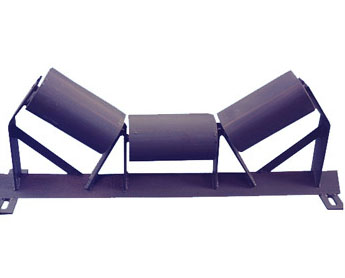
Troughing idlers are use for conveying bulk materials, and are designed and manufactured with Troughing angels of 20, 35, 45, and any other angle are also manufactured as per customer's design and drawings.

The return idlers which carry the weight of the empty belt in the return side or the lower side of the conveyor are mostly single roller straight idler.

Garland idler set comprises either 3-roll or 5-roll idlers joined together at the ends of their respective shafts by special lugs, to form a continuous 'chain' of idlers. On either end of this 'chain', the shafts are connected to an attachment bracket which enables the idler set to be attached to the conveyor stringer structure.
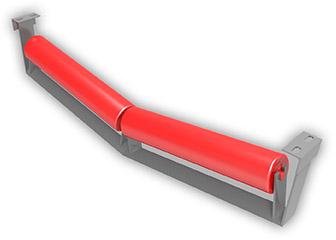
Where return idler sets comprise two rolls, a support frame is required which supports the idler pair and attaches the idlers to the conveyor frame. This 2-roll design forms the return belt into a 'v' trough and these return idler sets are referred to a 'V' return idlers. The trough angle of the 'V' return idler is usually 10 degrees and this feature has been developed to assist with belt training along the return strand.
 Kamal Kher (Gajanan Industries)
 48, Kesar Industrial Park,
Opp. Annapurna Estate, Inside Zaveri Estate,
Nr. Kathwada G.I.D.C.
Singarwa, Ahmedabad - 382430, Gujarat
48, Kesar Industrial Park,
Opp. Annapurna Estate, Inside Zaveri Estate,
Nr. Kathwada G.I.D.C.
Singarwa, Ahmedabad - 382430, Gujarat Share us via