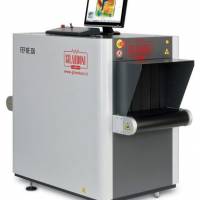
Offering X Ray Baggage Scanner.Baggage Scanning Machine is a most common equipment used for security reasons now a days. It is used to check luggage in detail and also in short time. When a bag enters into the tunnel of scanner, sensors on both side senses it and send a message to X-Ray Generator which generates X-Ray. The X-rays passes through the bag and make an image on the screen.The heart of an X-ray generator is the X-ray tube. Like any vacuum tube, the X-ray tube contains a cathode, which directs a stream of electrons into a vacuum, and an anode, which collects the electrons and is made of copper to evacuate the heat generated by the collision. When the electrons collide the target, about 1% of the resulting energy is emitted as X-rays, with the remaining 99% released as heat. Due to the high energy of the electrons that reach relativistic speeds the target is usually made of tungsten even if other material can be used particularly in XRF applications. A cooling system is necessary to cool the anode; many X-ray generators use water or oil recirculating systems.When baggage is placed on the conveyor, it is moved into the machine by the operator. There is an infrared transmitter and receiver assembly to detect the baggage when it enters the tunnel. This assembly gives the signal to switch on the generator and signal processing system. The signal processing system processes incoming signals from the detector and reproduce an image based upon the type of material and material density inside the baggage. This image is then sent to the display unit.The colour of the image displayed depends upon the material and material density : organic material such as paper, clothes and most explosives are displayed in orange. Mixed materials such as aluminum are displayed in green. Inorganic materials such as copper are displayed in blue and non-penetrable items are displayed in black (some machines display this as a yellowish green or red). The darkness of the color depends upon the density or thickness of the material.The material density determination is achieved by two-layer detector. The layers of the detector pixels are separated with a strip of metal. The metal absorbs soft rays, letting the shorter, more penetrating wavelengths through to the bottom layer of detectors, turning the detector to a crude two-band spectrometer.

 Write a Review
 Dhiraj Rai (PINNACLE SYSTEMS INDIA)
 RZ- 3097/34,, Tughlakabad, Delhi - 110019, India
 Share us via