Write a Review
Our Products
We offer a complete product range of Concrete Permeability Apparatus, Aggregate Crushing Value Apparatus, Compaction Factor Apparatus, J RING APPARATUS and Jolting Apparatus
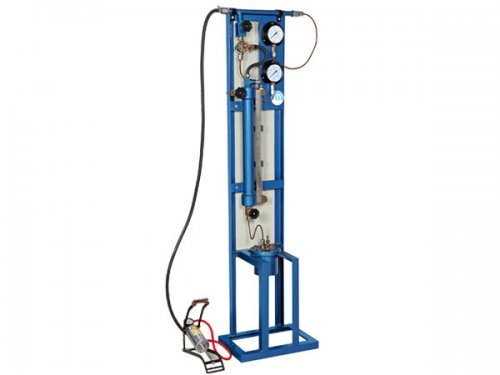
A concrete structure is considered to be of adequate durability if it performs in accordance with its intended level of functionality and serviceability over an expected or predicted life cycle. Concrete durability depends largely on the ease (or difficulty) with which fluids (water, carbon dioxide, oxygen) in the form of liquid or gas can migrate through the hardened concrete mass. Concrete is a porous material. Therefore, moisture movement can occur by flow, diffusion, or sorption. We are concerned with all three, but generally the overall potential for moisture in concrete by these three modes is referred to as its permeability.
General Description & SpecificationsThe set up consist of permeability cell, water reservoir and pressure lines, with glass bottles.
Permeability CellConsists of a metal cylinder with a ledge at the bottom for retaining the specimen, a flange at the top, removable cover plate and a funnel. A rubber gasket is seated in matching grooves, between the cell and the cover plate, to render the joint water tight. Internal working size of the cell will be 100mm dia X 100mm hight.
Water ReservoirConsists of a length of metal pipe, 50 to 100 mm in diameter and about 500 mm long. The reservoir fitted with a graduated side arm gauge-glass for admitting water and compressed air and a cock for drainage, bleeding and connection to the permeability cell.
Pressure LinesHeavy duty armored rubber hose with end fittings. Complete with glass bottles but without compressor. For specimen size 100 X 100 mm
Concrete permeability tester for three specimen of (100mm dia x 100mm height) or (150mm dia x 150mm height) or (150mm cube) is also available.Relavant Standard : IS : 3085
Optional AccessoriesAir Compressor
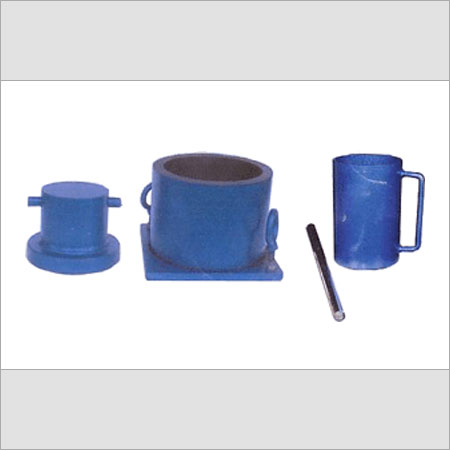
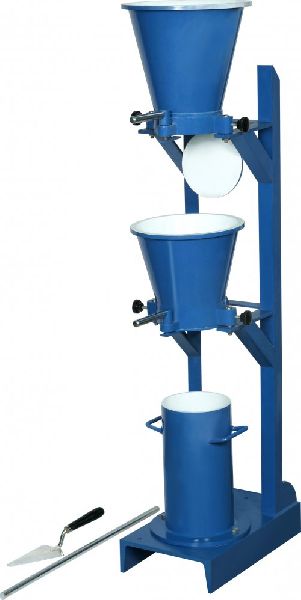
The compaction factor is defined as the ratio of the mass of the concrete compacted in the compaction factor apparatus to the mass of the fully compacted concrete. It involves dropping a volume of concrete from one hopper to another and measuring the volume of concrete in the final hopper to that of a fully compacted volume. The results of the compaction factor test can be correlated to slump, although the relationship is not linear. This test is difficult to run in the field and is not practical for large aggregates (over 1 inch) Compared to the slump test, the apparatus is bulky and a balance is required to perform measurements.
General Descripation & SpecificationsTThe apparatus, consist of a rigid frame that supports two conical hoppers vertically aligned above each other and mounted above a cylinder. The top hopper is slightly larger than the bottom hopper, while the cylinder is smaller in volume than both hoppers. To perform the test, the top hopper is filled with concrete but not compacted. The door on the bottom of the top hopper is opened and the concrete is allowed to drop into the lower hopper. Once all of the concrete has fallen from the top hopper, the door on the lower hopper is opened to allow the concrete to fall to the bottom cylinder. The excess concrete is carefully struck off the top of the cylinder and the mass of the concrete in the cylinder is recorded. This mass is compared to the mass of fully compacted concrete in the same cylinder achieved with hand rodding or vibration. Complete with trowel and tamping bar 0-60 cms long X 16mm dia.
Optional Accessories: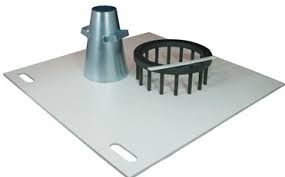
J-ring test the passing ability of the concrete .The equipment consists of rectangular section of 38 mm X 25 mm open steel ring drilled vertically with holes to accept threaded section of reinforcing bars 12 mm diameter 100 mm in length.The bars and sections can beplaced at different distance apart to simulate the congestion of reinforcement of the ring formed by vertical section is 300 mm and height 100 mm .
Equipments :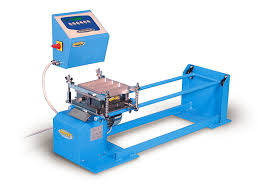
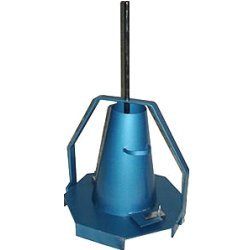
the oldest, most widely used test for determining workability. This test is used to determine the workability of fresh concrete, which would normally be undertaken at the point of delivery to ensure the concrete, is of adequate consistency for placement. The test is applicable to concrete of medium workability.
the device is a hollow cone-shaped mould. The mold is filled in three layers of each volume. Each layer is rodded with a 16mm steel rod 25 times. The mould is then lifted away and the change in the height of the concrete is measured against the mould. The slump test is a measure of the resistance of concrete to flow under it own weight.
the apparatus comprise of a slump cone with handles made of mild steel sheet, a chrome plated steel tamping rod of 16 mm diameter x 600 mm long, rounded off at one end, with a scale marked on it and a steel base plate with a carrying handle.
the mould for the test specimen will be in the form of frustum of a cone having the following internal dimensions as follows.
| dimensions | cm. |
| bottom diameter | 20 |
| top diameter | 10 |
| height | 30 |
the cone is constructed of metal of at least 1.6 mm thickness and the top and bottom are open and at right angles to the axis of the cone. The mould have a smooth internal surface and provided with suitable foot pieces to a base plate and also handles to facilitate lifting it from the moulded concrete test specimen in a vertical direction as required by the test. The base plate is provided with cleats & swivel handle.
optional accessories :concrete scoop.funnel for pouring concrete in cone straight edge
 Alpesh Patel (Haridarshan Instru-Lab)
 B10, Highway Estate, Opposite Kiran Motor, Sarkhej-Sanand Road, Sarkhej Ahmedabad - 382210, Gujarat, India
 Share us via