Details :
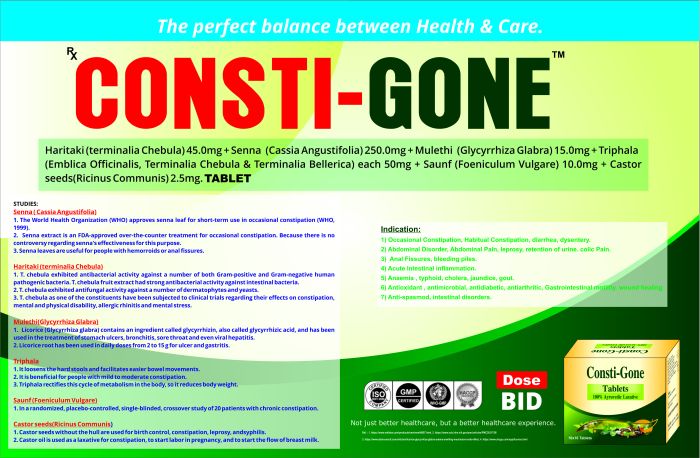
- Punch Line - The perfect balance between Health & Care.
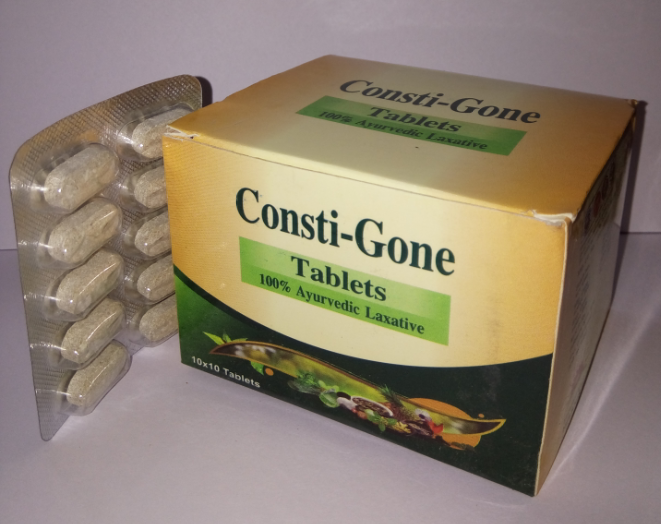
- Combination - Haritaki (terminalia Chebula) 45.0mg + Senna ( Cassia Angustifolia) 250.0mg + Mulethi(Glycyrrhiza Glabra) 15.0mg + Triphala ( Emblica Officinalis, Terminalia Chebula & Terminalia Bellerica) each 50mg + Saunf (Foeniculum Vulgare) 10.0mg + Castor seeds(Ricinus Communis) 2.5mg.
- Dose - BID Slug line - Not just better healthcare, but a better healthcare experience.
Indication :
- Occasional Constipation, Habitual Constipation, diarrhea, dysentery
- Abdominal Disorder, Abdominal Pain, leprosy, retention of urine, colic Pain
- Dyspepsia, cough and Bronchitis, ulcer
- Skin Disorder, leucoderma
- Anal Fissures, bleeding piles
- Acute Intestinal inflammation.
- Anaemia , typhoid, cholera, jaundice, gout,
- Antioxidant , antimicrobial, antidiabetic, antiarthritic, Gastrointestinal motility, wound healing
- Anti-spasmod, intestinal disordersr
- Losing weight (obesity). Reducing belly fat,
Studies - Senna ( Cassia Angustifolia) :
- The World Health Organization (WHO) approves senna leaf for short-term use in occasional constipation (WHO, 1999).
- Senna extract is an FDA-approved over-the-counter treatment for occasional constipation. Because there is no controversy regarding senna's effectiveness for this purpose.
- Clinical studies in the United States and abroad involving various age groups suggest that senna is effective in managing constipation associated with a number of causes including surgery, childbirth, and use of narcotic pain relievers
- Senna leaves are useful for people with hemorroids or anal fissures.
- Besides being a laxative, senna is used as a febrifuge, in splenic enlargements, anaemia, typhoid, cholera, biliousness, jaundice, gout, rheumatism, tumours, foul breath and bronchitis, and probably in leprosy.
- Usefull in constipation, abdominal disordes, leprosy, skin disorders, leucoderma, splenomegaly, hepatomegaly, dyspepsia, cough, and bronchitis.
Haritaki (Terminalia Chebula) :
- T. chebula is one of the most versatile plants having a wide spectrum of pharmacological and medicinal activities
- The plant has been demonstrated to possess multiple pharmacological and medicinal activities, such as antioxidant, antimicrobial, antidiabetic, hepatoprotective, anti-inflammatory, antimutagenic, antiproliferative, radioprotective, cardioprotective, antiarthritic, anticaries, gastrointestinal motility and wound healing activity.
- T. chebula exhibited antibacterial activity against a number of both Gram-positive and Gram-negative human pathogenic bacteria. T. chebula fruit extract had strong antibacterial activity against intestinal bacteria.
- T. chebula exhibited antifungal activity against a number of dermatophytes and yeasts
- T. chebula as one of the constituents have been subjected to clinical trials regarding their effects on constipation, mental and physical disability, allergic rhinitis and mental stress.
Mulethi(Glycyrrhiza Glabra) :
- Licorice (Glycyrrhiza glabra) contains an ingredient called glycyrrhizin, also called glycyrrhizic acid, and has been used in the treatment of stomach ulcers, bronchitis, sore throat and even viral hepatitis.
- Licorice root has been used in daily doses from 2 to 15 g for ulcer and gastritis.
- Use during pregnancy should be avoided. Licorice exhibits estrogenic activity and has reputed abortifacient effects.
Triphalar :
- It loosens the hard stools and facilitates easier bowel movements.
- It is beneficial for people with mild to moderate constipation.
- Triphala rectifies this cycle of metabolism in the body, so it reduces body weight. Its use also makes bones stronger and increases bone mineral density in obese people.
- Triphala is a common home remedy for constipation. It has mild laxative action.
Saunf (Foeniculum Vulgare) :
- In a randomized, placebo-controlled, single-blinded, crossover study of 20 patients with chronic constipation,
- F. vulgare , Sambucus nigra , Cassia augustifolia , and Pimpinella anisum was associated with improvements in colonic transit time as well as number of bowel evacuations, with the latter effects beginning during the second day of therapy.
- It has also been used as a stimulant to promote lactation and menstruation. Castor seed
(Ricinus Communis) :
- Castor seeds without the hull are used for birth control, constipation, leprosy, andsyphilis
- Castor oil is used as a laxative for constipation, to start labor in pregnancy, and to start the flow of breast milk.
- Constipation.Castor oil works as a stimulant laxative for reducing constipation when taken by mouth

 GST : 10AAECH2205D1ZL
 Write a Review
 Mr. Ravi Shankar Mehta (Helious Pharma Pvt. Ltd)
 Akopur, Nagwan, Janipur AIIMS Road, Patna, Bihar - 801505, India
 Share us via