Write a Review
Our Products
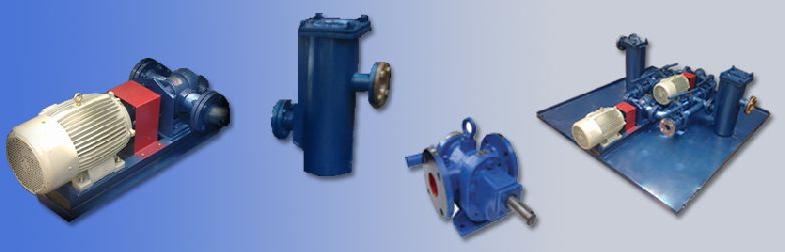
We offer the best product range of OIL TRANSFER PUMPING UNITS and Heating Oil Systems.
Furnace oil is best stored in cylindrical tanks either above or below the ground. Generally, the main storage tank is erected above ground when the capacity exceeds 70, 000 litres. For lower capacities, underground storage may be more economical. When erecting a storage tank above ground, remember to maintain safety distances from the surrounding structures, as prescribed by the Explosives Department.
Storage tanks are generally made from welded mild steel plates. The overhead tank should be mounted on concrete blocks, which provide a slight gradient of 1:50 towards the drain valve.
Each of the following fittings has a definite role to play. The Outlet or Draw-Off Pipe should be located at the raised tank end, not less than 15 cms. from the bottom.
The Vent Pipe, of gooseneck type, should be located at the highest point of the tank to facilitate filling by venting air and oil vapour during the filling operation. It should be at least 5 cms. in diameter and provided with a strainer at the outlet.
The Fill-Pipe could be located either at the top or at the bottom of the tank. If located at the top, it must be ensured that the pipe descends almost to the bottom of the tank.When located near the bottom, it is important to position a non-return valve on the line to avoid furnace oil re-entry into the tank-truck on account of back pressure. To avoid leakage of oil during decanting, it is advisable to have a camlock coupling at the filling end so that it fits snugly on the delivery hose.
The Drain Pipe, which is fitted at the lower tank end bottom, is used top periodically remove the accumulated water. It is a difficult task to drain the water and sludge from underground storage tanks. The water and sludge which settle down at the bottom should, however, be removed by a handpump. It would be advantageous to have two suction pipes-one at a lower level and the other at a higher level-so that in case the sludge accumulation is up to the lower point and the suction line chokes up, the alternative line could be put into operation and adequate time would be available to decide upon a time schedule for cleaning the tank.
Furnace oil as delivered may contain dust, dirt, gummy matter and water. During storage for prolonged periods, these tend to form sludge which accumulates in the various dead spaces of the tank, where the oil is not agitated during normal operations of the tank. This results in unsteady flames and clogging of filters. To avoid this, some means of agitation of oil in the tank may be necessary
In addition to the main storage tank(s), industries may have one or a number of day service tanks located in proximity to the units consuming oil.
The principles enumerated earlier for the maintenance of main storage tanks apply here too. The service tank may be sized for a shifts consumption or daily consumption-the choice depends on capacity required, ease of location of tank near the shop, pumping capacity, horse power, etc. certain additional precautions may, however, be taken with respect to service tanks:
a) Service tanks should not be located very near or above furnaces, hot air or process ducts, etc.b) They may be provided with overflow pipes which lead directly below to a sump. As a further refinement, limit switches could be provided to avoid the possibility of oil overflow.c) In gravity feed systems, the difference in height between the service tank and the burners should be at least 10 metres.
Removal of contaminantsFurnace oil should be free from possible contaminants such as dirt, sludge and water before it is finally fed to the combustion system.
Furnace oil arrives at the factory site either in tank lorries by road or by rail. Oil is then decanted into the main storage tank. To prevent the possibility of contaminants such as rags, cotton waste, loose nuts or bolts or screws from entering the system and damaging the pump, position a coarse strainer of 10 mesh size (not more than 3 holes per linear inch) on the entry pipe to the storage tanks. Progressively finer strainers should be provided at various points in the oil supply system to filter away finer contaminants such as external dust and dirt, sludge or free carbon. It is advisable to provide these filters in duplicate to enable one filter to be cleaned while oil supply is maintained through the other. Figure below gives an illustration of the duplex system of arrangement of strainers.
 Gunjan Bhardwaj (Hi-Therm Boiler Pvt. Ltd.)
 A-102, Oshiwara Industrial Estate, New Link Road,
Goregaon (W), Mumbai – 400104,
Maharashtra
A-102, Oshiwara Industrial Estate, New Link Road,
Goregaon (W), Mumbai – 400104,
Maharashtra Share us via