My ExportersIndia

For Buyer

For Seller

For Help

Our Products

We are leaders in the market for providing best range of Non-Oven Face Mask Ear Loop Welding Machines, Ultrasonic Gown Tie Spot Welder, Hot Plate Welding Machines, Ultrasonic PP Box Welders / Welding Machines and Ultrasonic PP Corrugated Box Welding Machines

Ultrasonic Plastic Welding Machines

  • Availability 134 KG
  • Throat Depth 11"
  • Generator UG 1526 (15khz 2600w) 5 step amplitude adjust
  • PLC control PLC Selec:3030 5 program storage
  • Input suppy 230v AC 1Phase
  • Start Two Hand palm switches
Ultrasonic plastic welding machines are industrial tools used to join plastic components by using high-frequency ultrasonic vibrations. These machines are commonly employed in industries like automotive, medical, consumer electronics, packaging, and toys due to their precision, speed, and reliability. How Ultrasonic Plastic Welding Works: Ultrasonic vibrations (typically 20 kHz70 kHz) are generated by a transducer. The plastic parts to be welded are held together under pressure. Vibrations create friction and heat at the interface of the parts, melting the material locally. The vibration stops, allowing the molten plastic to cool and solidify, creating a strong bond.
View Complete Details

Ultrasonic Liquid Processors

  • Size L*W*H =420MM*300MM*500WW
  • Inbuilt jack 100mm up - side is possible
  • Stand simple base size 310mm*220mm Height:520mm
  • Hight With enclosure: 16kg, stand 11kg
  • Table/Plate operating size Enclosure: 400*300mm Stand:220*310mm
  • Power Maximum 550w
  • Control Selec PLC 1010
Also known as Ultrasonic Homogenizers, Sonicators, or Ultrasonic Disruptors, these devices use high-frequency sound waves to process liquids. They are used in scientific, industrial, and medical applications for tasks such as mixing, emulsifying, dispersing, homogenizing, or breaking down materials at the molecular or cellular level. High-Frequency Sound Waves: Operate at frequencies typically ranging from 20 kHz to 50 kHz. Probe Design: Equipped with a probe (horn or sonotrode) that transmits ultrasonic energy into the liquid. Cavitation Effect: Generate microscopic bubbles that collapse violently, creating intense localized energy, which facilitates the desired processing. Adjustable Power Levels: Allow customization for different types of materials and applications. Temperature Control: Many units have integrated temperature sensors or cooling systems to prevent overheating.
View Complete Details

Hot Plate Welding Machines

  • Number Of Flower Industrial Welding Machine
  • Name Hot Plate Welding Machines
  • Usage Joining Thermoplastic Materials In Industrial Applications
  • Specialty Leak-proof Welding With Strong Joints
  • Material Thermoplastic Materials
  • Color Varies
  • Heating Method Heated Plate
Hot plate welding machines are used to weld big size jobs, which are not possible to weld on ultrasonic plastic welding machine or spin welding machine. Leak-proof welding is easily possible with strong welded joints Hot plate welding machines are specialized devices used in industrial applications to join thermoplastic materials. They are commonly employed for welding parts in automotive, medical, consumer goods, and other industries where strong, reliable, and airtight bonds are required. A heated plate (hot plate) is positioned between the two thermoplastic parts to be joined. The surfaces of the parts come into contact with the heated plate, causing the material to soften or melt. Once the surfaces are sufficiently molten, the hot plate is retracted. The two parts are pressed together, allowing the molten material to fuse and solidify, forming a strong weld.
View Complete Details

Ultrasonic Welding Hand Guns - Uwhg 3005

  • Availability 13 KG
  • Power Maximum 550w
  • Size L*W*H = 410*220*350MM
  • Operating frequency 27.2~27.8 Khz
  • Control Selec Timer
  • Display 01 Line LED display
  • Welding modes Time/manual stop
  • Control Time Weld Time 0.1~9.9 Sec, Least count 0.1 second
Ultrasonic Welding Hand Guns are portable tools designed to weld materials using high-frequency ultrasonic vibrations. These devices are commonly used in industries such as automotive, electronics, medical, packaging, and textiles for their ability to create strong, precise bonds without the need for adhesives or fasteners. Heres an overview of their features, applications, and benefits: Features of Ultrasonic Welding Hand Guns: Handheld design allows for flexibility in applications where fixed ultrasonic welders are impractical. Ideal for welding thermoplastics, as well as some non-ferrous metals. Operates typically between 20 kHz and 40 kHz, depending on the material and application. Many models feature adjustable power, time, and amplitude settings for precision welding. Designed to minimize operator fatigue during extended use. Customizable ultrasonic horns (sonotrode) tailored for specific materials and geometries.
View Complete Details

Ultrasonic Horns

  • Material Tool Steel, Special Aluminium Alloy, Aluminium Alloy
  • Number Of Flower Welding Tools
  • Special Feature Steel Horns Are Heat-treated

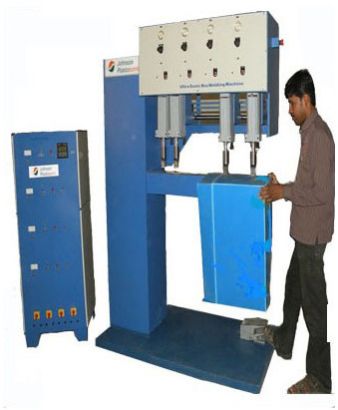
Horns and Fixtures for Welding Manufacturer, Supplier, Exporter Johnson 's wide experience supports successful application development for your welding needs. With extensive expertise, Johnson can develop your application and tooling essential for the success of ultrasonic welding, a crucial aspect of the process. Horns can be made in Tool Steel, Special Aluminium Alloy, and Aluminium Alloy. Fixtures are customized to meet specific needs. Steel horns are heat-treated, while Aluminium horns are hard anodized to ensure durability over extended periods. In welding, "horns and fixtures " refer to tools and equipment designed to facilitate precise and effective welding operations. These components are crucial in industries requiring consistent and repeatable welds, such as automotive, aerospace, and manufacturing. In Ultrasonic or Resistance Welding, horns (also known as sonotrodes in ultrasonic welding) play a critical role in transmitting energy to the materials being welded. They are:
View Complete Details

Ultrasonic PP Box Welders / Welding Machines

  • Number Of Flower Ultrasonic Welding Machine
  • Frequency 20-40 KHz
  • Amplitude Adjustable
  • Controls Pressure And Timing Controls
  • Welding Systems Manual, Semi-automatic, Fully Automated
High-frequency ultrasonic vibrations (usually 2040 kHz) are applied to the material. Vibrations cause the material 's molecules to heat up at the joint interface due to friction. The material melts and fuses together without additional adhesives or fillers. Pressure is maintained while the material cools, forming a strong bond. Key Features of PP Ultrasonic Welding Machines Designed specifically for thermoplastics like polypropylene. The ultrasonic horn (sonotrode) is tailored to the specific shape and size of the PP box. Adjustable frequency and amplitude: Pressure and timing controls for consistent welds. Options for manual, semi-automatic, or fully automated welding systems. Low energy consumption: Compared to other welding methods.
View Complete Details

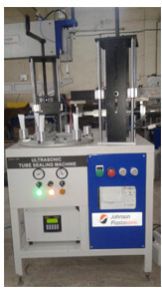
Ultrasonic Tube Sealing Machines

  • Availability 250 KG
  • Size W:L:H 1200MM*1400MM*2000MM
  • Table plate operating size Diameter 450mm 6 stations
Ultrasonic tube sealing machines are specialized devices used in industries such as cosmetics, pharmaceuticals, food, and chemical production to seal tubes made of materials like plastic, laminate, or aluminum. These machines utilize ultrasonic energy to create a secure, leak-proof seal at the open end of the tube. How Ultrasonic Tube Sealing Machines Work Tubes are placed in the machine, either manually or automatically, and positioned for sealing. The machine generates high-frequency ultrasonic vibrations. The vibrations are applied to the sealing area of the tube using a sonotrode (ultrasonic horn). The friction caused by the vibrations generates heat, which melts the material at the sealing surface. Pressure is applied to fuse the melted materials, forming a strong seal. Excess material at the seal may be trimmed for a clean finish. The sealed tubes are ejected or moved to the next stage of the production line.
View Complete Details

Manual Hand Press For Welding

  • Packaging Type Depends On Manufacturer
  • Material Metal
  • Packaging Usually Comes As A Single Unit
  • Application Small-scale Welding Tasks, Metal Fabrication And Assembly Processes
Manual hand press ultrasonic welders are economical compared to pneumatic-based welders, especially when welding small parts. These devices provide an efficient solution for small-scale welding tasks. A Manual Hand Press For Welding is a tool commonly used in metal fabrication and assembly processes, where precise, small-scale welding tasks are required. These devices are designed to combine pressure and heat to join two or more metal parts. Manual hand presses are essential tools in various manufacturing processes, including welding, for tasks such as joining, forming, and assembly. They can be used to align parts, hold components in place, or perform light-duty pressing tasks.
View Complete Details

Film Fabrics Ultrasonic Sealers

  • Number Of Flower Ultrasonic Sealers/Welders
  • Material PP Non-woven Fabric Bags, HDPE, LDPE, Thin Films
  • Usage Bag-making Applications
  • Key Features None, Ideal For Sterile Environments, Quick,
Due to environmental compliances, HDPE bags and LDPE bags are rapidly being replaced by PP non-woven fabric bags. Johnson Plastosonic provides state-of-the-art Indian-made Ultrasonic Generators & Horn Assembly for Bag Making Machines, offering continuous high-speed fabric sealers for bag-making applications. Ultrasonic Welders use high-frequency ultrasonic vibrations to create a bond between two pieces of material. These vibrations are applied under pressure to generate heat through molecular friction, melting the material at the joining point without the need for adhesives, fasteners, or external heat sources. Key Features of Ultrasonic Sealers/Welders: No adhesives or contaminants are required, making it ideal for sterile environments. Seals are formed quickly, increasing production efficiency. Creates durable, airtight, and watertight seals. Suitable for delicate materials like thin films and fine fabrics. Focused ultrasonic energy minimizes waste and reduces overall power consumption.
View Complete Details

Ultrasonic Spot Welding Machines

  • Number Of Flower Ultrasonic Spot Welder
  • Material Metals Or Plastics
  • Usage Joining Materials Using High-frequency Ultrasonic Vibrations
  • Frequency 20-40 KHz
  • Tool Sonotrode
  • Heat Source Friction Between Materials
An Ultrasonic Spot Welder is a type of welding machine that uses high-frequency ultrasonic vibrations to join materials, typically metals or plastics, together. The ultrasonic energy is applied to a localized spot between the parts to be welded, causing the materials to heat up and fuse at that specific point. This is an alternative to traditional spot welding, which relies on heat from an electric current to create the weld. Working of Ultrasonic Spot Welding In Ultrasonic Vibrations, a transducer generates ultrasonic waves (typically 20-40 kHz), which are then focused through a sonotrode (a tool that transmits the vibrations) onto the welding area. The parts to be joined are held under pressure. The ultrasonic vibrations generate heat due to the friction between the materials at the contact point. The localized heating causes the materials to melt and fuse together without the need for external heat sources like electric arcs or flames. After a brief period, the ultrasonic vibrations stop, and the welded joint solidifies as the materials cool down.
View Complete Details

Non-Oven Face Mask Ear Loop Welding Machines

  • Material Various Materials For Machine Construction
  • Color Varies
  • Packaging Depends On Manufacturer
  • Automation Fully Automated Operation For Efficiency
  • Efficiency High-speed Production For Large Quantities
Non-Oven Face Mask Ear Loop Welding Machines are specialized equipment used in the production of face masks. These machines play a crucial role in attaching the ear loops (elastic straps) to the mask body, which is an essential step in the mask-making process. They are typically used in the production of disposable face masks, such as surgical masks, N95 masks, and other similar products. Ultrasonic Welding Technology: These machines use ultrasonic welding to bond the ear loops to the mask material. The ultrasonic vibrations generate heat that melts the material at the bonding points, resulting in a strong and secure attachment of the ear loops. Automation: The machine is usually automated, feeding the masks and ear loops into the system, applying ultrasonic welding, and discharging the finished product without manual labor for each mask. High Efficiency and Fast Production: Designed for high-speed production, these machines enable manufacturers to produce large quantities of face masks in a short amount of time. Adjustable Settings: Many machines allow for adjustments in welding time, pressure, and temperature, enabling optimization for different mask materials and ear loops. Secure Attachment: The machines ensure ear loops are securely attached without damaging the mask, preserving the mask 's quality and integrity. Health and Safety Standards: Designed to meet health and safety standards, these machines ensure the masks they help produce are suitable for healthcare and other critical applications.
View Complete Details

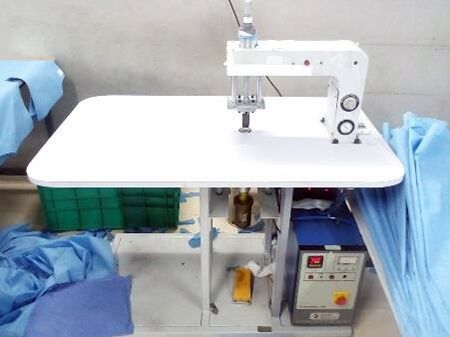
Ultrasonic Gown Tie Spot Welder

  • Weight 92kg
  • Operating Height 750mm
  • Distance Throat depth:11"
  • Positive Stop Positive stop with 1mm pitch
  • Coarse up down Pneumatic
  • Positive stop Cylinder in built positive stop
  • Generator UG 2010 (20Khz 1000w)
View Complete Details

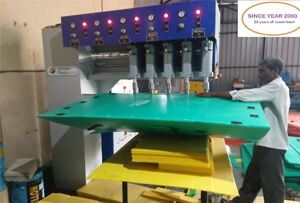
Ultrasonic PP Corrugated Box Welding Machines

  • Availability Approximately 1400kg
  • Size L*W*H=61\"*32\"*86\" ( BASE WIDTH 32\")
  • Table plate operating size arm length 1200mm (can be modified on request) arm thickness 32mm.
  • Up down Drive Linear rail bearings
  • Positive Stop Positive stop with 1mm pitch
Ultrasonic welding machines for polypropylene (PP) corrugated boxes are highly efficient tools designed for creating durable, strong, and aesthetically pleasing welds without adhesives or fasteners. These machines utilize high-frequency ultrasonic vibrations to generate heat at the interface of the materials, melting and fusing them together. Non-Invasive Joining: No need for adhesives, staples, or screws. Clean and environmentally friendly process. High Efficiency: Fast welding cycle times. Reduces production downtime and improves throughput. Strong Welds: Produces uniform, reliable, and tamper-proof joints. Perfect for applications requiring durability and precision. Material Compatibility: Specifically designed for PP and other thermoplastic materials. Ideal for corrugated sheets and box manufacturing. Precision and Control: Adjustable power and frequency settings for various thicknesses. Consistent results with minimal operator intervention
View Complete Details

Ultrasonic Sewing Machines - USM2

  • Weight 120 KG
  • Table plate operating size L:390mm W:300mm fixture parallelism adjustment provision.
  • Operating height 750mm
  • Distance Throat depth:11"
View Complete Details

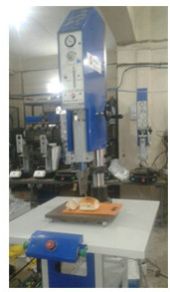
Ultrasonic Sweet Cutter Machines

  • Material Food-grade Materials
  • Usage/Application Cutting Sweet Products With Precision
  • Type Specialized Equipment
  • Technology Ultrasonic
  • Cutting Method High-frequency Vibrations
  • Features Minimizes Crumbs And Residue
Ultrasonic sweet cutter machines are specialized equipment designed to cut a variety of sweet products like cakes, pastries, chocolates, nougat, and other confections with precision. These machines use high-frequency ultrasonic vibrations to make clean, smooth, and consistent cuts without damaging or deforming the product. They are commonly used in industrial food production and bakeries where uniformity and efficiency are critical. Key Features of Ultrasonic Sweet Cutter Machines Operates with high-frequency vibrations (20-40 kHz), reducing resistance while cutting, ensuring smooth and precise edges using Ultrasonic Technology. Minimizes crumbs and residue, especially with sticky or layered products. Ideal for intricate designs and multi-layered confections. Automated systems for high-volume production, reducing manual labor and increasing output consistency. Designed with food-grade materials, easy to clean, ensuring compliance with food safety standards. Adjustable settings for thickness, speed, and cutting patterns, tailored for specific product dimensions and requirements.
View Complete Details

Ultrasonic Rotary Table Machines

  • Material Ceramics, Composites, Hardened Metals, Glass
  • Usage Precision Manufacturing Of Hard And Brittle Materials
  • Frequency Range 20 KHz To 50 KHz
  • Key Features High Precision, Fine Surface Finishes,
  • Special Features Ideal For Micro-holes, Thin Walls
Ultrasonic Rotary Table Machines are advanced manufacturing systems that combine ultrasonic machining technology with rotary table capabilities. These machines are designed for precision manufacturing and are particularly suited for materials that are difficult to machine with conventional methods, such as ceramics, composites, hardened metals, and glass. Key Features of Ultrasonic Rotary Table Machines Ultrasonic Technology utilizes high-frequency ultrasonic vibrations (typically in the range of 20 kHz to 50 kHz). Enhances cutting, drilling, and finishing processes by reducing machining forces. Achieves high precision and fine surface finishes. Rotary Table provides a rotating platform for workpieces, allowing for multi-axis machining, enabling complex geometries and 3D profiles. Supports automated loading/unloading in production environments. Material Compatibility is ideal for hard and brittle materials and is capable of achieving high precision in intricate features, such as micro-holes and thin walls.
View Complete Details

Ultrasonic Plastic Spin Welding Machines - Pswm

  • Availability 180kg
  • Operating Height 750mm
  • Distance Throat depth:11"
Introducing the Ultrasonic Plastic Spin Welding Machine - PSWM, weighing 180kg. This machine comes in a sleek design with a color combination of Blue 5010 and Siemens gray:7035. With an operating height of 750mm and a throat depth of 11 inches, it offers precision and efficiency for all your welding needs.
View Complete Details

Ultrasonic Cutter Systems

  • Frequency 20 KHz To 70 KHz
  • Cutting Speed Faster Than Traditional Methods
  • Cutting Force Low Applied Force Due To Self-lubricating Effect
  • Heat Generation Reduced Heat For Cutting Heat-sensitive Materials
  • Wear On Tools Minimized Wear On Cutter, Extended Lifespan
High-Frequency Vibrations: Ultrasonic cutters operate at very high frequencies (typically 20 kHz to 70 kHz), which causes the cutting blade to vibrate at ultrasonic speeds. This vibration reduces the friction between the blade and the material, allowing for smoother and more efficient cutting. Precision Cutting: The vibration of the blade allows for precise, clean cuts with minimal material deformation. This makes them ideal for materials that are difficult to cut with traditional methods, such as soft materials like foam, rubber, or some composites. Low Cutting Force: The ultrasonic vibration creates a "self-lubricating " effect, allowing the cutter to slice through materials with minimal applied force. This reduces the risk of damage to both the cutter and the workpiece. Reduced Heat Generation: The high-frequency vibrations reduce the heat generated during the cutting process, preventing thermal damage to sensitive materials. This is particularly important when cutting heat-sensitive substances like food, plastics, or textiles. Improved Cutting Speed: Due to the vibrations, ultrasonic cutters can cut faster than traditional mechanical methods, which can improve overall efficiency in production processes. Reduced Wear on Tools: The ultrasonic vibrations minimize the direct contact between the blade and the material, leading to less wear and tear on the cutter itself, thus extending its lifespan. Versatility: Ultrasonic cutter systems can be used for a wide variety of materials, including plastics, rubber, textiles, nonwovens, metals, and composites. Some systems are also capable of cutting through delicate items like food or medical materials. Cleaner Work Environment: Ultrasonic cutting often generates less dust, smoke, or debris compared to traditional cutting methods, resulting in a cleaner working environment. Customizable Systems: Ultrasonic cutting systems can be tailored to specific applications with adjustable parameters like frequency, amplitude, and power
View Complete Details

Ultrasonic Roller

  • Number Of Flower Welding Technology Device
  • Application Welding
  • Material Metal Or Plastic
  • Form Roller Or Wheel
  • Technology Ultrasonic
  • Frequency High-frequency
An Ultrasonic Roller in welding refers to a technology that integrates ultrasonic vibrations with conventional welding processes. It is typically used in the form of a roller or wheel that applies high-frequency ultrasonic vibrations to the material during the welding process. These vibrations help to improve the quality of the weld by enhancing the flow of the molten material, reducing defects like porosity, and promoting better bonding between the workpieces. An Ultrasonic Roller in welding refers to a device that utilizes ultrasonic vibrations to enhance the welding process, typically in ultrasonic welding. This process is used to join materials, typically metals or plastics, without the need for additional fillers or heat sources. The ultrasonic roller is used to apply high-frequency vibrations to the interface between the materials being welded, which generates localized heat due to friction, causing the materials to fuse together.
View Complete Details
Tell Us What are you looking for? Will call you back

Contact Us