Write a Review
Our Products
Our product range contains a wide range of Demineralisation Plant
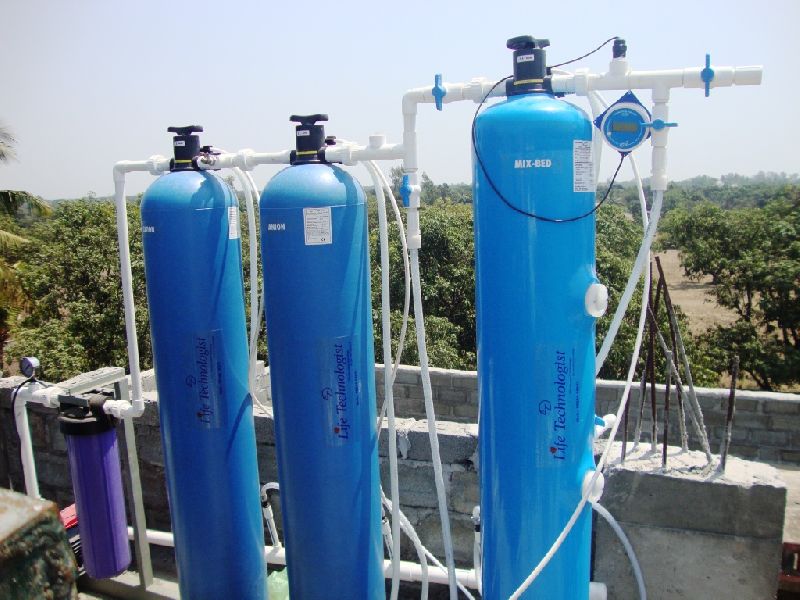
Demineralisationis the process of removing mineral salts from water by using the ion exchange process.
Demineralised water also known as De-ionised water. Deionisation is a physical process which usesion exchange resins which provides ion exchange site for the replacement of the mineral salts in water with water forming H+ and OH- ions. Because the majority of water impurities are dissolved salts, deionisation produces a high purity water that is generally similar to distilled water, and this process is quick and without scale build up.
De-mineralization technology is the proven process for treatment of water. A D.M. Water System produces mineral free water by operating on the principles of ion exchange, Degasification, and polishing. Demineralised Water System finds wide application in the field of steam, power, process, and cooling.
Principle :
Raw water is passed via two bed filled (ion exchange resins). While the cations get exchanged with hydrogen ions in first bed, the anions are exchanged with hydroxyl ions, in the second one.
Process :
Ion-exchange is a rapid and reversible process in which impure ions present in the water are replaced by ions released by an ion-exchange resin. The impure ions are taken up by the resin, which must be periodically regenerated to restore it to the original ionic form.
Ion Exchange Resins :
There are two basic types of resin - cation-exchange and anion-exchange resins. Cation exchange resins will release Hydrogen (H+) ions or other positively charged ions in exchange for impurity cations present in the water. Anion exchange resins will release hydroxyl (OH-) ions or other negatively charged ions in exchange for impurity anions present in the water.
There are three ways in which ion-exchange technology can be used in water treatment and purification
1.Cation-exchange resins alone can be used to soften water by base exchange.
2.Anion-exchange resins alone can be used for organic adsorption or nitrate removal.
3.Andcombinations of cation-exchange and anion-exchange resins can be used to remove virtually all the ionic impurities present in the feed water, a process known as deionisation. Water deionizers purification process results in water of exceptionally high quality
De-Mineralisation / De-ionisation :
For many industrial applications, high-purity water is essentially free from ionic contaminants is required. Water of this quality can be produced by deionisation. The two most common types of deionization are :
Two-bed deionization
Mixed-bed deionization
Two bed de-ionisation :
The two-bed deionizer consists of two vessels - one containing a cation-exchange resin in the hydrogen (H+) form and the other containing an anion resin in the hydroxyl (OH-) form. Water flows through the cation column, whereupon all the cations are exchanged for hydrogen ions. The same principle applies when considering anion-exchange.
The de-cationised water then flows through the anion column. This time, all the negatively charged ions are exchanged for hydroxide ions which then combine with the hydrogen ions to form water (H2O).
Mix bed (MB) de-ionisation :
In mixed-bed deionizers the cation-exchange and anion-exchange resins are intimately mixed and contained in a single pressure vessel. The thorough mixture of cation-exchangers and anion-exchangers in a single column makes a mixed-bed deionizer equivalent to a lengthy series of two-bed plants. As a result, the water quality obtained from a mixed-bed deionizer is appreciably higher than that produced by a two-bedplant.
Although more efficient in purifying the incoming feed water, mixed-bed plants are more sensitive to impurities in the water supply and involve a more complicated regeneration process. Mixed-bed deionisers are normally used to polish the water to higher levels of purity after it has been initially treated by either a two-bed deionizer or a reverse osmosis unit.Mixed bed polishing produces a water with less than0.1micro Siemens per centimetreconductivity. With sophisticated design and appropriate resins, the conductivity of pure water (0.055micro Siemens per centimetre) can be achieved. Residual silica values can be as low as 1micro Siemens per centimetre
Feature
With 5 /10 /20 Micron PP Filter
With Sand / Carbon Filter
Heavy Duty Shell / Vessel
Proper Sampling Points.
With / With out Skid Mounted
Easy in operation
No skill man power required
Easy to relocate
Plug & Play System
Proven Technology.
High quality design and materials of construction built to last
Modular design capability for rapid mobilization and reduced field set-up cost
Low maintenance automated design and controls
Reduced environmental footprint low energy and chemical consumption
Fully customizable to a variety of water sources and customer requirements
Reliable
Sustainable
Economical
 M/S Life (M/S Life Technologist)
 31, "Center Point", B/H IDBI Bank, Nr.Mahavir Nagar, N.H.NO-8. GIDC, Char Rasta, -, Vapi, Gujarat - 396195
 Share us via