
My ExportersIndia

For Buyer

For Seller

For Help

Our Product / Services

  1. Transmitter Device 9 Products available
  2. Transducer 6 Products available
  3. Measuring Instruments & Equipment 5 Products available
  4. Level Switches 5 Products available
  5. Sensors 3 Products available
  6. Measurement Gauges & Fittings 3 Products available
  7. Calibration Services 3 Services available
  8. Flow Meters 2 Products available
  9. Limit Controller 2 Products available
  10. Level Transmitters 2 Products available
  11. Commissioning Services 1 Services available
  12. Pressure Switches 1 Products available
  13. Hydraulic And Pneumatic Machines 1 Products available
  14. Optical & Laser Instruments 1 Products available
  15. Power Converter 1 Products available
  16. Process Controllers 1 Products available
  17. Testing Equipments 1 Products available
  18. Scanners 1 Products available
  19. Gas Analyzers 1 Products available
  20. Limit Switches 1 Products available
  21. GPS, Navigation & Tracking Devices 1 Products available
  22. Hydraulic Manifold Block 1 Products available
  23. Industrial Valves 1 Products available
  24. Electric Fittings And Components 1 Products available
  25. Others Products / Services 3 Products / Services available

Measurement Gauges & Fittings

We are leaders in the market for providing best range of Temperature Gauges, Pressure Gauge and Pressure Gauges

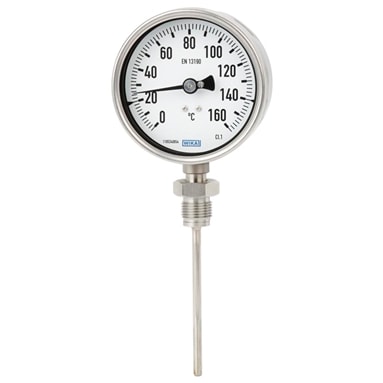
Temperature Gauges

  • Min. Order (MOQ) 10 Piece(s)
  • Number Of Flower Mechanical
  • Packaging Type Packed in corrugated boxes
  • Applications Chemical, petrochemical industry

Description :

  • This series of thermometers is designed for installation in pipes, tanks, plants and machinery.
  • Stem and case are made of stainless steel. To allow fitting to the process, different insertion lengths and process connections are available.
  • Through the high ingress protection of the thermometer (IP 65) and its liquid damping, operation under high vibration conditions is possible.


Special Features :

  • Application ranges from -70 .+600 oC
  • 6 different connection designs selectable
  • Case and stem material stainless steel


Applications :

  • Chemical, petrochemical industry
  • Power engineering
  • Machine buildung and general plant construction
  • Food industry

PDF


Download Detail File : Click Here

PDF


Download Detail File : Click Here
View Complete Details

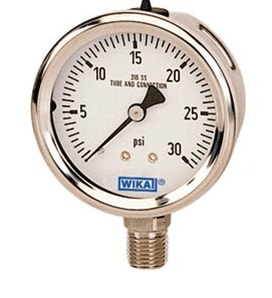
Pressure Gauge

  • Min. Order (MOQ) 100 Piece(s)
  • Material Metal
  • Packaging Type Packed in corrugated boxes
  • Condition New

When selecting a pressure gauge, it is important to consider the following factors to ensure safety and accuracy :

  • Pressure fluid composition
  • Pressure fluid temperature
  • Ambient conditions
  • Pressure range
  • Conditions affecting wear of the system
  • Method of mounting
  • Required accuracy


Details :

  • Pressure fluid composition Since the sensing element of a pressure gauge may be exposed directly to the measured medium, consider the characteristics of this medium. It may be corrosive, it may solidify at various temperatures or it may contain solids that will leave deposits inside the sensing element. For pressure fluids that will not solidify under normal conditions or leave deposits, a Bourdon tube gauge is acceptable. Otherwise a Sealgauge or diaphragm seal should be used. A chemical compatibility chart follows this section to aid in the selection of the proper sensing element material.
  • Pressure fluid temperature Steam and other hot media may raise the temperature of the gauge components above safe working limits of the sealed joints. In these cases it is recommended that a siphon, cooling tower or diaphragm seal be used in conjunction with the pressure gauge.
  • Ambient conditions The normal ambient temperature range for WIKA pressure gauges is -40o F to +140o F (-40o C to +60o C) for dry or silicone-filled gauges and -4o F to +140o F (-20o C to +60o C) for glycerine-filled gauges. The error caused by temperature changes is +0.3% or -0.3% per 18o F rise or fall, respectively. The reference temperature is 70o F (20o C). The correction is for the temperature of the gauge, not the temperature of the measured medium. Remote gauge mounting using a diaphragm seal and capillary line is one alternative for applications involving extreme ambient temperature. Moisture and weather effects must also be considered. Liquid-filled gauges prevent condensation build up. For outdoor use, stainless steel, brass or plastic cased gauges are recommended.
  • Pressure range A gauge range of twice the working pressure is generally selected. The working pressure in all cases should be limited to 75% of the gauge range. Where alternating pressure and pulsation are encountered, working pressure should be limited to 2/3 of the gauge range.
  • Conditions affecting wear of the system In applications involving severe pressure fluctuation or pulsation, the use of restrictors and/or snubbers is recommended. In addition, liquid-filled gauges increase the service life of gauges in these conditions. WIKA liquidfilled gauges are generally filled with glycerine. Silicone for larger temperature extremes and Halocarbon® for use with oxidizing agents such as chlorine, oxygen and hydrogen peroxide are also available.
  • Method of mounting Radial (LM) and back (CBM or LBM) connections are available for most WIKA gauges. WIKA stocks gauges with standard NPT threaded connections. Other types such as metric threads, straight threads, hose barbs and special fittings are available as a special order. Pressure gauges should be mounted in the upright position. For applications where the gauge is mounted side ways, horizontally or upside down, contact WIKA Customer Service for gauge type compatibility.
  • Required accuracy WIKA stocks gauges with accuracies from ± 3/2/3% to ±0.1% of span (ASME Grade B to Grade 4A). To ensure safe and accurate gauge selection, you must take all of the above factors into consideration.
View Complete Details

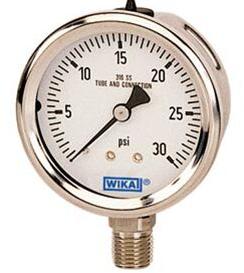
Pressure Gauges

Selecting a pressure gauge when selecting a pressure gauge, it is important to consider the following factors to ensure safety and accuracy: 1. Pressure fluid composition 2. Pressure fluid temperature 3. Ambient conditions 4. Pressure range 5. Conditions affecting wear of the system 6. Method of mounting 7. Required accuracy
View Complete Details
Tell Us What are you looking for? Will call you back

Contact Us