 Mobile Email
 5.0/5
5.0/5Our Product / Services
Our offered Product range includes Systematic Withdrawal Plan Services, Sip Investment Service, National Pension System Service and Lumpsum Investment Plan Service.


What is SWP (Systematic Withdrawal Plan)?
When it comes to liquidating mutual funds, most investors tend to either redeem all the units or simply just a part of their holdings. However, there’s another redemption method that many investors are not aware of - SWP or Systematic Withdrawal Plan. Wondering what the meaning of the Systematic Withdrawal Plan is? Here’s a comprehensive guide explaining the concept, how it works and the various advantages it offers.
What Is SWP in a Mutual Fund?
Systematic Withdrawal Plan (SWP) is a unique mutual fund redemption method that allows you to withdraw a fixed predetermined amount at specified intervals. Think of it as a Systematic Investment Plan (SIP) but for mutual fund redemption. Investors often use SWP as a way to receive regular income from their mutual fund investments without redeeming them entirely.
How Does a SWP Work?
Now that you’re aware of what SWP in a mutual fund means, let’s try to understand how it works with the help of a hypothetical example.
Assume you invested a lump sum amount of Rs. 5 lakhs in an equity-oriented mutual fund 5 years ago. Currently, the value of your investment is Rs. 7 lakhs. Since you wish to create a steady income stream from your mutual fund investment, you decide to set up a Systematic Withdrawal Plan where you withdraw Rs. 20, 000 each month until you completely redeem all of your mutual fund units.
On the first day of each month, the SWP determines the number of units that need to be redeemed to fulfill your withdrawal request. The number of units to be redeemed is determined by dividing Rs. 20, 000 by the Net Asset Value (NAV) of the mutual fund on the first day of each month.
Now, if the NAV of the fund is Rs. 200 on the first day of a month. The SWP will redeem 100 units (Rs. 20, 000 ÷ Rs. 200). And if the NAV of the fund rises to Rs. 205 in the subsequent month, the Systematic Withdrawal Plan will redeem 98 units. This process is repeated each month until there are sufficient mutual fund units to redeem.
Who Should Consider SWPs?
Systematic Withdrawal Plans can be particularly advantageous for the following category of investors.
Investors looking to create a steady stream of income to cover their living expenses.
Investors who wish to distribute their mutual fund investments to their beneficiaries in a systematic manner.
Investors who wish to save tax can use SWP to reduce their overall liability.
Investors with specific financial goals like funding a home purchase or their child’s education expenses.
Advantages of Systematic Withdrawal Plans
As an investor, you not only need to know the meaning of SWP in mutual funds but also be aware of its various benefits. Here’s a quick overview of some crucial benefits Systematic Withdrawal Plans offer.
Regular Income Stream By setting up a SWP, you can effectively create a consistent, predictable and regular income stream for yourself irrespective of how the market moves. If you’re fast approaching retirement or are simply looking to supplement your main source of income, opting for a Systematic Withdrawal Plan can be hugely beneficial.
Flexibility Another major benefit of SWP is that it is completely flexible and customizable. You get the freedom to choose the redemption amount and the frequency according to your requirements. Most mutual funds offer monthly, quarterly, semi-annual and annual withdrawal frequencies.
Tax Savings The gains from your mutual fund investments are subject to either long-term or short-term capital gains tax depending on how long you hold them for. In the case of long-term mutual fund investments, only gains above Rs. 1 lakh are taxed at 10%.
By setting up a Systematic Withdrawal Plan, you can ensure that the total amount of gains you get during a year is below the taxable threshold limit of Rs. 1 lakh. This will allow you to bypass long-term capital gains tax entirely. You don’t get such a benefit if you redeem all your mutual fund units at once.
Elimination of Market-Timing Timing the market can be very tough and risky due to the unpredictable nature of the stock market. Since Systematic Withdrawal Plans automatically redeem your mutual fund units at predetermined intervals, the need to time your market exit doesn’t arise.
What is SIP (Systematic Investment Plan) ?
Systematic Investment Plan, commonly known as SIP is an investing channel initiated by Mutual Funds, under which one can invest a fixed amount at predetermined time intervals in Mutual Fund Scheme. Such an amount is generally invested every month, but it could be invested once a week, once in a quarter, half-yearly, or even annually. The system of SIP can be easily understood as a recurring deposit under which a certain fixed amount is deposited on a specific date for a predetermined time period.

NPS INVESTMENT---
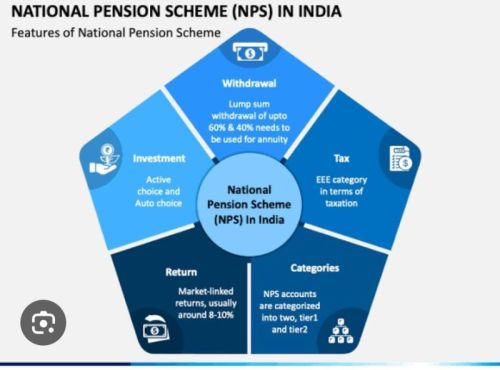
The National Pension System (NPS) is a retirement savings plan that allows individuals to contribute to their pension account while they are working. The goal is to build a pension fund that can provide a regular income after retirement.
Here are some things to know about NPS:
Eligibility
NPS is available to all Indian citizens between the ages of 18 and 70, including those living abroad. It is mandatory for Central Government employees who started working on or after January 1, 2004, with some exceptions. Many State Governments have also adopted NPS for their employees.
Contributions
Individuals can contribute to their NPS account, and their employer can also contribute on their behalf.
Account opening
When an individual opens an NPS account, they receive a unique Permanent Retirement Account Number (PRAN).
Withdrawals
Individuals can make partial withdrawals from their NPS account up to three times during the account's lifetime. They can withdraw up to 25% of their contributions at any time, excluding employer contributions.
Phased withdrawals
Subscribers can choose to withdraw their lump sum amount in phases over a period from age 60 to 75.
Tax efficiency
NPS is a tax-efficient way to save for retirement.
Risk tolerance
NPS may be a good option for people who are willing to take moderate risks and seek higher returns.
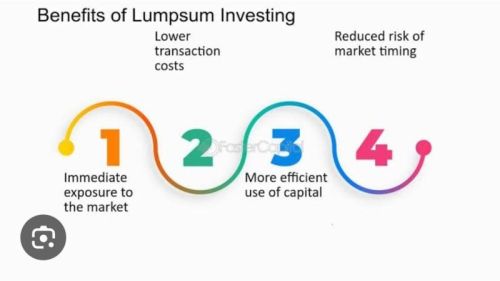
A lump sum investment in a mutual fund is when an investor invests a large amount of money in a single transaction. This is different from a Systematic Investment Plan (SIP), where an investor invests a fixed amount of money at regular intervals.
Lump sum investment Systematic Investment Plan (SIP) Investment strategy Invest a large amount of money at once Invest a fixed amount of money regularly When to consider When you have a large amount of money to invest, such as from an inheritance, bonus, or gift To build a corpus for retirement Suitability Ideal for long-term investment, and for investors who are comfortable with higher risk Helps avoid timing the market Lump sum investments are popular with big-ticket investors and HNIs. They can be a good way to take advantage of potential market growth, but they're not suitable for short-term investments.
You can use an online mutual fund lump sum calculator to estimate the returns on your investment.
 Mr.Nitin Shah(Majic Financial Distribution)
 B-202, Mukta Mahek Residency, 90 Ft Road, Thakur Complex, Kandivali East, Mumbai, Maharashtra - 400101, India
 Share us via