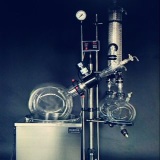
Arotary evaporatoris a device used in chemical industries &laboratories for the efficient and gentle removal of solventsfrom samples by evaporation.(rotavap/rotovap)
The main components of a rotary evaporator are:
- A motor unit that rotates the evaporation flask or vial containing the user's sample.
- a vapor duct that is the axis for sample rotation, and is a vacuum-tight conduit for the vapor being drawn off the sample.
- a vaccumsystem, to substantially reduce the pressure within the evaporator system.
- a heated fluid bath (generally water) to heat the sample.
- a condenserwith either a coil passing coolant, or a "cold finger" into which coolant mixtures such as dry ice and acetone are placed.
- a condensate-collecting flask at the bottom of the condenser, to catch the distilling solvent after it re-condenses.
- a mechanical or motorized mechanism to quickly lift the evaporation flask from the heating bath.
- Advanced frequency conversion and electronic speed regulation, to ensure stable operation of motor, and improve the evaporation and recovery rate.
- Height adjustable bath pan, and vacuum feeding, to reduce the damage of glass flask caused during rotation; ice-bath in the receiving flask during low-boiling-point evaporation, to reduce secondary evaporation.
- Due to the adoption of ball-milling port connection, the receiving flask can be easily assembled and disassembled, and can be sealed at high performance.
- Due to the adoption of high-temperature-resistant and corrosion-resistant long-acting precision sealing elements, the air tightness under the conditions of high temperature, high negative pressure and strong corrosion is ensured in the dynamic sealing process.
- The base plate, bath pan, main rod and crankshaft of the rotary evaporator are made of high-quality stainless steel; the rotary evaporator has attractive appearance and can resist to corrosion.
 Write a Review
 Mr. Bharat R Patel (MEET SCIENTIFIC WORKS)
 D/40 SARDAR INDUSTRIAL ESTATE, ROAD NO. 3, AJWA ROAD, VADODARA-390019, Gujarat
 Share us via