Write a Review
Our Products
Leading Manufacturer, Supplier & Retailer of Almond and Cashew.
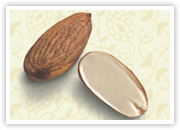
Almond is the name of the edible and widely cultivated nut of the tree of the genus Prunus. Although popularly referred to as a nut, the almond fruit's seed is botanically not a true nut, but the seed of a drupe (a botanic name for a type of fruit).
Almonds are the perfect combination of iron, copper, phosphorus & vitamin B1; this help in the formation of new blood cells & raises the hemoglobin levels in the blood. It maintains a smooth physiological function of the brain, nerves, bones, heart & liver. Almonds are scientifically proven to increase brain vitality & its protein content is an established muscle builder. The best method of consumption of this resourceful food for the mind & body; is simply have a portion of almonds with a glass of warm milk in the mornings.
Almond History Almonds are mentioned as far back in history as the Bible. They were a prized ingredient in breads served to Egypt's pharos. Their exact ancestry is unknown, but almonds are thought to have originated in China and Central Asia.
Explorers ate almonds while traveling the "Silk Road" between Asia and the Mediterranean. Before long, almond trees flourished in the Mediterranean, especially in Spain and Italy. The almond tree was brought to California from Spain in the mid-1700's by the Franciscan Padres. By the 1870's, research and cross-breeding developed several of today's prominent almond varieties.
By the turn of the 20th century, the almond industry was firmly established in the Sacramento and San Joaquin areas of California's great Central Valley. In the past 30 years, California's almond yield has quadrupled. More than 450, 000 acres in the lush San Joaquin and Sacramento valleys are under almond cultivation, stretching 400 miles between Bakersfield and Red Bluff, California.
Throughout history, almonds have maintained religious, ethnic and social significance. The Bible's "Book of Numbers" tells the story of Aaron's rod that blossomed and bore almonds, giving the almond the symbolism of divine approval.
The Romans showered newlyweds with almonds as a fertility charm. Today, Americans give guests at weddings a bag of sugared almonds, representing fertility, happiness, romance, good health and fortune. In Sweden, cinnamon-flavored rice pudding with an almond hidden inside is a Christmas custom. Find it, and good fortune is yours for a year.
Health Benefits The almond is one of the most versatile nuts in the world. It is delicious alone as a nutritious snack, and it is a prime ingredient in home kitchens and in food manufacturing. Almonds enhance virtually every food they grace with their distinctive taste and satisfying crunch.
A few health benefits are listed as under:
Almonds help in fighting diabetes and heart diseases: The presence of powerful nutrients like proteins, dietary fibre, mono unsaturated fatty acids (MUFA) and Vitamin E make almond a rich diet source for combating degenerative diseases such as diabetes and heart diseases.
Almonds are the best source of alpha-tocopherol form of Vitamin-E: Almonds are among the best whole food sources and the best nut source of alphatocepherol form of Vitamin E.
Almonds are a great cholestrol lowering food: Nearly 70 percent of the fat in almonds is mono saturated, a suggested substitute to saturated fats, to reduce the cholesterol levels. Research also shows that almond and almond oil have similar cholesterol-lowering effects.
Almonds can aid in cancer prevention: Two flavonoids in almonds (quercetin and kaempferol ) were found to be strong suppressors of lung and prostate tumor growth and these plant chemicals inhibited the tumor cell growth in culture in the studies at Pennsylvania State University. Flavonoids found in almonds also suppressed breast cancer cell growth when these cells have been exposed to cancer-causing agents as evident from other research findings.
You can avail of a selection of dry fruits, special mithai, dry fruit cake and dry fruit roast made from the choicest almonds from America for any occasion from the house of American Dry Fruits. Enjoy this healthy and delectable spread with family and friends.
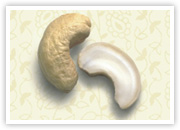
The cashew is a tree in the flowering plant family Anacardiaceae. The plant is native to northeastern Brazil. Its English name derives from the Portuguese name for the fruit of the cashew tree, caju, which in turn derives from the indigenous Tupi name, acaj. It is now widely grown in tropical climates for its cashew "nuts" and cashew apples.
The true fruit of the cashew tree is a kidney or boxing-glove shaped drupe that grows at the end of the pseudofruit. The drupe develops first on the tree, and then the peduncle expands into the pseudofruit. Within the true fruit is a single seed, the cashew nut. Although a nut in the culinary sense, in the botanical sense the fruit of the cashew is a seed.
Cashews have less fat than almonds, walnuts, peanuts & pecans. They are power food which has protein, fiber, potassium, magnesium, selenium, iron & zinc. When eaten in moderation, cashews are useful addition to a healthy diet. To enjoy its benefit at its best, store cashews in airtight containers.
Cashew History Cashews are native to equatorial South America. From there it migrated through the East Indies to India by the Portuguese in the late 16th century. From there cashews were introduced to Asia and Africa and later to Australia.
Cashew, a native of Eastern Brazil was introduced to India just as other commercial crops like rubber, coffee, tea etc. by the Portuguese nearly five centuries back. The first introduction of cashew in India was made in Goa from where it spread to other parts of the country. The commercial exploitation began from the early 60s, marginal lands and denuded forests were the areas set apart for the plantation development. Due to the absence of high yielding varieties and multiplication techniques, indiscript seeds and seedlings were used for planting purposes. Because of its adaptive ability in wide range of agro climatic conditions cashew has become a crop of high economy and attained the status of an export oriented commodity bringing considerable foreign exchange to the country.
Health Benefits Eaten in moderation, cashews are a useful addition to healthy diet.
Cashew helps maintain healthy gums and teeth.
Cashew is an energizing food.
Cashew contains healthy monounsaturated fat that promotes good cardiovascular health, because monounsaturated fats reduce high triglyceride levels which are associated with increased risk for heart disease.
Cashew is rich in antioxidants that help in the elimination of free radicals that may cause some cancer.
Cashew nuts have a high energy density and high amount of dietary fiber, both have been attributed to a beneficial effect on weight management, but only when eaten in moderation
Cashews high copper content is vital in energy production, greater flexibility in blood vessels, bones and joints.
Cashew nut consumption helps the body utilize iron, eliminate free radicals, develop bone and connective tissue, and produce the skin and hair pigment melanin.
Choose from a selection of dry fruits, special mithai, dry fruit cake and dry fruit roast made from the best graded Southern Indian cashews, for all festive occasions from American Dry Fruits. Enjoy this delectable spread with family and friends.
 MH Foods Pvt Ltd(MH foods pvt ltd)
 369 Dr D. N. Road, Flora Fountain, 400 001. ,Tel: +91-22-2204 1515 / 0404, Fort, Mumbai, Maharashtra
 Share us via