 Write a Review
Our Product / Services
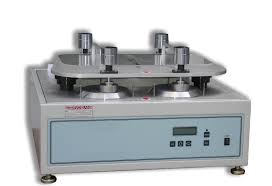
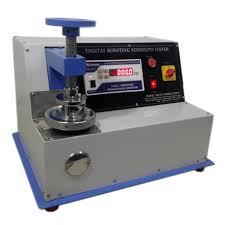
We offer a complete product range of Abrasion Tester, Bursting Strength Tester, Tensile Strength Tester, Cement Testing Equipment and Wide-Width Tensile Strength
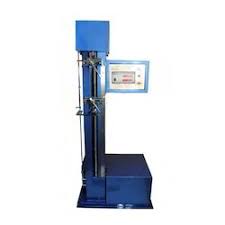
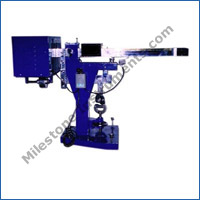
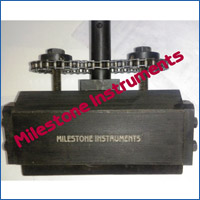
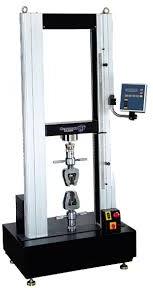
Two clamping systems 200 mm wide and 50 mm length in the direction of the applied force are mechanical wedge type and facilitate conducting Narrow Strip and Wide Width Tensile Strength tests as per many international specifications. These grips allow simple and rapid sample loading.
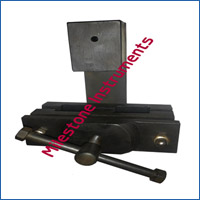
This test measures the ability of the geotextile to distribute concentrated loads. Specially devised clamps (25 mm wide) with a gauge length of 100 mm are placed across 200 mm square samples or 200 mm x100 mm samples. The sample is then subjected to tension at a specified rate until failure occurs. It is widely used by manufacturers as a quality control tool and as such is the most commonly reported tensile strength value. It can also be used for relative comparisons between geotextiles of the same type.
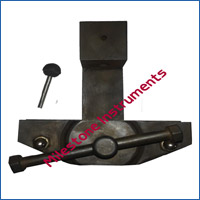
Geotextiles can be cut or punctured during field installation, which can create a possible condition by which strength is controlled by a tearing resistance. An outline of an isosceles trapezoid is marked on a rectangular specimen (150 mm x 75 mm) cut for the determination of tearing strength, (with a 6 to 9 mm cut) and the nonparallel sides of the trapezoid marked on the specimen are clamped in parallel jaws of the Tensile Testing System.
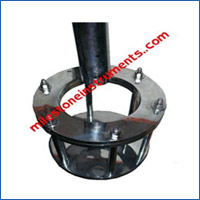
Fabric is clamped to give an inner diameter of 15 cm and a 50 mm CBR plunger is pushed centrally through a fabric at a specified rate. The load at failure is the push through load and when divided by the cross-sectional area of the plunger, gives CBR push through resistance.
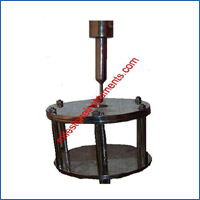
The geotextile specimen is clamped to obtain an inside dia of 44.45 mm and force is applied through an 8 mm dia plunger till failure. The puncture strength so obtained is felt to reflect the fabrics ability to withstand aggregate penetration.
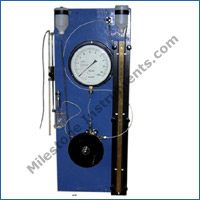
The pore pressure measuring apparatus consists of a screw pressure pump, null indicator in Perspex, pressure gauge, mercury manometer, volume change burette and the necessary connecting tubes and valves. It is used for measuring pore water pressure and pore air pressure in soils. It has many features, which simplify the operation. The Null Indicator is made from a transparent Perspex block. It is a simplified U-Tube Null Indicator, in which water can bypass mercury if null indicator is tilted; thus de-airing process by circulation of water is facilitated. All features enable a visual check to be made during the de-airing operation of apparatus. A mercury manometer and a pressure gauge of Bourdon Tube type are provided on the panel on which the whole equipment is mounted. Very small positive or negative pressures are observed on the manometer. A 50 ml burette is clamped to a sliding bracket on one side of the panel. It is used for measuring the volume change in the specimen when subjected to confining pressure in the triaxial cell The following models of Pore Pressure Apparatus are available: 1. Pore Pressure Apparatus, 1000 kPa (10 kg/cm2) Capacity The equipment consists of:
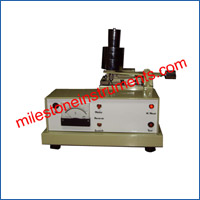
For determining the scratch hardness of ready mixed paints and enamels, which is the minimum load required to produce a scratch showing the bare metal surface of the painted panel. The apparatus consists of a 1mm dia hemispherical stainless steel needle, fixed to a platform of a counter- balanced rod, which is assembled on a grooved platform. A rack moves through the groove, to which a painted panel can be clamped. An indicator lamp is provided to indicate the metal contact if the Needle penetrates the paint surface to make contact with the metal. Complete with 1 kg weight. Suitable for operation of 230 V, 50 Hz, single phase, AC supply.
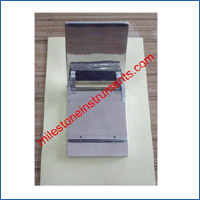
The paint film is bent through 180 over a 6.35 mm dia rod and examined for any damage, detachment or cracking of the film. The tester consists of two plates hinged at one end with the help of a 6.35 mm dia rod. A stop is provided on one plate against which the painted panel can be held. Complete with x10 magnifier.
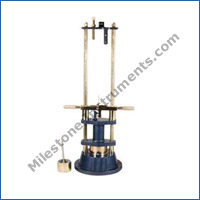
It is for determining the aggregate impact value and has been designed in accordance with IS: 2386 (Part 4), IS: 9377-1979. The sturdy construction consists of a base and support columns to form a rigid framework around the quick release trigger mechanism to ensure an effective free fall of the hammer during test. The free fall can be adjusted through 380 5 mm. The hammer is provided with a locking arrangement. Following model of Aggregate Impact Value Apparatus is available:
 Pankaj Kuma (Milestone Instruments)
 WZ-8 Dayal Sar Colony Uttam Nager, Uttam Nagar, Delhi - 110059, India
 Share us via