 Write a Review
Our Products
We offer the best product range of Anchor Bolts, U-bolt and Stud and U Bolts.
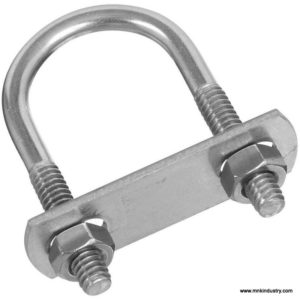
Anchor boltis a fastenerused to attach objects or structures to concrete. These are many types consisting of designs that are mostly proprietary to the manufacturing companies. All consist of a threaded end, to which a nut and washer can be attached to the external load.Theyare extensively used on all types of projects, from standard buildings to dams and nuclear power plants. They can also be used to firmly affix embed plates to a concrete foundation when used with a structural steel element.
The simplestanchor boltis a cast-in-place anchor. There are designs, some consisting of a bent bolt with a hook on the end, or some other sorts of bending like V, U, J, L. Cast-in-placeanchor boltsare the strongest type of fastener, but the casting is difficult, and they are usually only used for heavy machines mounted on poured concrete floors. Another use is to connect the concrete foundation of a building to its wall. With this, the building is more resistant to earthquakes. Currently, there are several devices to assist in holding and in placinganchor boltto set in the concrete.
A concrete nervous is another way of attaching things to concrete that has already been poured and set.
Function Of Anchor Bolt:-Thecharacteristicof anchor bolts is totransfermassesto the masonry from attachmentsinclusive ofledges, sills, and bearing plates. Bothshear andanxietyare transferredviaanchor boltsto resistlayoutforceswhich includeupliftdue tothe windon the pinnacleof a column or wall or vertical gravityhundredson ledgers supportingjoists or trusses. Thesignificanceofthoseloadsvariessignificantlywith theutility
All wide range of foundation bolts is manufactured by us in a wide range of sizes and in zinc, nickel and powder coating as required by the customer.
How to install Anchor Bolt??Keepthe anchor bolt and templatemeetingrigidly infunctionthroughoutthe concreteplacement. Usetimbertemplates or another positive waytomake certainaccuratepositioning of anchor bolts.
Anchor Bolt Tighteningsystem: Tighten anchor bolts forsite visitorssignpoles, roadwayillumination poles with shoe bases, excessivemast illumination poles, and overheadsignassist
structures.
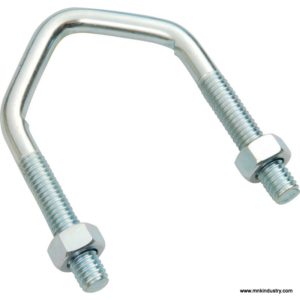
It is a bolt in the shape of theletter Uwith threading for screw on both the ends.
U-bolts have been used basically to support pipework, pipes through which fluids and gasses pass. As such, U-bolts were measured using pipe-work engineering speak. It described by the size of pipe it was supporting. They are also used to hold ropes together.
Thenominal boreof a pipe is actually a measurement of the inside diameter of the pipe. Engineers are interested in this because they design a pipe by the amount of fluid/gas it can transport.
As U-bolts are now being used by a much wider audience to clamp any kind of tubing / round bar, then a more convenient measurement system needs to be used.
Four elements uniquely define any U-bolt:
 Mnk Industry (mnk industry)
 5A Industrial Area, Phase 1, Mohkam Pur, (U.P) ., Meerut, Uttar Pradesh
 Share us via








