 GST : 19AADCK9121A1ZU
 Write a Review
Our Products
We offer a complete product range of Geogrids, Geomembranes, Non Woven Geotextiles and Coir Geocells
Introduction:
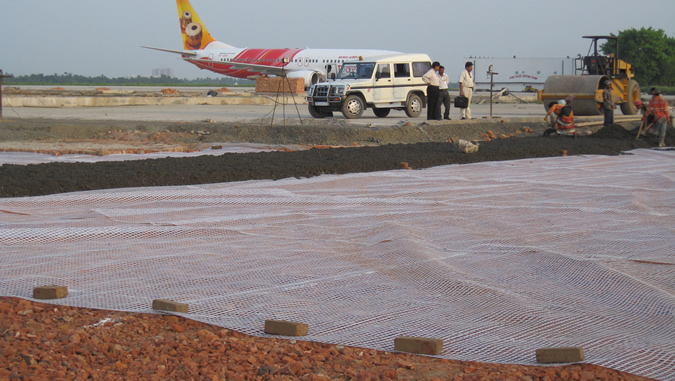
Geogrids are polymeric products formed by joining intersecting ribs. They have large open spaces known as "apertures". The directions of the ribs are referred to as machine direction (md), orientated in the direction of the manufacturing process or cross machine direction (cmd) perpendicular to the machine direction ribs. Geogrids are mainly made from polymeric materials, typically polypropylene (PP), high density polyethylene (HDPE) and polyester (PET). Geogrids are manufactured as either biaxial or uniaxial. Biaxial geogrids are those that exhibit the same strength in both the machine and cross machine directions while uniaxial geogrids exhibit the primary strength in the machine direction with minimal strength, enough to maintain the aperture structure, in the cross machine direction.
Function of Geogrid:
Basic function of Geogrid is soil reinforcement. Geogrids work by interlocking with the granular or soil material placed over them.
Reinforcement:
The mechanical properties of Geogrids, make them ideal for reinforcing slopes and other soil structures.
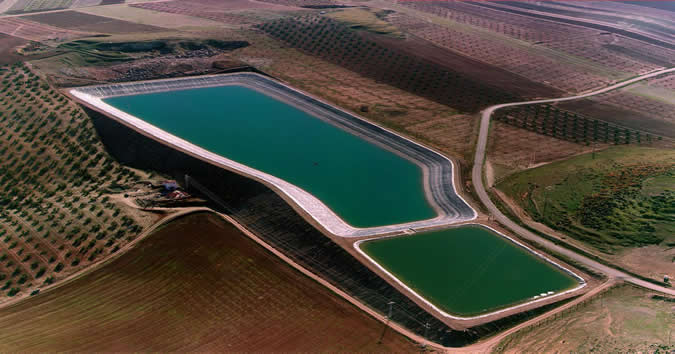
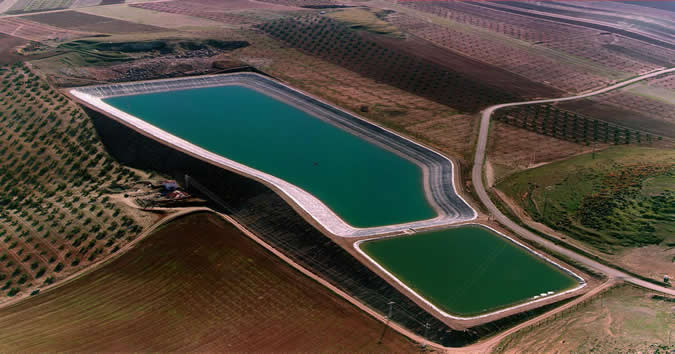
Geomembranes are manufactured using high density polyethylene (HDPE). These are of various thicknesses and with either smooth or textured surfaces (for steeper slopes). The product is suitable for sealing landfill caps and base liners, secondary containment, potable water and non-toxic containment applications such as water conveyance structures, canals or ponds.
Introduction:Non-Woven Geotextile are needle punched fabrics made from polypropylene. The dry laid needle punch technology is based on a two step process. Firstly, polypropylene resin is extruded into fibres. Secondly, the fibres are carded and needlepunched. Finally, some types are added thermal treatment. Weights range from 100 g/m2 up to 1200 g/m2.
Functions of Non-Woven Geotextile:
Primary Functions:
Separation
The durability and mechanical properties of Non-Woven Geotextiles make them ideal as separating layers in construction works.
Filtration
The characteristic opening size of Non-Woven Geotextiles is designed to retain particles while allowing free movement of water, making it possible to separate two layers during intense hydraulic activity.
Protection
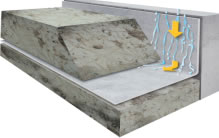
When placing a Non-Woven Geotextile on both sides of a waterproof membrane, the thickness and strength of the geotextile protect the membrane from puncture.
Secondary Function:
Drainage
Excess water is drained off the construction - not by passing through the Non-Woven Geotextile as when used for filtration - but by flowing in the plane of the geotextile leading it away from the construction.
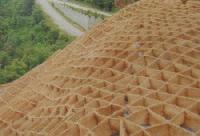
On steep barren slopes it is difficult to place top soil. CoirGeo-cell is 15cm wideband of tightly woven coir geo-textile bound in a honeycomb cell like structure. They are laid on steep slopes using steel pins or natural. The honey comb shaped structure can then be filled with soil and saplings planted in them.
Applications:
Technical Specification
| Products | Ht. of cell (cm) | Nominal Width of Cell (cm) | Length of installed panel (m) | Width of installed panel (m) | Application area | Water Flow (m/sec) |
|---|---|---|---|---|---|---|
| FCG-1 | 15 | 40x40 | 3.6 | 9 | Up to 60° slope, Slope length up to 25m, | 4 to 6 |
 Mr. Ketan Shah (K K Enviro Tech Pvt Ltd)
 8, Townshend Rd, Bakul Bagan, Bhowanipore, Kolkata, West Bengal - 700025, India
 Share us via