Write a Review
Our Products
We offer a complete product range of Thermoplastic Elastomeric Water Stop Seal and Metal Water Stop Seal
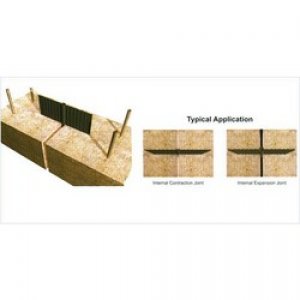
Use of Thermoplastic Elastomeric (TPE) water stops made of Poly Vinyl Chloride blended with Nitrile Butadiene Rubber is commonly recommended by engineers and architects for a variety of water applications and chemical environments. These water stops function as a watertight and fluid tight diaphragm in concrete structures. TPE water stops when installed in concrete structures develop excellent mechanical bonding with the structure and work as an effective barrier against the flow of water and other fluids through the joints.
Maruti TPE water stops have great resistance to a variety of fluids, oils, minerals, solvents, acids, glycols, alkalis, fuels, chlorinated sea water and other aggressive chemicals. Maruti TPE water stop also has high resistance to ozone and oxidation processes. The water stops have excellent staining resistance and ageing properties, and display good reliance and compression set resistance properties at very low temperatures of up to -32 C.
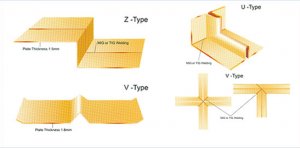
Copper or Metal Water Stop Seal is most often used in heavy structures where joints require extra protection. Copper is highly ductile metal and hence best suited for such joints. Copper water stops come in a variety of shapes and sizes but the ones having the thickness of 1.5 mm or 1.8 mm are most commonly used in heavy structures. You need to properly fabricate the water stop splices in the structure to get the best results for a foolproof fluid tight system.
For an effective fluid tight system, you need to have proper water splices and should also take into consideration the changes in direction; intersections etc. You also need to take into account the effect of butting straight lengths. You need to ensure that the copper water stop is continuous throughout the extension of the joint. Water stop should be positioned to cover the entire area of V or Z expansion zones. Water stop should be firmly secure and installed in the structure to minimize the chances of displacement during the filling of concrete in the structure. Since it is not easy to fabricate metallic water stops to continuous lengths of the joints, they are usually not recommended by the engineers and the architects.
 Mr. Aakarshan Jain (manager) (Namokar Enterprises)
 4056/202 Ajmeri Gate, Delhi-110006, India, Mori Gate
 Share us via