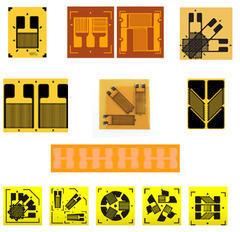
Strain gaugesused to apply electrical measurementtechniques to the measurement of mechanical quantities. As theirname indicates, they are used for the measurement of strain. As atechnical term, strain is comprised of tensile and compressive strain, distinguished by a positive or negative sign. Thus, strain gauges can beused to detect expansion as well as contraction.The strain of a body is always caused by an external influence or aninternal effect. Strain can be caused by forces, pressures, moments, heat, structural changes of the material and the like. If certainconditions are fulfilled, the amount or the value of the influencingquantity can be derived from the measured strain value. Inexperimental stress analysis, this feature is widely exploited.Experimental stress analysis uses the strain values measured on thesurface of a specimen or structural part to determine the stress in thematerial and also to predict its safety and endurance. Specialtransducers can be designed for the measurement of forces or otherderived quantities, e.g., moments, pressures, accelerations, displacements, vibrations and others. The transducer generallycontains a pressure-sensitive diaphragm with strain gauges bonded to it.Prime strain gaugeselectionconsiderationsgauge lengthnumber of gauges in gauge patternarrangement of gauges in gauge patterngrid resistancestrain-sensitive alloycarrier materialgauge width

 GST : 08ECQPS0564D1ZA
 Write a Review

 Naveen Kumar (National Instrument & Engineering)
 F2,172,21 South, Jhotwara, Jaipur, Rajasthan - 302012, India
 Share us via









