Write a Review
Our Products
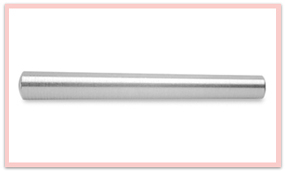
We offer a complete product range of Spring Dowel Pin, Taper Pins, Groove Pin, Split Pin and Cotter Pins
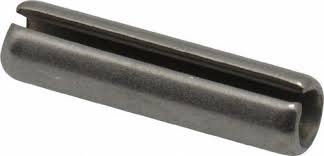
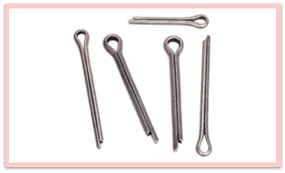
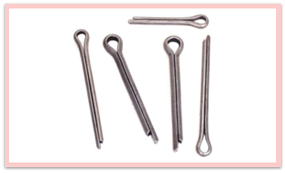
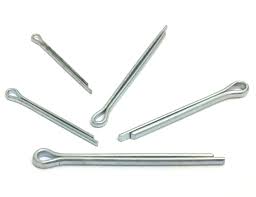
A cotter pin, as a split pin or cotter key is a metal fastener with two tines that are bent during installation, similar to a staple or rivet. Typically made of thick wire with a half-circular cross section, split pins come in multiple sizes and types.
There are signs that manufacturers and stockiest are increasingly listing both names cotter pin and split pin together to avoid confusion; this led to the term split cotter sometimes being used for a split pin. We manufacture cotter-pins in 5/64 to 5/8" & 2 to 16mm diameter.
We also manufacture cotter-pins in BRASS, COPPER, BRONZE, AND STAINLESS STEEL materials as well as per standards DIN 94, ISO 1234 , BS 1574, etc.
Available Material :
Application:Split pins are frequently used to secure other fasteners, e.g. clevis pins. A common application of this is when used to secure a castellated nut.
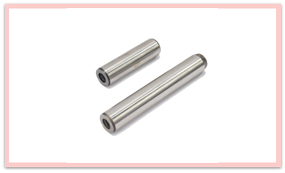
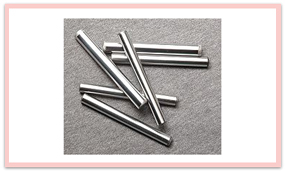
Hardened and precisely shaped NAZARETH Dowel pins are used to retain machine components in accurate alignment; They are also used as location guides for adjacent machine parts to join different components together and to keep the two sections of a punch and die in accurate alignment.
Our Dowel pins are mostly used for precise locating applications. They are ground to close tolerances, so that they perfectly fit in corresponding holes that are ideally reamed. A dowel pin may have a loose sliding fit, or a tight interference fit depending on the application.
In automobiles, dowels are used for precise location and alignment as in engines, differential gear casings and transmissions, etc.
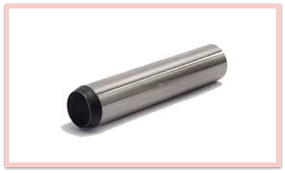
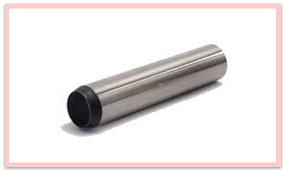
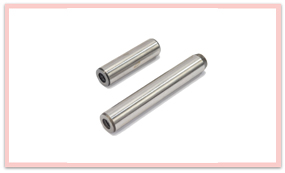
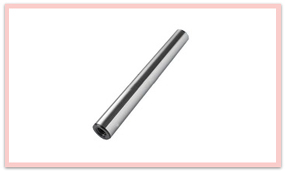
Cylindrical (Dowel) or Parallel pins are used either to retain parts in a fixed position or to preserve alignment. A few of them are illustrated above. Type A, B, C & D are unhardened and from C-40 (EN-8) material.Our manufacturing range for Cylindrical (Dowel) Pins is 2mm to 25 mm in diameter and 5 mm to 150 mm in length.Type E is hardened from Silver Steel material.
Interal Threaded Cylindrical (Dowel) Pin are for easy extraction, from blind holes. They are manufactured in soft condition (Type G) from C-40 material. Hardened Pins (Type F) are manufactured from case hardened alloy steel or as per buyers requirement. Air Vent may be Provided.

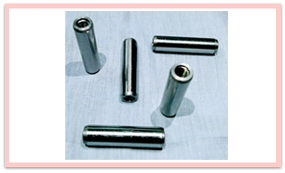
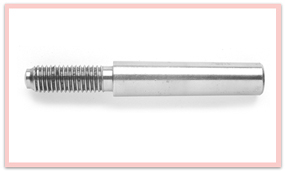
Internal / External Threaded Taper Pins are used for extraction of the pins more conveniently especially from blind holes. They are also used in very accurate constructed tools and gauges which have to be kept in absolute alignment. External & Internal Threaded Taper Pins are made and supplied in unhardened condition DIN 7977 & 7978 Ext. Thread Taper Pins can also be manufactured to DIN ? 258, ISO : 8736 or ISO : 8737 and to Customers Specifications.
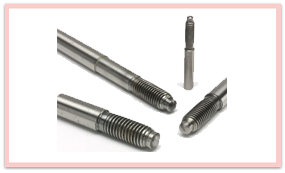
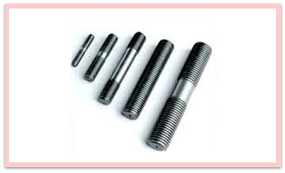
Continuous-thread studs are threaded from end to end and are often used for flange bolting with two nuts applied. Tap-end studs have a short thread on one end, called the tap end. Double-end studs have equal-length threads on each end to accommodate a nut.
Type :
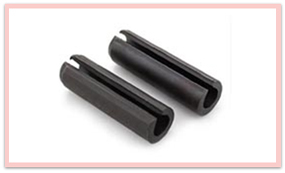
Spring dowel pins are slotted pin made from high carbon spring steel material. They can also be manufactured from stainless steel material. Spring Dowel pin is accurately made to diameter greater than the drilled hole into which it is pressed. When inserted the elasticity of the material then exerting a continuous radial force over the full length of the pin. The purpose of the slot in the pins is to allow compression when inserted in the hole
A Spring Dowel pin is the most economical, quick, simple and easy fastening system, which is particularly suitable for bulk production.
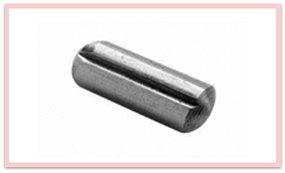
Grooved pins are non-threaded press fit fasteners a fastener that is pressed into an appropriate sized hole, providing the proper interference fit to lock the fastener in place. It is Commonly used as locking devices, pivots, bearing faces or locating elements where there is not a high degree of end load.It is available with many different groove types.
Typically zinc-plated, made from unhardened, low-carbon steel but available in a wide range of finishes and heat treatments for shear resistance.The groove of a grooved pin is formed by a swaging operation in which three tools penetrate the nominal diameter of the metal at 120 intervals. This penetration displaces a controlled amount of metal to each side of the grooving tool, forming a raised portion along the side of each groove.
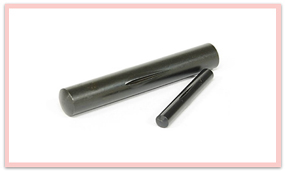
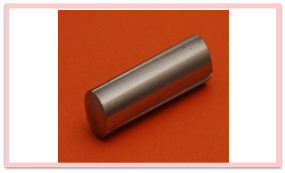
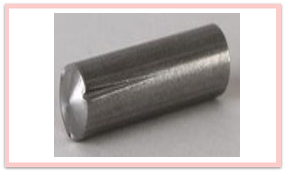
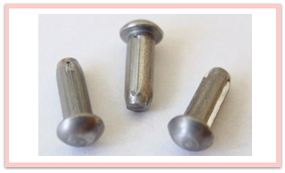
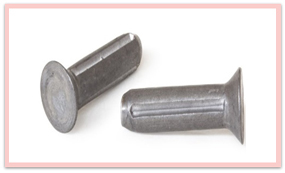
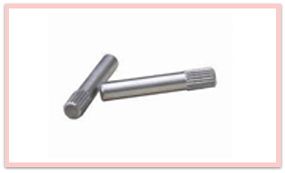
Knurled Pins are similar to grooved pins that have serrations around the diameter. However, knurled pins feature many more serrations. They are press fit fasteners that, when compressed into a hole, extrude radial forces to hold the fastener in place.
The best fastener for die casting and plastic application; superior fastening in the assembly of components which have thin cross sections and for formed sheet metal hinges.
Available with straight, helical or diamond knurling Knurled pins are similar to grooved pins because they have serration around the nominal diameter of the pin. The knurled pin differs from the grooved pin while there are many serrations on a knurled pin. Also, knurled pins are typically roll formed whereas grooved pins are swaged. A knurled section may have either a straight knurl, a helical knurl, or a diamond knurl configuration.
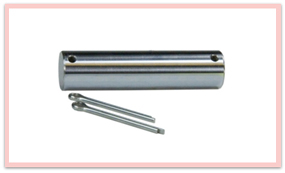
A clevis fastener is a three-piece fastener system consisting of a clevis, clevis pin, and tang. The clevis is a U-shaped piece that has holes at the end of the prongs to accept the clevis pin. The clevis pin is similar to a bolt, but is only partially threaded or unthreaded with a cross-hole for a split pin. The tang is a piece that fits in the space within the clevis and is held in place by the clevis pin.
The combination of a simple clevis fitted with a pin is commonly called a shackle, although a clevis and pin is only one of the many forms a shackle may take. Clevises are used in a wide variety of fasteners used in farming equipment and sailboat rigging, as well as the automotive, aircraft and construction industries. They are also widely used to attach control surfaces and other accessories to servo controls in airworthy model aircraft. As a part of a fastener, a clevis provides a method of allowing rotation in some axes while restricting rotation in others. There are two main types of clevis pins: threaded and unthreaded.
Unthreaded clevis pins have a domed head at one end and a cross-hole at the other end. A cotter pin (USA usage) or split pin is used to keep the clevis pin in place. Threaded clevis pins have a partially threaded shank on one end and a formed head on the other. The formed head has a lip, which acts as a stop when threading the pin into the shackle, and a flattened tab with a cross-hole. The flattened tab allows for easy installation of the pin and the cross-hole allows the pin to be moused. A bolt can function as a clevis pin, but a bolt is not intended to take the lateral stress that a clevis pin must handle. Normal bolts are manufactured to handle tension loads, whereas clevis pins and bolts are designed to withstand shearing forces.
Clevis pins should be closely fitted to the holes in the clevis to limit wear and reduce the failure rate
Product DescriptionThere are two main types of clevis pins: with head and without head. Headed clevis pins have a head at one end and cross - hole at the other end.
A cotter Pin or Split pin is used to keep the clevis pin in place.
Clevis Pin offers more flexibility and rotation than other fastners .
It is mostly used for railway application and also in farm equipments , ships etc
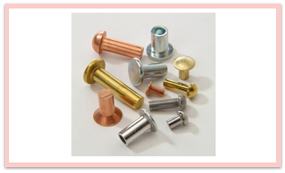
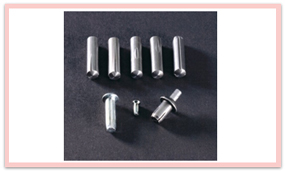
A rivet is a permanent mechanical fastener. Before being installed, a rivet consists of a smooth cylindrical shaft with a head on one end. The end opposite the head is called the tail. On installation the rivet is placed in a punched or drilled hole, and the tailis upset, or bucked (i.e., deformed), so that it expands to about 1.5 times the original shaft diameter, holding the rivet in place. To distinguish betweenthe two ends of the rivet, the original head is called the factory head and the deformed end is called the shophead or buck-tail.
Because there is effectively a head on each end of an installed rivet, it can support tension loads (loads parallel to the axis of the shaft); however, it is much more capable of supporting shear loads (loads perpendicular to the axis of the shaft). Bolts and screws are better suited for tension applications.
Fastenings used in traditional wooden boat building, such as copper nails and clinch bolts, work on the same principle as the rivet but were in use long before the term rivet was introduced and, where they are remembered, are usually classified among nails and bolts respectively.
 Norbert Felix Nazareth (Nazareth Industrial Products)
 A/78, New Empire Indl Estate, Kondivita Road, J.B.Nagar, Andheri (E), Mumbai - 400059, Maharashtra., Andheri East
 Share us via