Write a Review
Our Products
We offer a complete product range of Polypropylene Sheet & Rod
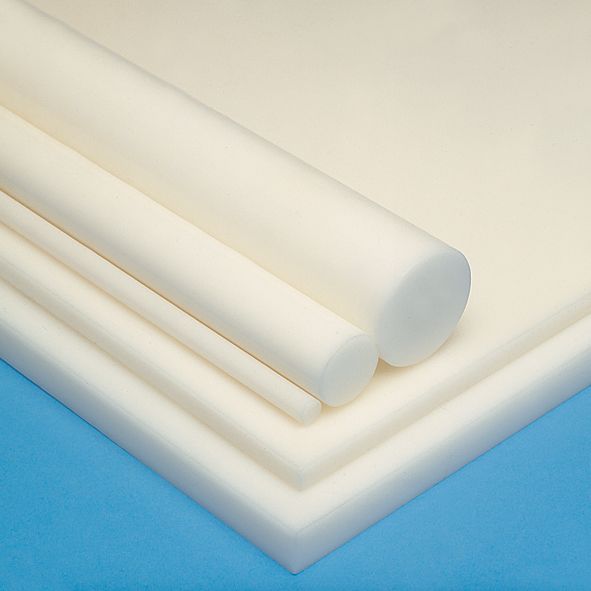
POLYPROPYLENE (PP) SHEET & RODPolypropylene is a thermoplastic made by the polymerization of propylene gas, a by-product of petroleum refining. Various techniques can alter the physical, chemical or mechanical properties of polypropylene.Changes in the way the material is polymerized can show dramatic improvements in certain mechanical properties; example, random copolymers block copolymers.Copolymerization of an additional resin group can enhance physical properties. Addition of fillers can improve mechanical or thermal stability.Homopolymer polypropylene is a light density (.91-.92 gm/cm3) thermoplastic. It can be stabilized to enhance prolonged use at elevated temperatures, prolonged life in exposure to ultra-violet light and improved flame retardancy.Polypropylene fabricates with standard woodworking tooling. It can be butt welded, extrusion welded, fusion welded, and spun welded. It can be machined with ordinary wood or metalworking equipment.Polypropylene offers a good balance of thermal, chemical and electrical properties with moderate strength. It is a good strength to weight ratio. Because it has such a hard, high gloss surface, polypropylene is ideally suited to environments where there is concern for bacteria build up or build up that can interfere with flow.Polypropylene has good insulating properties, but dielectric strength shows some degree of change at elevated temperatures. Excellent track, arc resistance and dielectric strength allows polypropylene to be used extensively in electrical applications. It can also be modified to be conductive or antistatic.As a homopolymer, polypropylene uses temperatures in the range of 30 to 210F depending on specific chemistry; copolymers in the range of -20 to 180F.Resistance to chemicals and solvents is very good. It has good resistance to aqueous salts, acids or alkaline solutions. It also has very low permeability to water vapor and gases. Because of its excellent resistance to solvents, it finds extensive use in the semi-conductor industry. It performs well in the presence of DI water. Care must be taken when in the presence of active oxidizing agents, especially with fabricated parts. Numerous chemical resistance charts are based solely on press molded plaques and don't take fabricated parts into consideration. The resins are attacked, however, by halogens, fuming nitric acid and other active oxidizing agents, and by aromatic and chlorinated hydrocarbons at high temperatures.Polypropylene can be used in direct contact with foods.It can be processed via extrusion, injection molding, blow molding, compression molding, and rotational molding. It is extremely stable and relatively easy to process.It is available in various forms such as, but not limited to, films, sheets, blocks, pipes, hollow tubes, round rods, square rods, profiles, fittings and valves.Nonstandard shapes are possible through pressure, thermo or vacuum forming.Great care should be used in designing with polypropylene, taking into consideration its coefficient of thermal expansion, modulus of elasticity, and its compressive strength.
 P&D ENGINEERS PVT LTD (P&D ENGINEERS PVT LTD)
 P&D ENGINEERS PVT LTD
17 - Prarthana Estate, Nr. Shakriba Party Plot, C.T.M, - 380026 , , Ctm, Ahmedabad, Gujarat
P&D ENGINEERS PVT LTD
17 - Prarthana Estate, Nr. Shakriba Party Plot, C.T.M, - 380026 , , Ctm, Ahmedabad, Gujarat Share us via