We are engaged in Manufacturing, Exporting and Supplying of well processed
Tanzanite Stone. Our Tanzanite Stone is free from all sorts of impurities and can be availed at market leading prices.
Tanzanite & Fancy Zoisite Gemstones Source : Tanzania (Tanzanite), Kenya (Zoisite: Anyolite), Norway (Zoisite: Thulite)
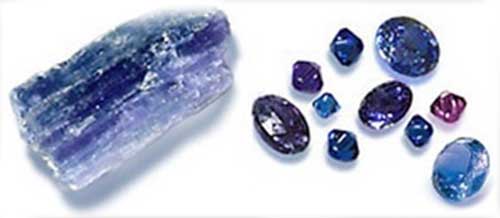
Birthstone : December (Alternate: Turquoise, Zircon) Tanzanite is a rare mineral only found in the Mererani, or 'Merelani hills' tanzanite mining area of Tanzania. Located in the Simanjiro district, the Merelani mining area is 16 kilometers south of the Kilimanjaro International Airport, and 70km south-east. To this day, the only source of Tanzanite in the world is this several square mile area in the Merelani Hills, and the limited supply makes Tanzanite 1, 000 times rarer than Diamonds. Tanzanite is a blueish-purple gemstone variety of the mineral zoisite, named after Siegmund Zois, Baron von Edelstein (1747-1819). Zoisite is a calcium aluminium hydroxy sorosilicate belonging to the epidote group of minerals. Tanzanite can sometimes be mistaken for blue sapphire, but tanzanite can have very pronounced pleochroism, which reflects different colors from different angles. Pleochroism is an optical phenomenon due to the double refraction of light which is divided into two "polarized" paths at a 90 angle to each other. When viewed from the top or front, tanzanite's hue will appear blue to violet-blue, and when viewed from the back it will appear violet to bluish-purple.
Tanzanite HistoryThis purple-blue variety of zoisite is a newly discovered gemstone who's name "Tanzanite" was established in 1968 by Henry Platt, the president of Tiffany & Co., after being introduced to the stone by John Saul of Swala Gem Traders in Tanzania. One year earlier on July 7th, 1967, an Arusha tailor named Manuel d'Souza (below, left - on left) was prospecting for gold in the region of Lake Victoria in Tanzania, when he discovered a transparent blue stone laying on the ground which he mistook for a sapphire. After testing the stone's hardness de Souza ruled out sapphire, and initially misidentified his discovery as the mineral olivine (peridot), and later as dumortierite. The correct identification of de Souza's discovery was soon made by Ian McCloud, a Tanzanian government geologist in Dodoma, with later confirmations from Harvard, the British Museum, and University of Heidelberg. Shortly after de Souza's discovery, he attempted to register his mining claim with the Tanzanian government Mines & Geology Department, but other prospectors had already registered zoisite mining claims before he gotten around to changing the name on his original claim registration. During this period another popular name for this variety of zoisite was "Skaiblu, " a Swahili-language interpretation of the English term "Sky Blue." It is rumored that German and Swiss gemstone dealers were anxious for a new name for this gemstone because the German pronunciation of "zoisite" sounded too similar to the English word "suicide" The entire area soon became covered in mines, and d'Souza was unable to maintain control over his mining claim. In 1971, the Tanzanian government took control of the mines and turned them over to the State Mining Corporation in 1976. Masai legend is that cattle herders first noticed this stone some 30 years previously, after a brush-fire caused by lightning burned large areas of the plains at the base of Mt. Kilimanjaro in Tanzania. The herders noticed that brown Zoisite crystals had turned a deep blue-purple due to the heat from the fire.
Tanzanite Mining in MereraniThere are four actively mined tanzanite areas or 'blocks, ' that are labeled A through D. The 'A block' and 'C block' were reserved for foreign investment, while B and D can be mined by ingenious locals. In 2005 a privately owned company named Tanzanite One Ltd. took control of Tanzania's largest tanzanite mine known as "C-Block" (above, right). The mine has already reached a depth of 1000 feet and there is growing concern that the supply of Tanzanite could be depleted in a few decades. The world's largest tanzanite crystal was found in TanzaniteOne's C-Block mine in 2005. The crystal weighed 16, 839 carats and measured 22 cm at its widest point.
Small-Scale (Wana-Apollo) Tanzanite MiningThe world's largest tanzanite crystal was found in TanzaniteOne's C-Block mine in 2005. The crystal weighed 16, 839 carats and measured 22 cm at it's widest point. There are 430 'plots' that can be mined in the remaining B and D blocks. These non-mechanized miners use daisy-chains of workers to hand excavate the mining shafts. Merelani Township is the tanzanite trading center for small-scale miners.
Tanzanite (Zoisite) Chemistry & Physical Properties - Crystal System - orthorhombic
- Crystal Habit - disphenoidal, bladed
- Specific gravity (SG) - 3.35
- Mohs Hardness Scale - 6.0 to 6.5
- Toughness - fair to poor
- Fracture - uneven to conchoidal
- Cleavage - perfect
- Streak - white
- Chemical Composition - Ca2Al3(SiO4)3(OH)
Tanzanite (Zoisite) Optical Properties - Optical Properties - doubly refractive
- Refractive Index - 1.69 - 1.70
- Birefringence - 0.009
- Pleochroism - strong, dichroism or trichroism (depending on color)
- Surface Luster - vitreous
- Diaphaneity - transparent, translucent
- Gem Color - blue, brown, gray, greenish-brown, purple, violet
Tanzanite ColorTanzanite specimens that have a predominantly blue color can be more expensive than purplish-blue varieties, because these crystals tend to form with the blue color axis oriented along the width of the crystal as opposed to its length. Cut orientation is critical to take maximum advantage of the color.Blue tanzanite obtains its distinct violet-blue or lavender-blue coloration from trace amounts of vanadium. In Tanzania, zoisite typically occurs in colors ranging from gray, dirty white, dull greenish-brown, salmon pink and yellow. There is also a vivid green non-gem (opaque) variety of chrome tanzanite (chrome zoisite) that is colored by trace amounts of chromium, and a vivid pink (manganese pink) variety known commercially as "fancy zoisite."
Unheated (left) & Heated Tanzanite (right) Fancy Zoisite Tanzanite. Fancy Zoisite & 'African Ruby'When left in their unheated form, zoisite can occur in a wide variety of colors - most of which are dull or uninteresting - but there are specimens that can have vivid pink, orange, green or yellow hues. Those fancy zoisites which have a suitably intense color for a cut gem are rare.A gemstone known as "African Ruby" is a type of Zoisite that is found with opaque ruby (corundum). African Ruby is typically not enhanced, and is used primarily for cabochons or in carvings and statuary. A higher amount of ruby color in the stone increases its value.
Tanzanite Grading & MarketingThe quality, and therefore value of cut tanzanite is judged based on a recognized set of criteria that has been established by the Tanzanite Foundation, and its proprietary Tanzanite Quality Scale [6]. This scale is similar to the GIA's 4 C's criteria used to evaluate diamonds, but with a special emphasis on color - described as "vB or bV plus" indicating a predominance of either violetish-Blue, or bluish Violet hues.
Color (vB or bV plus) - E Exceptional
- V Vivid
- I Intense
- M Moderate
- L Light
- P Pale
Clarity - EC Eye Clean
- SI Slightly Included
- MI Moderately Included
- HI Heavily Included
Cut - Excellent
- Very Good
- Good
- Fair
Note : If color intensity exceeds the Exceptional grade, the stone would be graded Exceptional+ The Tanzanite Foundation is a non-profit industry supported organization whose primary mission is to standardize marketing methods, promote ethical conduct within the industry, and to develop the tanzanite industry by growing demand and creating value for stakeholders.
Tanzanite One Sight holdersTanzanite is the first colored gemstone in which both sales and distribution are controlled in the same manner that DeBeers has employed with diamonds. TanzaniteOne Trading is a Group subsidiary based in Arusha, which markets tanzanite by channeling it's supply and distribution through authorized Sightholders, using the 'preferred supply strategy.' Operating under the guidelines of the Tucson Tanzanite Protocols [5], TanzaniteOne purchases rough tanzanite from smaller miners, brokers and dealers, then directing the supply to their eight designated Sightholders (May 2009 listed below).
The Tucson Tanzanite ProtocolThe establishment of the Tucson Tanzanite Protocol in 2002 was a proactive step within the jewelry industry to restore confidence in tanzanite, to protect the legitimacy of the gem's supply chain, and to foster economic development in all aspects of the gem trade within Tanzania. This came on the heels of a spokesman for the U.S. Department of State announcing that there was no evidence that al Qaeda or any other terrorist group was currently using tanzanite to finance terrorism. The protocol is a cooperative effort by the government of Tanzania and all of the major industry stakeholders, including miners (Arusha Regional Miners Association, Tanzanian Chamber of Mines), dealers (including the Tanzania Mineral Dealers Association), manufacturers, suppliers and retail jewelers. Industry groups included the American Gem Trade Association, the American Gem Society, the International Color Stone Association, Jewelers of America, the Jewelers Vigilance Committee, the Manufacturing Jewelers and Suppliers of America, the Indian Diamond and Colorstone Association, and the Jewelers Association of Jaipur. This is similar to the establishment of the Diamond High Council (HRD) trade organization in 1976, or the Kimberley Process Certification Scheme (KPCS) in 2000. The Kimberley Process was designed to prevent conflict diamonds from entering into the mainstream rough diamond market.
Tanzanite Durability & CareTanzanite has a distinct cleavage plane, and it is softer than quartz. This means that tanzanite is a stone which has a lower durability and is more prone to chipping than most traditional gemstones - especially when worn in exposed locations such as a ring. The stone's inherent cleavage can also present a threat to its structural integrity during setting. Additionally, tanzanite should never be expose to sudden changes in temperature or extreme heat from steam jewelry cleaners, as this could cause the stone to fracture. Tanzanite's cleavage also makes it susceptible to fracturing if cleaned in an ultrasonic cleaner. Avoid!Use a soft brush and warm soapy water to clean the stone, then pat dry with a soft absorbent cloth. Store your tanzanite jewelry in a protective pouch and/or keep it separated from other jewellery to avoid scratching or chipping the stone.
Tanzanite Color EnhancementMost tanzanite is heated before it reaches the market. The natural color of tanzanite (the mineral zoisite), prior to the application of heat, is brown, bronze, grey, pink or yellow, which can be especially pronounced when observing the stone on its 'C' axis, or "salmon" (pink, grey, yellow) axis. The heating of tanzanite is considered to be a "legitimate" enhancement process within the gem trade.
Synthetic or Simulant TanzaniteThere is a new material on the gem market known as "Tanzanion" which is manufactured in Russian. Tanzanion is a laboratory-created pulled synthetic Forsterite that is a relatively convincing stimulant of Tanzanite. Tanzanion shares some of the physical and pleochroic properties of natural tanzanite, with a higher hardness of 7.0. Tanzanion has a refractive index of 1.635 to 1.670 and a specific gravity of 3.24. There is also a YAG simulated tanzanite that is a convincing substitute.
 Write a Review
 Ankit Zaveri (Paz Jewels)
 S. V. Road, Andheri (west), Andheri West, Mumbai, Maharashtra - 400058, India
 Share us via