 GST : 07ABAFP2015R1Z3
 4.3/5
4.3/5
Our Product / Services
Our offered Product range includes Haccp Certification Consultancy and Iso 13485 Certification Consultancy.
The HACCP system, which is science based and systematic, identifies specific hazards and measures for their control to ensure the safety of food. HACCP is a tool to assess hazards and establish control systems that focus on prevention rather than relying mainly on end-product testing. Any HACCP system is capable of accommodating change, such as advances in equipment design, processing procedures or technological developments.
It provides a risk based approach that supports other management systems standards across the food industry – such as ISO 22000 Food Safety Management.
HACCP can be applied throughout the food chain from primary production to final consumption and its implementation should be guided by scientific evidence of risks to human health. As well as enhancing food safety, implementation of HACCP can provide other significant benefits. In addition, the application of HACCP systems can aid inspection by regulatory authorities and promote international trade by increasing confidence in food safety.
Principles Of The Haccp System The HACCP system consists of the following seven principles:
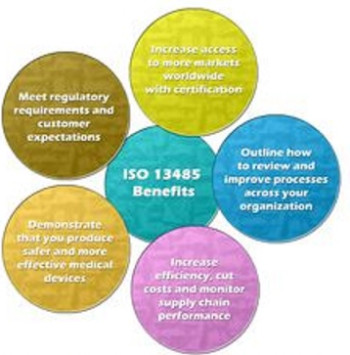
ISO 13485 Standard includes the requirements for the implementation of a Quality Management System for medical devices. The structure of the Standard and the requirements are similar to those of international Quality Standard ISO 9001. Their main differences are the requirements for monitoring records for each product, the risk management in all process stages, the monitoring of infrastructure maintenance, the documented procedures for the work environment, the service provision, the customer feedback as well as keeping interested parties informed.
ISO 13485 adapts the ISO 9000 process-based model for a regulated medical device manufacturing environment. While ISO 13485 is based on the ISO 9001 process model concepts of Plan, Do, Check, Act, it is designed for regulatory compliance. It is more prescriptive in nature and requires a more thoroughly documented quality management system.
ISO 13485 was written to support medical device manufacturers in designing quality management systems that establish and maintain the effectiveness of their processes. It ensures the consistent design, development, production, installation, and delivery of medical devices that are safe for their intended purpose.
 Mr. S.S. Sharma (Prime 4 B Solutions)
 B-5/53, 2nd Floor, Sector 5, Rohini, Delhi - 110085
 https://www.consultancy4iso.in
 Share us via