The scottish Dirks were carved by hand and mounted on custom made blades. They represent a range of dirk styles from the earliest examples of what may be identified as a truely Scottish style dirk circa 1650, on the left. Then a piece from the mid 18th century, that illustrates the last period with a functional dagger that is starting to show the design elements that will be the hallmarks of the dress daggers worn since the end of the 1700's. The dirk on the right shows the height of form and function, when the dirk was a working tool as well as showing the full development of the carved hilt circa 1700. These have all been sold. Scottish Dirks are one of the most distinctive varieties of knives. Owing to its present form, the Scottish dirk is a massive piece of male jewelry, mounted in gold or silver, capped with semi-precious stones and worn with the kilt as part of formal evening dress.
The first true dirks appeared in the early 1600's, evolving from the medieval ballock dagger that was a stabbing weapon, designed to pierce armor, with a heavy, sharply-pointed blade. It retained the ballocks between the handle and blade but developed a wide, flaring pommel capped by a circular brass disk.
By the beginning of 1800, the dirks underwent transformation. The blade of the dirk then, retained its traditional size and shape, but the hilt began to assume impractical forms. Some looked like three balls stacked one upon the other and others took an extreme thistle shape having a small handle. Pommels remained large and became highly decorated with engraving and/or three dimensional castings.
Being unique in western culture, the dirk is still made and worn, along with the sgian dubh, or stocking knife. Although it comes in an infinite variety, it has always been instantly recognizable as a Scottish Dirk.
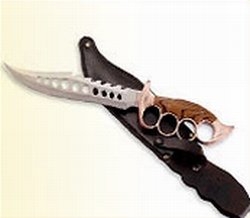


 Gauhar Rais (Raisons Overseas)
 P O Box No. 349, Kothi Atanas, Meerut, Uttar Pradesh - 250002, India
 Share us via









