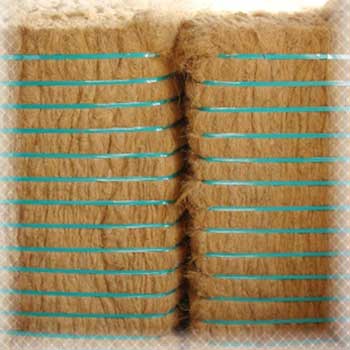
Coir fiber, obtained from the tissues surrounding the seed of the coconut palm, Cocos nucifera, is one of the few natural fibers that are strong, highly durable and water-proof. Coir fiber has the ability to stretch beyond its elastic limit without rupturing. Its resistance to microbial degradation and salt water and the power to take up a permanent stretch is unique. We supply natural Coconut Coir Fiber in continuous and long term volume. These Natural Coir Fiber are mainly used to replace foam materials in beds, seat cushion, coir mattress, coir doormats, geo textile, plant box, soil erosion prevention, mattresses, car seats, sofas, etc. coco fiber has many advantages in these applications mentioned. The quality of our fiber can provide you a competitive advantage to your products. We are listed as the most dependable Coir Fiber Exporter and are also counted among the coir fiber Suppliers in India.
- Color : Brown & Golden Brown
- Fiber Length : 10 20 cms
- Impurities : Below 3 %
- Package : 145-150 Kg & 100-120 Kg
- Load Ability : 18 Tones in 40'HC FCL
- Moisture : Less than 15% White Coir Fiber The immature husks are suspended in a river or water-filled pit for up to ten months. During this time micro-organisms break down the plant tissues surrounding the fibers to loosen them a process known as retting. Segments of the husk are then beaten by hand to separate out the long fibers which are subsequently dried and cleaned. Cleaned fiber is ready for spinning into yarn using a simple one-handed system. This coir fiber is also known as yarn fiber, mat fiber or retted fiber. White coir fiber is mainly used for manufacturing coir products such as mats, mattings, carpets and rope. Brown Coir Fiber Brown Coir fiber is obtained from fully ripe brown coconut husks by wet or dry milling. The process involves soaking brown coconut husks up to one month in fresh water, and combing on a pair of rotating spiked drums. Dirt and other rubbish are removed from the Brown coir fiber and then dried and packed into bales. Brown coir fiber is used mainly for filling mattresses and upholstery, for manufacture of needle felt pads used in innerspring mattresses, and in drainage filters with perforated pipes. Machine Twisted Fiber/Curled Coir/Coir rope Coir rope-making is a common cottage industry in India. This is where a family works together from their home. They actually work outside, somewhere with plenty of space to stretch out the lengths of rope and preferably with shade, like under big trees. The coconut fiber is attached to hooks on a wheel that is turned by hand. This twists the coir while more is added. It forms a strong rope that doesnt unwind or break. The coir fiber industry is important for developing countries such as India and Sri Lanka. India makes 60 per cent of the worlds supply of white coir fiber. Coir rope has many uses, including tying up animals, securing loads, and webbing for beds. Coir fiber is also used to make other things like brushes, doormats, mattress filling, padding inside furniture, sacking, garden twine, and matting for pot plants and gardens. Products made from good quality coir absorb water without weakening the fiber. Coir is the only natural fiber that resists damage by salt water.
 Write a Review
 SS Govindharaj (RG Exports)
 G-4, Krishnakamalam Residency, Venkatasamy Road East, R.S.Puram, R S Puram, Coimbatore, Tamil Nadu - 641002, India
 Share us via