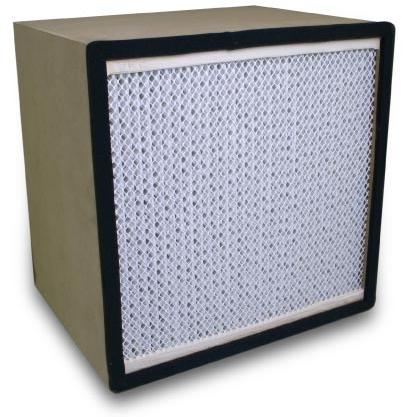
Hepa is a type ofair filter. Filters meeting the HEPA standard have many applications, including use in medical facilities, automobiles, aircraft, and homes. HEPA filters are composed of a mat of randomly arranged fibres. The fibres are typically composed offiberglassand possess diameters between 0.5 and 2.0 micrometers. Key factors affecting function are fibre diameter, filter thickness, and face velocity. The air space between HEPA filter fibres is much greater than 0.3m. The common assumption that a HEPA filter acts like asievewhere particles smaller than the largest opening can pass through is incorrect. Unlikemembrane filtersat this pore size, where particles as wide as the largest opening or distance between fibres cannot pass in between them at all, HEPA filters are designed to target much smaller pollutants and particles. These particles are trapped (they stick to a fibre) through a combination of the following three mechanisms : Interception, where particles following a line of flow in the air stream come within one radius of a fibre and adhere to it. Impaction, where larger particles are unable to avoid fibres by following the curving contours of the air stream and are forced to embed in one of them directly; this effect increases with diminishing fibre separation and higher air flow velocity.
- Diffusion, an enhancing mechanism that is a result of the collision with gas molecules by the smallest particles, especially those below 0.1m in diameter, which are thereby impeded and delayed in their path through the filter; this behaviour is similar toBrownian motionand raises the probability that a particle will be stopped by either of the two mechanisms above; it becomes dominant at lower air flow velocities.
- Diffusion predominates below the 0.1 m diameter particle size. Impaction and interception predominate above 0.4 m. In between, near the Most Penetrating Particle Size (MPPS) 0.3 m, both diffusion and interception are comparatively inefficient. Because this is the weakest point in the filter's performance, the HEPA specifications use the retention of these particles to classify the filter.
- Lastly, it is important to note that HEPA filters are designed to arrest very fine particles effectively, but they do not filter out gasses andodormolecules. Circumstances requiring filtration ofvolatile organic compounds, chemical vapors, cigarette, pet, and/orflatulenceodors call for the use of anactivated carbon(charcoal) filter instead of or in addition to a HEPA filter.
HEPA filters, as defined by theDOEstandard adopted by most American industries, remove at least 99.97% ofairborne particles0.3micrometers(m) in diameter. The filter's minimimal resistance to airflow, orpressure drop, is usually specified around 300Paat its nominalflow rate.The specification usually used in theEuropean Unionis theEuropean NormEN 1822:2009. It defines several classes of HEPA filters by their retention at the given Most Penetrating Particle Size (MPPS):
 GST : 27AIBPN9094J1ZP
 4.6/5
4.6/5
 Nadaf D A (S A Industries)
 Dattanagar,Tal-shirol, Dist Kolhapur, Jaysingpur, Maharashtra - 416120
 https://www.saindustry.co.in
 Share us via