Write a Review
Our Products
Our offered Product range includes Ground Granulated Blast Furnace Slag, Natural Gypsum, Potash Feldspar and Soda Feldspar.
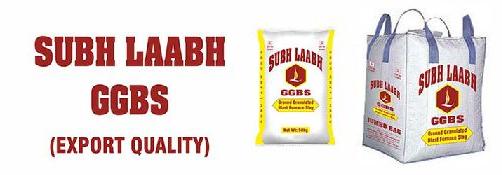
Ground Granulated Blast Furnace Slag (GGBS) or GGBFS has proven to be highly advantageous for construction. It can be used in the construction of high-rise buildings, sewage treatment plants, dams, pipes, blocks and more.
We at Subh Laabh have a good amount of experience in the production of GGBS, which has made us one of the best GGBS manufacturers in Karnataka. From the use of high-quality raw materials obtained directly from steel manufacturers to the production of the best quality with best technology, we take each and every step with utmost precision.
What is GGBFS Or GGBS?
In case you do not know, Granulated Blast Furnace Slag (GBS) is obtained as a by-product when iron is obtained from its ore. Once the iron ore melts inside the blast furnace along with lime stone and coke, it leads to the formation of molten slag, which floats right above the molten iron. The temperature of the slag remains between 1500 and 1600 degree Celsius. The molten iron is then extracted, which in turn leaves behind the molten slag. Now, when the molten slag is water quenched, it turns into glassy granulates, also known as Granulated Blast Furnace Slag.
The granulated form of slag is comprised of 30 to 40 percent of Silicon Oxide, around 40 percent of Calcium oxide, and more or less 18% of Alumina. Finally, the granulated slag is grounded into fine particles, which are known as Ground Granulated Blast Furnace Slag.
Some applications of GGBFS or GGBS you must know
High quality GGBS can be used for a number of applications. As we are one of the most reliable Ground Granulated Blast furnace slag manufacturers in Karnataka, we do take the quality aspect very seriously.
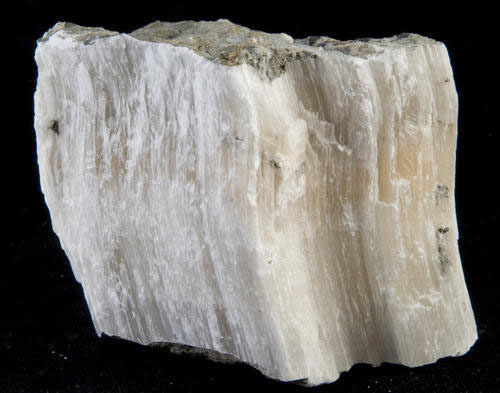
We are the importers of Natural Gypsum and supply to max cement industries. Gypsum is crystalline Calcium Sulphate. It occurs mainly in soft white massive deposits.
Applications:
In ceramic bodies, the main vitrifying (fluxing) agent is Potash Feldspar. The majority of white ware bodies contain good proportions of feldspar. It acts as a flux. In the ceramic industry, the flux is defined as that portion of the body which develops glass phase. This is provided mostly by feldspar. The amount of flux in a ceramic body should be only in such a proportion as to develop the desired amount of vitrification. If excess of flux is added, the fired body becomes very glassy and consequently, brittle.
Feldspar is generally used for Ceramics, Glass, Electrodes.
The glass and ceramic industries are the major consumers of feldspar and account for 95% of the total consumption.
In ceramic bodies, the main vitrifying (fluxing) agent is Soda Feldspar. The majority of white ware bodies contain good proportions of feldspar. It acts as a flux. In the ceramic industry, the flux is defined as that portion of the body which develops glass phase. This is provided mostly by feldspar. The amount of flux in a ceramic body should be only in such a proportion as to develop the desired amount of vitrification. If excess of flux is added, the fired body becomes very glassy and consequently, brittle. The glass and ceramic industries are the major consumers of feldspar and account for 95% of the total consumption. Feldspar is generally used for Ceramics, Glass, Electrodes
| Sodium Feldspar | SF/01 | |
| Silica | SiO2 | 68% ( 1%) |
| Alumina | Al2O3 | 18% ( 1%) |
| Sodium Oxide | Na2O | 9% ( 1%) |
| Potassium Oxide | K2O | 1.50% ( 0.5%) |
| Titanium Oxide | TiO2 | Nil |
| Calcium Oxide | CaO | 0.50% |
| Magnesium Oxide | MgO | Traces |
| Ferric Oxide | Fe2O3 | 0.08% ( 0.05%) |
| Loss On Ignition | LOI | 0.40% |
 Subh (Subh Laabh Group)
 1/A, 29th Ward,
M.J. Nagar, Near City Hospital,
Dam Road, .
, MJ Nagar, Hospet, Karnataka, India
1/A, 29th Ward,
M.J. Nagar, Near City Hospital,
Dam Road, .
, MJ Nagar, Hospet, Karnataka, India Share us via