Our Products
Leading Manufacturer, Supplier & Retailer of Screw Conveyor and Belt Conveyor.
Screw conveyors are one of the most reliable and cost-effective methods for conveying bulk materials. Due to their versatility, screw conveyors can convey a wide variety of bulk materials ranging from dry, free-flowing Portland cement to wet, sluggish dewatered bio solids.Screw conveyors can be designed to operate in almost any position, from horizontal to vertical. Inclined screw conveyors are used to convey and elevate bulk materials from one level to another. Depending upon the bulk material and the objective, proper design and construction of an inclined screw conveyor will provide many years of uninterrupted service and productivity. The purpose of this article is to help the reader understand the basics of inclined screw conveyor design for various applications.
Working Principle :A screw conveyor consists essentially of a shaft mounted screw rotating in a trough and a drive unit for running the shaft. The material is moved forward along the axis of the trough by the thrust of screw thread or flight. The trough is usually of the U-shape.A helical blade is attached to a drive shaft which is coupled to a drive unit. The shaft is supported by two end bearings and intermediate bearings. The U-shaped trough has a cover plate with an opening for loading the conveyor. A discharge opening is provided at the bottom of the trough. The loading and discharging points can be located anywhere along the trough. More than one feed hopper and discharge hopper may be fitted according to the necessity.
Application :Conveyor systems are commonly used in many industries, including the Pan Masala, automotive, agricultural, computer, electronic, food processing, pharmaceutical, chemical, bottling and canning, print finishing and packaging. Although a wide variety of materials can be conveyed, some of the most common include food items such as beans and nuts, bottles and cans, automotive components, scrap metal, pills and powders, wood and furniture and grain and animal feed. The principle of material movement along the trough is similar to the sliding motion of a nut along a rotating screw when the nut is not allowed to rotate. The weight of the material and the friction of the material against the wall prevent the load from rotating with the screw
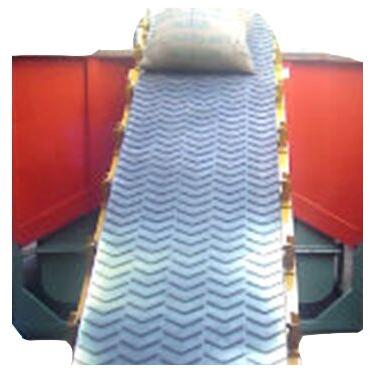
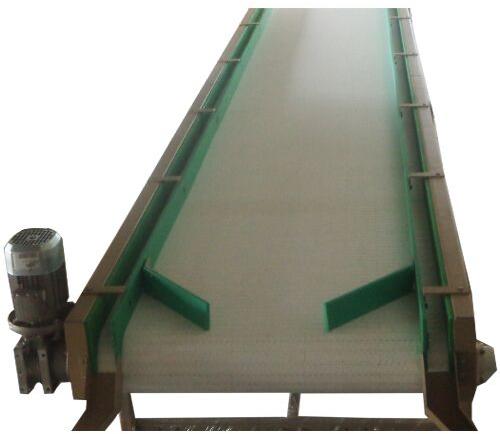
Conveyors are able to safely transport materials from one level to another, which when done by human labor would be strenuous and expensive. They can be installed almost anywhere, and are much safer than using a forklift or other machine to move materials. They can move loads of all shapes, sizes and weights. Also, many have advanced safety features that help prevent accidents. There are a variety of options available for running conveying systems, including the hydraulic, mechanical and fully automated systems, which are equipped to fit individual needs.A belt conveyor system is one of many types of conveyor systems. A belt conveyor system consists of two or more pulleys (sometimes referred to as drums), with an endless loop of carrying mediumthe conveyor beltthat rotates about them.
Working Principle :One or both of the pulleys are powered, moving the belt and the material on the belt forward. The powered pulley is called the drive pulley while the unpowered pulley is called the idler pulley. There are two main industrial classes of belt conveyors; Those in general material handling such as those moving boxes along inside a factory and bulk material handling such as those used to transport large volumes of resources and agricultural materials, such as grain, salt, coal, ore, sand, overburden and more.
Application :Conveyor systems are commonly used in many industries, including the Pan Masala, automotive, agricultural, computer, electronic, food processing, pharmaceutical, chemical, bottling and canning, print finishing and packaging. Although a wide variety of materials can be conveyed, some of the most common include food items such as beans and nuts, bottles and cans, automotive components, scrap metal, pills and powders, wood and furniture and grain and animal feed.
 Jitendra Bhalla (Thermocare Engineers India Pvt. Ltd)
 F-40, Site 5, Rd No 13, Panki Industrial Area, Udhyog Kunj, Kanpur-22., Uttar Pradesh - 208022
 Share us via







 Write a Review