Write a Review
Our Products
Our product range contains a wide range of Tube Settler Media and Sludge Dewatering Machine
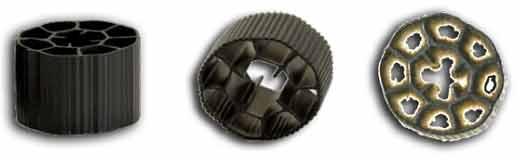
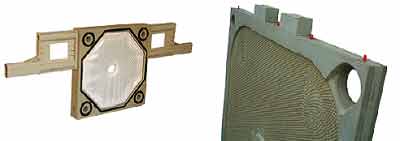
The filter press basically consists of a number of chamber filter plates (also referred to as recessed filter plate pack) mounted vertically on and between two sidebars or suspended from an overhead support beam. A filter cloth is mounted over each of the two faces of the filter plate. The cloth is joined at the feed eye by an impervious sleeve or tube also known as a barrel neck.
Filter Press Feed Cycle:-Step 1 :Sludge is fed into the filter press by a suitable pumping system and passes through the feed eye of the succeeding plates along the length of the plate pack until all chambers are full of slurry. This is known as the fast fill portion of the filter cycle.
Step 2 :Flowing under pressure, the solid particles begin to deposit on the surface of the filter cloth forming the initial layer of filter cake referred to as the pre-coat. Once applied, this pre-coat layer becomes the actual filtering medium.
Step 3 :As filtering continues the cake thickness gradually increases, until the adjacent filter cake in each chamber touch or bridge. At this point of the filter cycle, the dewatering phase enters into final cake consolidation to achieve maximum cake dryness.
The filter cloths are woven fabrics using monofilament or multifilament synthetic fibers or a combination of both. The most commonly used materials are polypropylene, polyester, and nylon. Filter cloths are primarily selected for filtration, strength, and cake release properties.
Sludge drying beds may be used for dewatering sludge. Drying beds are confined, under drained and shallow layers of sand over gravel on which wet sludge is distributed for draining and air drying. Drying beds have proved satisfactory at most small and medium-sized sewage treatment plants located in warm, dry climates.
 Trity Enviro (trity enviro)
 B-416, Sector-17, Vasundhara, , Ghaziabad, Uttar Pradesh, India
 Share us via