Write a Review
Our Products
Our offered Product range includes Chain Stitched Rugs, Ladakh Carpet, Chain Stitch Rug, Kashmir Silk Rug and Kashmiri Carpets.
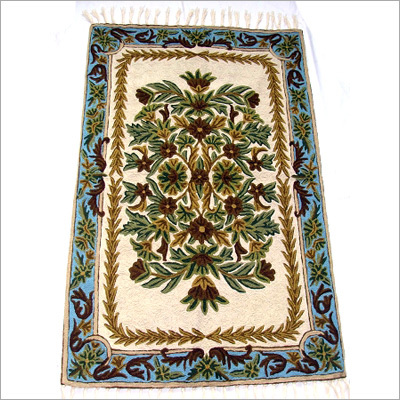
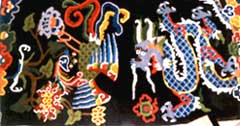
Women dominance is widely felt in weaving of the carpets. A vertical wooden loom, light in weight is the sole basis on which it is made. It requires simple wedges to tighten and tied the wrap thread which are looped to the beams and tied together. The usual size of the carpet is 3x6 ft known as Khalidan. These carpets are woven by the method of looping knots, known as "Khabdan" in local parlance.
The designs woven into the carpet are generally derived from the religious myths. The motifs are inspired by the Mahayana Budhist symbolism. Dragon motif is quite common. A few more designs like Guanakchagri (Chinese, wall), Khorlo (three wheels), Tashi stak gyat (eight lucky signs), Mentok (flower) and Cha (birds) are also used. The eight lucky signs of symbols are those of lotus, wheel of religion, conch-shell, banner of victory, holy-vase endless knot, pair of golden fish and umbrella in Buddism.
There is one more type of the carpet woven in Ladakh. This is a peculiar type of the carpet, the wrap and weft of the rug used are both of woollen yarn. This is called TSUKDAN in local dialect.
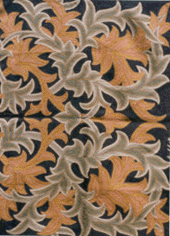
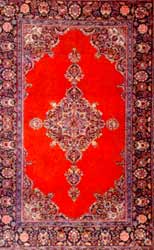
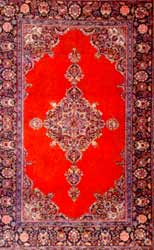
The origin of hand knotted carpets locally known as "Kal baffi" dates back to 15th century after which it progressively attained the high degree of perfection. It is said that Sultan Zain-ul-Abidin brought carpet weavers from Persia and central Asia in to Kashmir to train the local inhabitants.There are different types of knots and in Kashmir the Farsi baff and the Persian system known as Sehna, or Sinneh, knot is originally used. Very simple tools are used to thread these knots, a wood or Metal comb to push knots and weft tightly together and pair of short scissors to cut the pile of the carpet to an even form once it is finished.
 Mushtaq Ahmad Bhat (Valley Brick Kallan Anantnag)
 J L N Udyog Bhavan, Railhead Complex, Panama Chowk, Jammu., Jammu & Kashmir, India
 Share us via