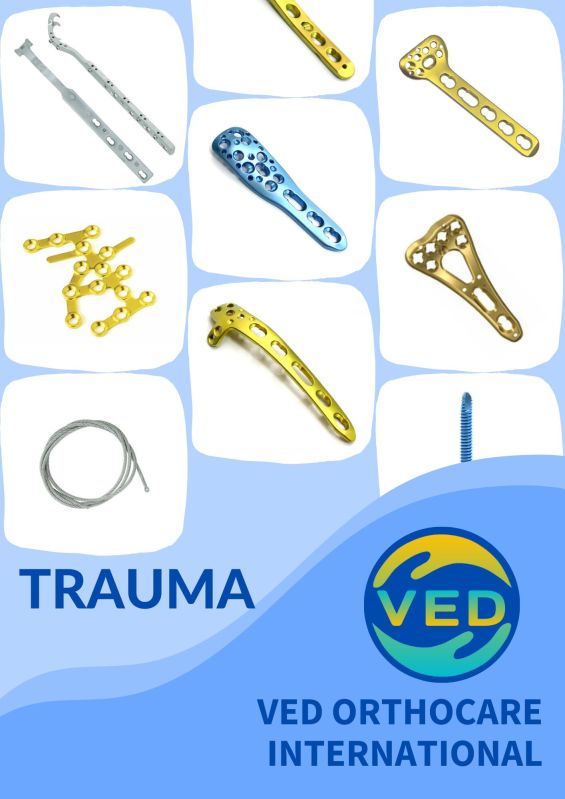
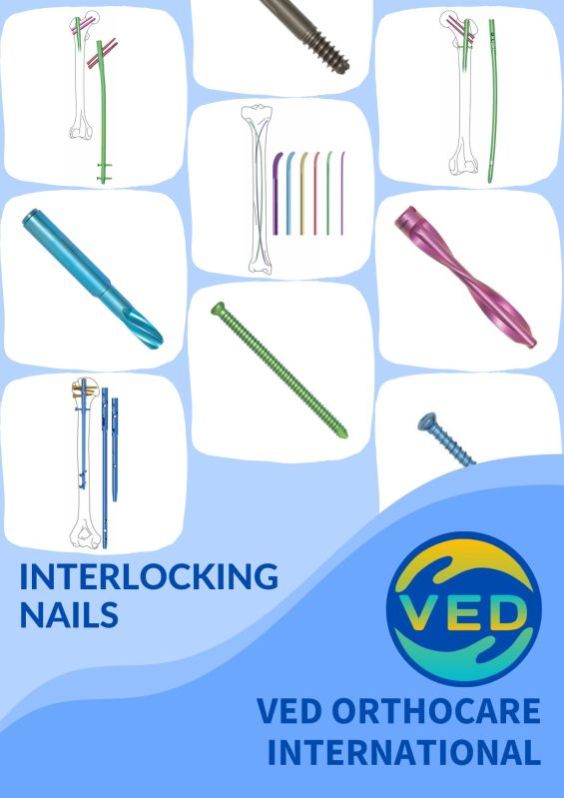
Our Products
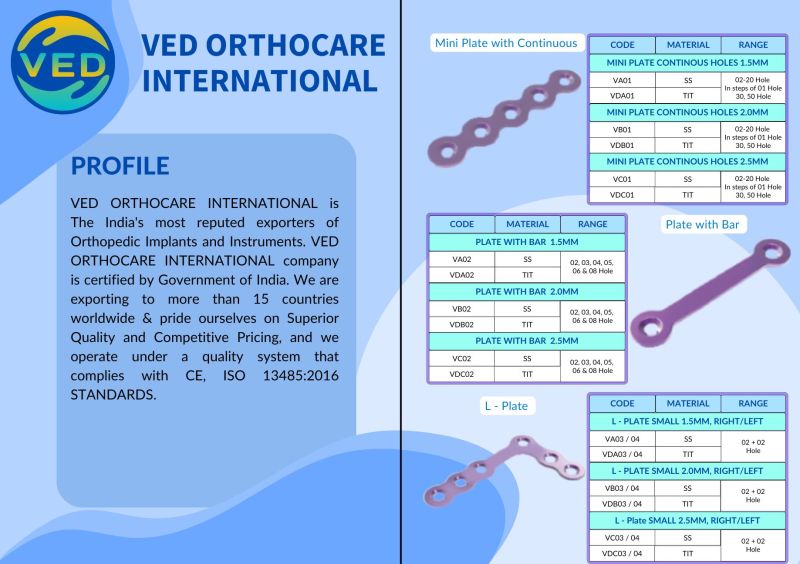
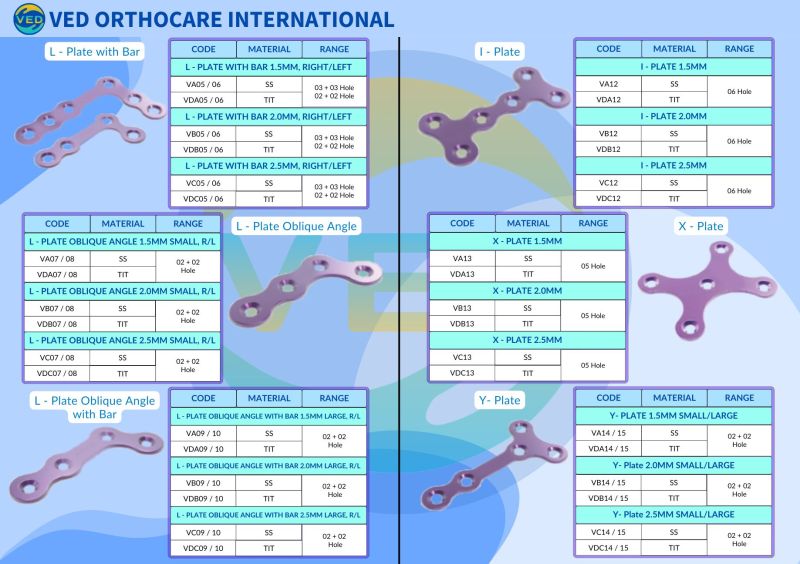
Leading Manufacturer, Supplier & Retailer of Orthopedic Implants Surgical Instruments, Locking Bone Compression Plate Broad, locking particular distal lateral fibular plate, Locking One Third Plate and Locking Metaphyseal Plate FOR Distal Medial Humerus 3.5mm.
MANUFACTURER & EXPORTER OF ORTHOPAEDIC IMPLANTS & SURGICAL INSTRUMENTS CATALOGUE & CERTIFICATE, PRICE LIST
Dear Respected Sir
WE ARE MANUFACTURER & EXPORTER OF ORTHOPAEDIC IMPLANTS & ALLIED SURGICAL INSTRUMENTS.
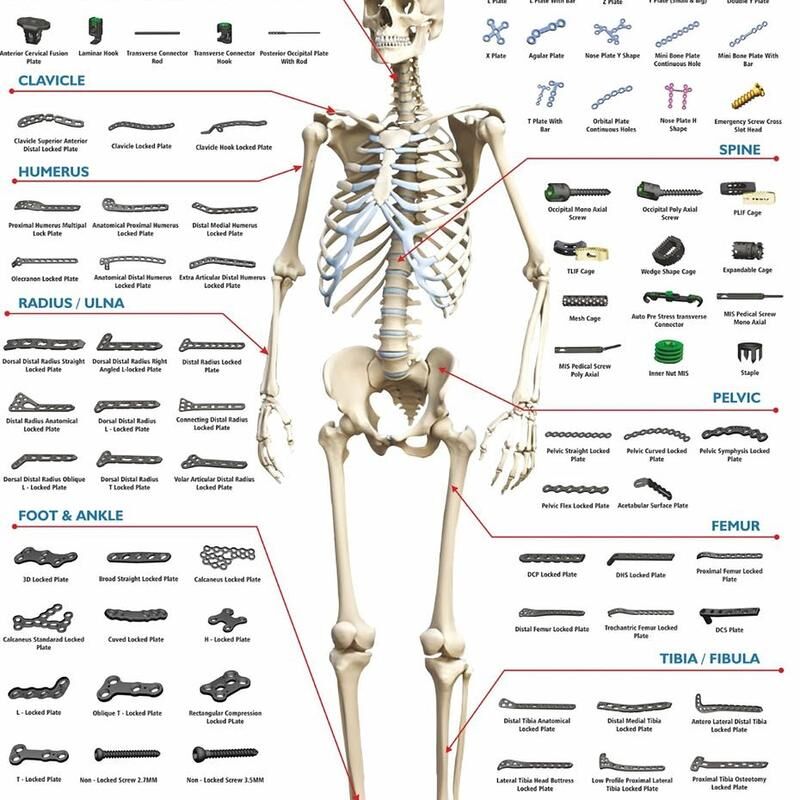
(1) TRAUMA LOCKING - NON LOCKING SEGMENTS,
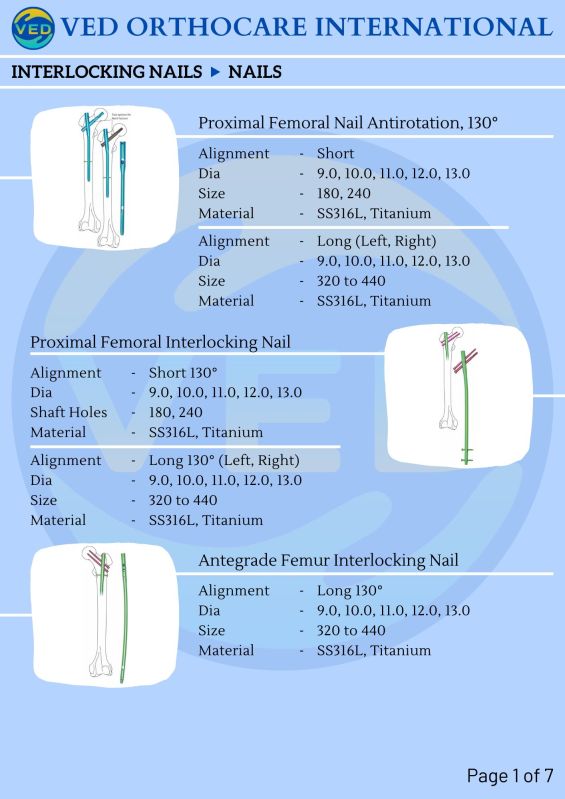
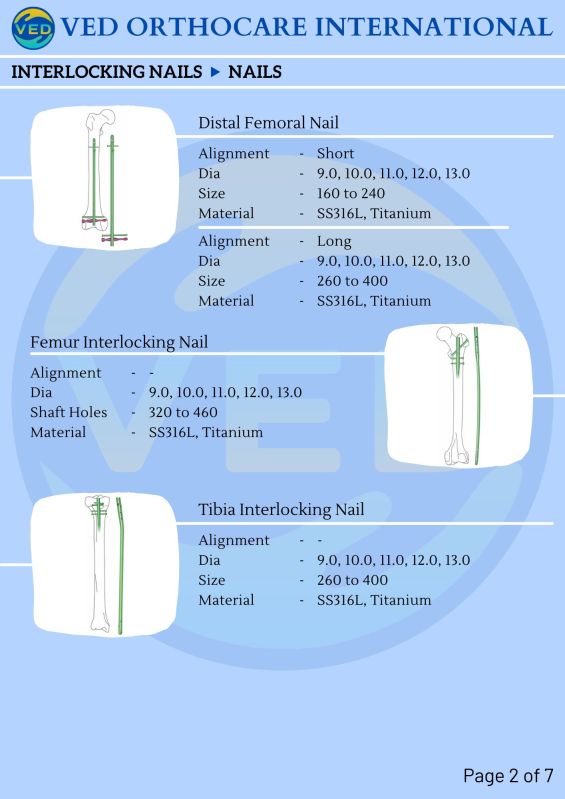
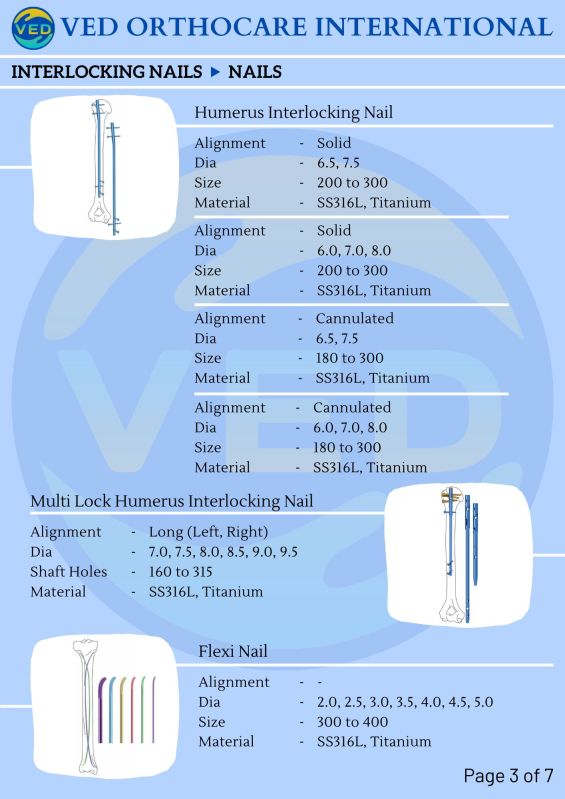
(2) INTERLOCKING NAILING SEGMENTS,
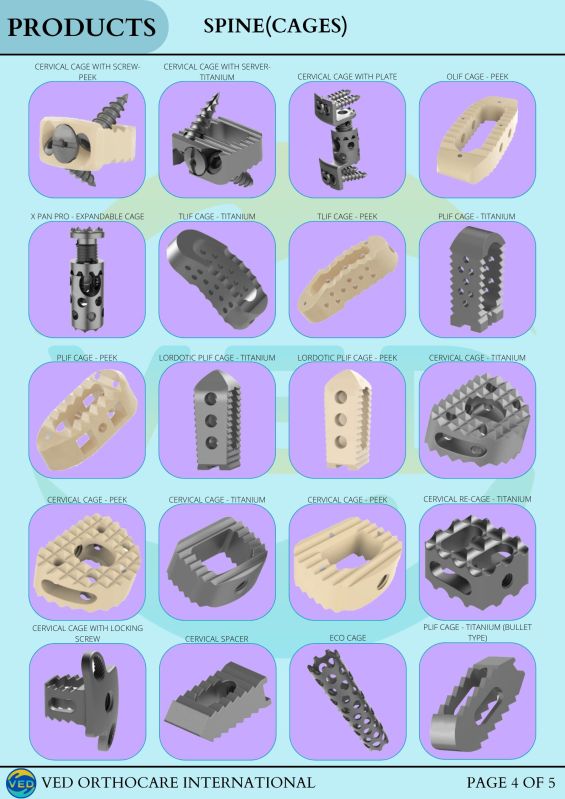
(3) SPINAL SYSTEMS,
(4) HIP PROSTHESIS,
(5) MAXILLOFACIALS,
(6) EXTERNAL - FIXATOERS.
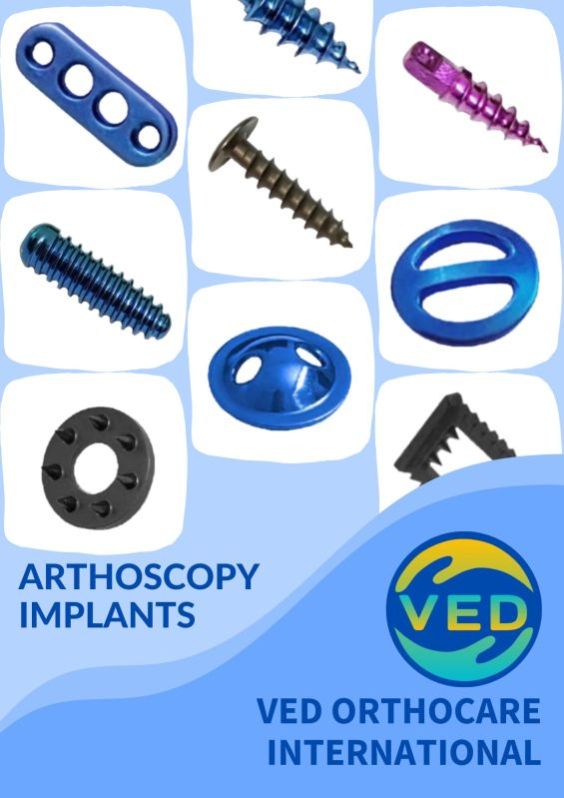
(7) ARTHROSCOPY IMPLANTS
(8) ORTHOPAEDIC REHABIATION PRODUCTS
PLEASEREQUIREMENT OF ORTHOPAEDIC IMPLANTS - ALID SURGICALS INSTRUMENTS WITH HEALTHCARE PRODUCTS SEND ME LIST PROVIDE YOU BEST QUALITY & BEST SUITABLE QUOTATION.
THANKS FOR COORDINATION AND GIVING US YOUR PRECIOUS TIME.
ORTHOPAEDIC IMPLANTS & SURGICAL INSTRUMENTS MFG. & EXPORTER
VED ORTHOCARE INTERNATIONAL
(M) + 91 98257 54157
Email : vedorthocare2021@gmail.com
Web site: www.vedorthocare.com
Additional Information:
Payment Terms : L/C, D/A, D/P, T/T, Western Union,
Delivery Time : 30 DAYS
dear respected sir
we are manufacturer & exporter of orthopaedic implants & allied surgical instruments.
(1) trauma locking - non locking segments,
(2) interlocking nailing segments,
(3) spinal systems,
(4) hip prosthesis,
(5) maxillofacials,
(6) external - fixatoers.
(7) arthroscopy implants
(8) orthopaedic rehabiation products
pleaserequirement of orthopaedic implants - alid surgicals instruments with healthcare products send me list provide you best quality & best suitable quotation.
thanks for coordination and giving us your precious time.
thanks & regards,
vaishali kayastha
orthopaedic implants & surgical instruments mfg. & exporter
Dear Respected Sir
WE ARE MANUFACTURER & EXPORTER OF ORTHOPAEDIC IMPLANTS & ALLIED SURGICAL INSTRUMENTS.
(1) TRAUMA IMPLANTS LOCKING - NON LOCKING SEGMENTS,
(2) INTERLOCKING NAILING IMPLANTS SEGMENTS,
(3) SPINAL IMPLANTS SYSTEMS,
(4) HIP PROSTHESIS IMPLANTS,
(5) MAXILLOFACIALS IMPLANTS,
(6) EXTERNAL - FIXATOERS.
(7) ARTHROSCOPY IMPLANTS
Trauma implants are specialized orthopedic devices used to stabilize and support fractured or damaged bones after accidents, falls, or injuries. They include plates, screws, nails, pins, and prostheses designed to restore bone alignment, promote healing, and regain mobility.
Materials UsedStainless Steel: Durable, corrosion-resistant, widely used.
Titanium


The Locking Distal Radius Plate 2.4/2.7mm is an orthopedic implant designed for stable fixation of distal radius fractures, typically used in wrist surgeries. It is available in stainless steel or titanium and works with 2.4mm and 2.7mm locking screws to provide strong, anatomical support.


The Locking Distal Radius Buttress Plate 2.4/2.7mm is a specialized orthopedic implant designed for fixation of complex distal radius fractures, particularly those involving the articular surface of the wrist. It provides strong buttress support to prevent fragment collapse and ensures stable fixation even in osteoporotic bone.
Material: Medical-grade stainless steel or titanium


The Locking Distal Radius Plate Extra Articular, 2.4/2.7mm is an orthopedic implant specifically designed for stabilizing extra-articular fractures of the distal radius (fractures that do not extend into the wrist joint). It provides strong fixation while preserving wrist function and allowing early mobilization.
Product OverviewName: Locking Distal Radius Plate (Extra Articular, 2.4/2.7mm)
Application: Used for extra-articular distal radius fractures, common in wrist trauma.
Material: Medical-grade stainless steel or titanium.
Compatibility: Works with 2.4mm and 2.7mm locking screws.
Design: Anatomically contoured plate for volar fixation (front of wrist).


The Locking Distal Radius Plate Straight, 2.4/2.7mm is an orthopedic implant designed for fixation of distal radius fractures, especially when a straight plate profile is preferred for extra-articular or simple fracture patterns. It provides strong fixation with locking screw technology and is commonly used in wrist trauma surgery.
Product OverviewName: Locking Distal Radius Plate (Straight, 2.4/2.7mm)
Application: Stabilization of distal radius fractures (wrist injuries).
Material: Medical-grade stainless steel or titanium.
Compatibility: Works with 2.4mm and 2.7mm locking screws.
Design: Straight plate profile for versatile fixation.


The Locking L Distal Radius Plate 2.4/2.7mm is an orthopedic implant designed for fixation of distal radius fractures, especially those requiring an Lshaped plate profile to provide enhanced coverage and support for complex fracture patterns.
Product OverviewName: Locking L Distal Radius Plate (2.4/2.7mm)
Application: Used for intraarticular and extraarticular distal radius fractures.
Material: Medicalgrade stainless steel or titanium .
Compatibility: Works with 2.4mm and 2.7mm locking screws.
Design: Lshaped plate for broader fixation across distal radius bone.


The Locking LOblique Distal Radius Plate 2.4/2.7mm is a specialized orthopedic implant designed for fixation of complex distal radius fractures, particularly those requiring oblique buttress support. Its unique Loblique shape provides enhanced coverage and stability for fragments in the distal radius, making it especially useful in intraarticular fracture management.
Product OverviewName:Locking LOblique Distal Radius Plate (2.4/2.7mm)
Application:Used for intraarticular and comminuted distal radius fractures.
Material:Medicalgrade stainless steelor titanium .
Compatibility:Works with 2.4mm and 2.7mm locking screws.
Design:Loblique shape for extended fixation across fracture lines.


The Locking T Distal Radius Plate 2.4/2.7mm is an orthopedic implant designed for fixation of distal radius fractures, particularly those requiring a Tshaped plate profile to provide broad coverage and secure fixation of distal fragments.
Product OverviewName: Locking T Distal Radius Plate (2.4/2.7mm)
Application: Used for intraarticular and extraarticular distal radius fractures.
Material: Medicalgrade stainless steel or titanium.
Compatibility: Works with 2.4mm and 2.7mm locking screws.
Design: Tshaped plate for extended fixation across distal radius bone.


The Locking Volar Distal Radius Plate Standard 2.7/3.5mm is a robust orthopedic implant designed for fixation of distal radius fractures using the volar (front) approach. This plate is larger and stronger than the 2.4/2.7mm variants, making it suitable for complex, comminuted, or loadbearing fractures of the wrist.
Product OverviewName: Locking Volar Distal Radius Plate (Standard, 2.7/3.5mm)
Application: Used for intraarticular and extraarticular distal radius fractures.
Material: Medicalgrade stainless steel or titanium .
Compatibility: Works with 2.7mm and 3.5mm locking screws.
Design: Anatomically contoured volar plate for strong fixation.


The Locking Radial Head Rim Plate 2.4mm is a specialized orthopedic implant designed for fixation of radial head fractures, particularly those involving the rim or marginal fragments of the radial head in the elbow joint. Its small size and locking mechanism make it ideal for stabilizing delicate bone fragments while preserving joint function.
Product Overview
Name:Locking Radial Head Rim Plate (2.4mm)
Application:Used in fixation of radial head fractures, especially rim or marginal fractures.
Material:Medicalgrade titanium or stainless steel.
Compatibility:Works with 2.4mm locking screws.
Design:Lowprofile rim plate contoured to fit the radial head anatomy.


The Locking Radial Head Neck Plate 2.4mm is a specialized orthopedic implant designed for fixation of radial neck fractures in the elbow joint. Its small size and locking mechanism make it ideal for stabilizing delicate bone structures while preserving elbow mobility and function.
Product Overview
Name: Locking Radial Head Neck Plate (2.4mm)
Application: Used for fixation of radial neck fractures and certain complex radial head injuries.
Material: Medicalgrade titanium or stainless steel.
Compatibility: Works with 2.4mm locking screws.
Design: Lowprofile plate contoured to fit the radial neck anatomy.


The Locking Wrist Fusion Plate 2.4mm is a specialized orthopedic implant designed for arthrodesis (fusion) of the wrist joint. It is used when severe trauma, arthritis, or instability makes wrist preservation impossible, and fusion is required to restore strength and stability.
Product OverviewName: Locking Wrist Fusion Plate (2.4mm)
Application: Used for wrist arthrodesis in cases of severe trauma, degenerative arthritis, or failed prior surgeries.
Material: Medicalgrade titanium or stainless steel.
Compatibility: Works with 2.4mm locking screws.
Design: Long, anatomically contoured plate spanning the distal radius and carpal bones.


The 2.4/2.7mm VA Locking TwoColumn Distal Radius Plate (Volar, Narrow, 6 Holes, Width) is a highly specialized orthopedic implant designed for volar fixation of distal radius fractures, particularly those involving both columns of the distal radius. Its variableangle (VA) locking technology allows surgeons to place screws at customized angles, providing superior fixation in complex fracture patterns.
Product OverviewName: VA Locking TwoColumn Distal Radius Plate (Volar, Narrow, 6 Holes, Width)
Application: Fixation of intraarticular and extraarticular distal radius fractures.
Material: Medicalgrade titanium or stainless steel.
Compatibility: Works with 2.4mm and 2.7mm VA locking screws.
Design: Narrow volar plate with twocolumn support and 6 screw holes.


The 2.4/2.7mm VA Locking TwoColumn Distal Radius Plate (Volar, Standard, 6 Holes, Width 22mm) is a specialized orthopedic implant designed for volar fixation of distal radius fractures, especially those involving both columns of the distal radius. Its variableangle (VA) locking technology allows surgeons to place screws at customized angles, ensuring secure fixation even in complex fracture patterns.
Product OverviewName: VA Locking TwoColumn Distal Radius Plate (Volar, Standard, 6 Holes, Width 22mm)
Application: Fixation of intraarticular and extraarticular distal radius fractures.
Material: Medicalgrade titanium or stainless steel.
Compatibility: Works with 2.4mm and 2.7mm VA locking screws.
Design: Standard volar plate with twocolumn support, 6 screw holes, and width of 22mm.


The 2.4/2.7mm VA Locking TwoColumn Distal Radius Plate (Volar, Wide, 7 Holes, Width 25.5mm) is a highstrength orthopedic implant designed for volar fixation of distal radius fractures, especially complex intraarticular fractures involving both columns. Its wide profile and variableangle (VA) locking technology provide maximum stability and flexibility for screw placement.
Product OverviewName: VA Locking TwoColumn Distal Radius Plate (Volar, Wide, 7 Holes, Width 25.5mm)
Application: Fixation of intraarticular and extraarticular distal radius fractures.
Material: Medicalgrade titanium or stainless steel.
Compatibility: Works with 2.4mm and 2.7mm VA locking screws.
Design: Wide volar plate with twocolumn support, 7 screw holes, and width of 25.5mm.


The Locking Proximal Humerus Plate MultiAngle, 3.5mm is an advanced orthopedic implant designed for fixation of proximal humerus fractures, particularly those involving the humeral head and neck. Its multiangle locking screw technology provides surgeons with flexibility to stabilize complex fracture patterns while preserving shoulder function.
Product OverviewName: Locking Proximal Humerus Plate (MultiAngle, 3.5mm)
Application: Fixation of proximal humerus fractures (common shoulder injuries).
Material: Medicalgrade titanium or stainless steel.
Compatibility: Works with 3.5mm locking and cortical screws.
Design: Anatomically contoured plate with multiple screw trajectories for humeral head fixation.


The Locking Particular Proximal Humerus Plate 3.5mm is an advanced orthopedic implant designed for fixation of proximal humerus fractures, especially those involving the humeral head, neck, and shaft. Its design provides multidirectional screw placement and strong fixation, making it suitable for complex fracture patterns and osteoporotic bone.
Product OverviewName: Locking Particular Proximal Humerus Plate (3.5mm)
Application: Fixation of proximal humerus fractures (2part, 3part, and 4part fractures).
Material: Medicalgrade titanium or stainless steel.
Compatibility: Works with 3.5mm locking and cortical screws.
Design: Anatomically contoured plate with multiple screw trajectories for humeral head stabilization.


The Locking Distal Humerus Plate 2.7/3.5mm is a specialized orthopedic implant designed for fixation of distal humerus fractures, particularly those involving the supracondylar and intercondylar regions of the elbow. Its locking technology provides rigid fixation, making it suitable for complex fracture patterns and osteoporotic bone.
Product OverviewName: Locking Distal Humerus Plate (2.7/3.5mm)
Application: Fixation of distal humerus fractures (extraarticular, intraarticular, comminuted).
Material: Medicalgrade titanium or stainless steel.
Compatibility: Works with 2.7mm and 3.5mm locking/cortical screws.
Design: Anatomically contoured plate for distal humerus with multiple screw trajectories.


The Locking Distal Humerus Plate with Lateral Support 2.7/3.5mm is a specialized orthopedic implant designed for fixation of distal humerus fractures, particularly those involving the supracondylar and intercondylar regions of the elbow. The addition of lateral support provides enhanced stability for complex fracture patterns, making it especially useful in comminuted or osteoporotic bone.
Product OverviewName:Locking Distal Humerus Plate with Lateral Support (2.7/3.5mm)
Application:Fixation of distal humerus fractures (extraarticular, intraarticular, comminuted).
Material:Medicalgrade titanium or stainless steel.
Compatibility:Works with 2.7mm and 3.5mm locking/cortical screws.
Design:Anatomically contoured plate with lateral extension/supportfor added stability.


The Locking Metaphyseal Plate for Distal Medial Humerus 3.5mm is a specialized orthopedic implant designed for fixation of distal humerus fractures, particularly those involving the medial column metaphyseal region. Its anatomical contour and locking technology provide strong fixation in complex fracture patterns, while minimizing soft tissue irritation around the elbow.
Product OverviewName: Locking Metaphyseal Plate for Distal Medial Humerus (3.5mm)
Application: Fixation of distal humerus fractures (extraarticular, intraarticular, comminuted).
Material: Medicalgrade titanium or stainless steel.
Compatibility: Works with 3.5mm locking and cortical screws.
Design: Anatomically contoured plate for medial metaphyseal support.


The Locking ExtraArticular Distal Humerus Plate 3.5mm is an orthopedic implant designed specifically for fixation of extraarticular distal humerus fractures, where the fracture does not extend into the elbow joint surface. Its anatomical contour and locking technology provide strong fixation for the distal humerus while preserving elbow function.
Product OverviewName: Locking ExtraArticular Distal Humerus Plate (3.5mm)
Application: Fixation of extraarticular distal humerus fractures (supracondylar, metaphyseal).
Material: Medicalgrade titanium or stainless steel.
Compatibility: Works with 3.5mm locking and cortical screws.
Design: Anatomically contoured plate for distal humerus shaft and metaphysis.


The Locking Distal Humerus Medial Plate 2.7/3.5mm is an orthopedic implant designed for fixation of distal humerus fractures, specifically targeting the medial column. This plate provides strong metaphyseal and diaphyseal support, ensuring stability in complex fracture patterns while preserving elbow function.
Product OverviewName: Locking Distal Humerus Medial Plate (2.7/3.5mm)
Application: Fixation of distal humerus fractures (extraarticular, intraarticular, comminuted).
Material: Medicalgrade titanium or stainless steel.
Compatibility: Works with 2.7mm and 3.5mm locking/cortical screws.
Design: Anatomically contoured plate for medial column stabilization.


The Locking T Small Plate 3.5mm is a compact orthopedic implant designed for fixation of small bone fractures, particularly in areas where a Tshaped plate provides optimal buttress support. It is commonly used in the distal radius, distal humerus, or other small bone applications where precise fixation is required.
Product OverviewName: Locking T Small Plate (3.5mm)
Application: Fixation of small bone fractures requiring Tshaped support (e.g., distal radius, distal humerus).
Material: Medicalgrade titanium alloy or stainless steel.
Compatibility: Works with 3.5mm locking and cortical screws.
Design: Small Tshaped plate with locking technology for secure fixation.


The Locking T Oblique Plate 3.5mm is an orthopedic implant designed for fixation of small bone fractures, especially in the distal humerus, distal radius, and distal tibia. It provides angular stability with locking screw technology and comes in left and right anatomical versions.
Key FeaturesDesign: T-oblique anatomical shape for precise placement and buttress support.
Material: Available in stainless steel and titanium.
Screw Compatibility: Works with 3.5mm locking and cortical screws.
Hole Options: Typically 310 holes depending on fracture type and location.
Versions: Left and right angled plates for anatomical fit.
Profile: Low-profile with rounded edges to minimize tendon/soft tissue irritation.


The Locking Bone Compression Plate, Small 3.5mm, is an orthopedic implant used for fixation of small bone fractures (radius, ulna, fibula, pediatric humerus) and corrective osteotomies. It provides both compression and angular stability with locking screw technology, making it versatile for metaphyseal and diaphyseal fractures.
Key FeaturesDesign: Anatomically contoured small plate with compression slots for controlled fracture compression.
Material: Available in stainless steel (SS316L/SS316LVM) and titanium.
Screw Compatibility:
3.5mm locking head screws (self-tapping, hex or star drive).
4.0mm cancellous screws for metaphyseal fixation.
Hole Options: Plates available in 214 holes depending on fracture type.
Profile: Low-profile with rounded edges to reduce soft tissue irritation.
Stability: Locking technology prevents screw loosening and provides angular stability.


The Locking Olecranon Plate 3.5mm is a specialized orthopedic implant designed for fixation of fractures in the proximal ulna, particularly olecranon fractures. It combines the benefits of anatomical contouring with locking screw technology to provide angular stability and secure fixation.
Key FeaturesDesign: Anatomically contoured to fit the olecranon region of the ulna.
Material: Manufactured in stainless steel (SS316L/SS316LVM) and titanium.
Screw Compatibility:
3.5mm locking head screws (self-tapping).
4.0mm cancellous screws for metaphyseal fixation.
Hole Options: Available in multiple lengths (typically 412 holes).
Profile: Low-profile design to minimize soft tissue irritation.
Stability: Locking technology prevents screw loosening and maintains fixation even in osteoporotic bone.


The Locking Clavicle Hook Plate 3.5mm is an orthopedic implant specifically designed for fixation of lateral clavicle fractures, especially those involving the acromioclavicular joint. The hook portion of the plate engages under the acromion, providing stable fixation while maintaining joint alignment.
Key FeaturesDesign: Anatomically contoured plate with a hook extension for lateral clavicle stabilization.
Material: Available in stainless steel (SS316L/SS316LVM) and titanium.
Screw Compatibility:
3.5mm locking screws for shaft fixation.
4.0mm cancellous screws for metaphyseal fixation.
Hole Options: Typically 412 holes depending on fracture type and plate length.
Profile: Low-profile design to minimize soft tissue irritation.
Hook Function: The hook sits beneath the acromion, preventing upward displacement of the lateral clavicle fragment.


The Locking Reconstruction Plate (Round Hole), 3.5mm, is a versatile orthopedic implant used for fixation of complex fractures in small and long bones. Its round-hole design allows both locking and non-locking screw fixation, giving surgeons flexibility in treatment.
Key FeaturesDesign: Straight reconstruction plate with round holes, enabling both compression and locking fixation.
Material: Available in stainless steel (SS316L/SS316LVM) and titanium.
Screw Compatibility:
3.5mm locking screws.
3.5mm cortical screws.
4.0mm cancellous screws (for metaphyseal fixation).
Hole Options: Typically 412 holes depending on fracture type.
Profile: Low-profile design with rounded edges to reduce soft tissue irritation.
Flexibility: Can be contoured to fit anatomical curves, making it suitable for irregular bone surfaces.


The Locking Reconstruction Plate (B.C. Hole), 3.5mm, is a versatile orthopedic implant used for fixation of complex fractures in small and long bones. The B.C. hole refers to the bi-combi design, which allows the use of both locking screws and cortical screws in the same plate hole, giving surgeons flexibility in fixation strategy.
Key FeaturesDesign: Straight reconstruction plate with bi-combi holes (B.C. holes) that accept both locking and non-locking screws.
Material: Available in stainless steel (SS316L/SS316LVM) and titanium.
Screw Compatibility:
3.5mm locking screws.
3.5mm cortical screws.
4.0mm cancellous screws (for metaphyseal fixation).
Hole Options: Typically 412 holes depending on fracture type.
Profile: Low-profile design with rounded edges to reduce soft tissue irritation.
Flexibility: Can be contoured to fit anatomical curves, making it suitable for irregular bone surfaces.


The Locking Proximal Femoral Plate (PFP) 5.0mm is a specialized orthopedic implant designed for fixation of fractures in the proximal femur, particularly subtrochanteric and intertrochanteric fractures. It provides angular stability with locking screw technology and is contoured to match femoral anatomy.
Key Features
Design:Anatomically contoured plate for proximal femur fixation.
Material:Available in stainless steel (SS316L/SS316LVM)and titanium.
Screw Compatibility:
5.0mm locking screws for shaft fixation.
6.5mm cancellous screws for metaphyseal fixation.
Lag screws for femoral head stabilization.
Hole Options:Plates available in multiple lengths (typically 412 holes).
Profile:Low-profile design to minimize soft tissue irritation.
Stability:Locking technology provides angular stability, especially useful in osteoporotic bone.


The Locking Proximal Femoral Plate Type 2, 5.0mm, is a specialized orthopedic implant designed for fixation of fractures in the proximal femur, particularly subtrochanteric and intertrochanteric fractures. The Type 2 designation usually refers to a plate variant with specific anatomical contouring and hole configuration for enhanced fixation.
Key Features
Design: Anatomically contoured plate for proximal femur fixation, Type 2 variant with optimized geometry.
Material: Available in stainless steel (SS316L/SS316LVM) and titanium.
Screw Compatibility:
5.0mm locking screws for shaft fixation.
6.5mm cancellous screws for metaphyseal fixation.
Lag screws for femoral head stabilization.
Hole Options: Multiple lengths (typically 412 holes).
Profile: Low-profile design to minimize soft tissue irritation.
Stability: Locking technology provides angular stability, especially useful in osteoporotic bone.


The Locking Distal Femoral Plate (B.C. Hole), 95 is a specialized orthopedic implant designed for fixation of distal femur fractures, particularly supracondylar and intercondylar fractures. The 95 angle provides biomechanical alignment for the distal femur, while the bicombi (B.C.) holes allow surgeons to use either locking screws or cortical screws in the same plate hole.
Key FeaturesDesign:Anatomically contoured distal femoral plate with fixed 95 angle.
Material:Available in stainless steel (SS316L/SS316LVM)and titanium.
Screw Compatibility:
5.0mm locking screws for shaft fixation.
6.5mm cancellous screws for metaphyseal fixation.
Lag screws for condylar fixation.
Hole Options:Multiple lengths (typically 612 holes).
Profile:Lowprofile design to minimize soft tissue irritation.
B.C. Hole Advantage:Flexibility to choose locking or nonlocking fixation per hole.


The Locking Distal Femoral Plate 5.0mm is an orthopedic implant designed for fixation of distal femur fractures, especially supracondylar and intercondylar fractures. It provides angular stability through locking screw technology and is anatomically contoured to match the distal femur.
Key FeaturesDesign:Anatomically contoured plate for distal femur fixation.
Material:Available in stainless steel (SS316L/SS316LVM)and titanium.
Screw Compatibility:
5.0mm locking screws for shaft fixation.
6.5mm cancellous screws for metaphyseal fixation.
Lag screws for condylar fixation.
Hole Options:Plates available in multiple lengths (typically 612 holes).
Profile:Lowprofile design to reduce soft tissue irritation.
Stability:Locking technology ensures angular stability, especially in osteoporotic bone.


The Locking Medial Distal Femoral Plate 5.0mm is an orthopedic implant designed for fixation of fractures in the distal femur, specifically on the medial side. It is anatomically contoured to match the medial distal femur and provides angular stability through locking screw technology.
Key FeaturesDesign:Anatomically contoured for medial distal femur placement.
Material:Available in stainless steel (SS316L/SS316LVM)and titanium.
Screw Compatibility:
5.0mm locking screws for shaft fixation.
6.5mm cancellous screws for metaphyseal fixation.
Lag screws for condylar fixation.
Hole Options:Plates available in multiple lengths (typically 612 holes).
Profile:Lowprofile design to minimize soft tissue irritation.
Stability:Locking technology ensures angular stability, especially in osteoporotic bone.


The Locking Bone Compression Plate (Broad), 5.0mm, is a heavy-duty orthopedic implant designed for fixation of large bone fractures, especially in the femur and tibia. Its broad profile provides greater stability and load-bearing capacity compared to narrow plates, making it suitable for diaphyseal and metaphyseal fractures in weight-bearing bones.
Key FeaturesDesign: Broad plate with multiple holes for strong fixation.
Material: Available in stainless steel (SS316L/SS316LVM) and titanium.
Screw Compatibility:
5.0mm locking screws (shaft fixation).
6.5mm cancellous screws (metaphyseal fixation).
Lag screws for fracture compression.
Hole Options: Typically 414 holes depending on fracture type and bone length.
Profile: Broad design distributes stress across a larger surface area.
Stability: Locking technology prevents screw loosening and provides angular stability, especially in osteoporotic bone.


The Locking Bone Compression Plate (Narrow), 5.0mm, is an orthopedic implant designed for fixation of fractures in long bones such as the femur and tibia. Compared to the broad version, the narrow plate is slimmer, making it suitable for bones with less surface area or where soft tissue coverage is limited.
Key FeaturesDesign: Narrow profile plate with multiple holes for fixation.
Material: Available in stainless steel (SS316L/SS316LVM) and titanium.
Screw Compatibility:
5.0mm locking screws for shaft fixation.
6.5mm cancellous screws for metaphyseal fixation.
Lag screws for compression across fracture lines.
Hole Options: Typically 414 holes depending on fracture type and bone length.
Profile: Narrow design reduces bulk and soft tissue irritation.
Stability: Locking technology ensures angular stability, especially in osteoporotic bone.


The Locking Proximal GT (Greater Trochanter) Bone Plate is a specialized orthopedic implant designed for fixation of fractures involving the greater trochanter of the femur. It is particularly useful in complex proximal femur fractures where stabilization of the trochanteric fragment is essential for hip function.
Key FeaturesDesign:Anatomically contoured plate for the greater trochanter region.
Material:Manufactured in stainless steel (SS316L/SS316LVM)and titanium.
Screw Compatibility:
5.0mm locking screws for shaft fixation.
6.5mm cancellous screws for metaphyseal fixation.
Lag screws for trochanteric fragment stabilization.
Hole Options:Multiple lengths (typically 48 holes).
Profile:Low-profile design to minimize soft tissue irritation.
Stability:Locking technology provides angular stability, especially in osteoporotic bone.


The Locking Cable Plate (Broad) is an orthopedic implant designed for fixation of fractures in long bones where additional stabilization with cerclage cables is required. The broad version provides greater surface area and strength, making it suitable for large bones such as the femur.
Key FeaturesDesign:Broad plate with integrated cable holes for cerclage fixation.
Material:Available in stainless steel (SS316L/SS316LVM)and titanium.
Screw Compatibility:
5.0mm locking screws for shaft fixation.
6.5mm cancellous screws for metaphyseal fixation.
Lag screws for compression.
Cable Integration:Special round holes allow passage of stainless steel or titanium cables to secure bone fragments.
Hole Options:Typically 412 holes depending on fracture type.
Profile:Broad design distributes stress across a larger surface area.
Stability:Combines angular stability of locking screws with circumferential fixation from cables.


The Locking Proximal GT (Greater Trochanter) Cable Plate is an orthopedic implant designed for fixation of fractures involving the greater trochanter of the femur, especially when cerclage cables are required for additional stabilization. It combines the benefits of locking screw technology with cable fixation to secure comminuted or displaced trochanteric fragments.
Key FeaturesDesign:Anatomically contoured plate for the greater trochanter region, with integrated cable holes.
Material:Manufactured in stainless steel (SS316L/SS316LVM)and titanium.
Screw Compatibility:
5.0mm locking screws for shaft fixation.
6.5mm cancellous screws for metaphyseal fixation.
Lag screws for fragment compression.
Cable Integration:Special holes allow passage of stainless steel or titanium cerclage cables to secure bone fragments.
Hole Options:Typically 48 holes depending on fracture type.
Profile:Lowprofile design to minimize soft tissue irritation.
Stability:Combines angular stability of locking screws with circumferential fixation from cables.


The Locking Lateral Tibial Plate 5.0mm is an orthopedic implant designed for fixation of fractures in the proximal and distal lateral tibia. It is anatomically contoured to match the lateral tibial surface and provides angular stability through locking screw technology.
Key FeaturesDesign:Anatomically contoured plate for lateral tibial placement.
Material:Available in stainless steel (SS316L/SS316LVM)and titanium.
Screw Compatibility:
5.0mm locking screws for shaft fixation.
6.5mm cancellous screws for metaphyseal fixation.
Lag screws for articular fragment compression.
Hole Options:Plates available in multiple lengths (typically 612 holes).
Profile:Lowprofile design to minimize soft tissue irritation.
Stability:Locking technology ensures angular stability, especially in osteoporotic bone.


The Locking Proximal Tibial Plate 3.5mm is an orthopedic implant designed for fixation of fractures in the proximal tibia, especially tibial plateau fractures. Its smaller 3.5mm profile makes it suitable for cases requiring less bulky fixation, often in smaller bones or patients with limited soft tissue coverage.
Key Features
Design:Anatomically contoured plate for proximal tibia placement.
Material:Available in stainless steel (SS316L/SS316LVM)and titanium.
Screw Compatibility:
3.5mm locking screws for shaft fixation.
4.0mm cancellous screws for metaphyseal fixation.
Lag screws for articular fragment compression.
Hole Options:Plates available in multiple lengths (typically 410 holes).
Profile:Slim, lowprofile design to minimize soft tissue irritation.
Stability:Locking technology ensures angular stability, especially in osteoporotic bone.


The Locking Proximal Medial Tibial Plate 3.5mm is an orthopedic implant designed for fixation of fractures in the proximal tibia, specifically on the medial side. Its smaller 3.5mm profile makes it ideal for tibial plateau fractures and cases where a lowerprofile implant is preferred due to limited soft tissue coverage.
Key Features
Design: Anatomically contoured for medial proximal tibia placement.
Material: Available in stainless steel (SS316L/SS316LVM) and titanium.
Screw Compatibility:
3.5mm locking screws for shaft fixation.
4.0mm cancellous screws for metaphyseal fixation.
Lag screws for articular fragment compression.
Hole Options: Typically 410 holes depending on fracture type.
Profile: Slim, lowprofile design to minimize soft tissue irritation.
Stability: Locking technology ensures angular stability, especially in osteoporotic bone.


The Locking Posteromedial Proximal Tibial Plate 3.5mm is a specialized orthopedic implant designed for fixation of fractures in the proximal tibia, specifically on the posteromedial surface. This plate is particularly useful for complex tibial plateau fractures where posteromedial fragments need stable fixation.
Key Features
Design:Anatomically contoured for posteromedial tibial placement.
Material:Available in stainless steel (SS316L/SS316LVM)and titanium.
Screw Compatibility:
3.5mm locking screws for shaft fixation.
4.0mm cancellous screws for metaphyseal fixation.
Lag screws for articular fragment compression.
Hole Options:Typically 410 holes depending on fracture type.
Profile:Slim, lowprofile design to minimize soft tissue irritation.
Stability:Locking technology ensures angular stability, especially in osteoporotic bone.


The Locking Medial Distal Tibial Plate 3.5mm is an orthopedic implant designed for fixation of fractures in the distal tibia, specifically on the medial side. Its smaller 3.5mm profile makes it suitable for fractures where a lowerprofile implant is preferred, often in patients with limited soft tissue coverage around the ankle.
Key Features
Design: Anatomically contoured for medial distal tibia placement.
Material: Available in stainless steel (SS316L/SS316LVM) and titanium.
Screw Compatibility:
3.5mm locking screws for shaft fixation.
4.0mm cancellous screws for metaphyseal fixation.
Lag screws for articular fragment compression.
Hole Options: Typically 612 holes depending on fracture type.
Profile: Slim, lowprofile design to minimize soft tissue irritation near the ankle.
Stability: Locking technology ensures angular stability, especially in osteoporotic bone.


The Locking Distal Tibial Plate with Knob, 3.5mm is a specialized orthopedic implant designed for fixation of distal tibia fractures, particularly pilon fractures and comminuted distal tibial injuries. The knob feature refers to an extended projection or tab on the plate that provides additional fixation points for small articular fragments, enhancing stability in complex fracture patterns.
Key FeaturesDesign: Anatomically contoured for distal tibia with a special knob extension for fragment fixation.
Material: Manufactured in stainless steel (SS316L/SS316LVM) and titanium.
Screw Compatibility:
3.5mm locking screws for shaft fixation.
4.0mm cancellous screws for metaphyseal fixation.
Lag screws for articular fragment compression.
Hole Options: Typically 612 holes depending on fracture type.
Knob Feature: Provides extra fixation points for small distal tibial fragments near the ankle joint.
Profile: Slim, lowprofile design to minimize soft tissue irritation.
Stability: Locking technology ensures angular stability, especially in osteoporotic bone.


The Locking Tomo Fixation Plate (with & without capsule) is a specialized orthopedic implant used in high tibial osteotomy (HTO) procedures. These plates stabilize the tibia after corrective osteotomy, helping realign the knee joint in cases of varus or valgus deformity. The capsule refers to an additional cover or sleeve over the plate holes, which can provide enhanced fixation and protection.
Key FeaturesDesign: Anatomically contoured plate for proximal tibia osteotomy fixation.
Material: Available in stainless steel (SS316L/SS316LVM) and titanium.
Screw Compatibility:
3.5mm or 5.0mm locking screws depending on plate size.
Cancellous screws for metaphyseal fixation.
Hole Options: Multiple lengths (typically 48 holes).
Capsule Variant:
With capsule: Provides reinforced fixation, reduces screw backout, and protects soft tissue.
Without capsule: Standard design, lighter, and easier to handle.
Profile: Lowprofile design to minimize soft tissue irritation.
Stability: Locking technology ensures angular stability, especially in osteoporotic bone.


The Locking Tomo Fixation Plate (Small) with & without capsule is a specialized orthopedic implant used in high tibial osteotomy (HTO) procedures, particularly when smaller plates are required for patients with smaller bone structures or less demanding load conditions. The capsule variant provides reinforced fixation, while the noncapsule version is lighter and simpler.
Key FeaturesDesign: Small, anatomically contoured plate for proximal tibia osteotomy fixation.
Material: Available in stainless steel (SS316L/SS316LVM) and titanium.
Screw Compatibility:
3.5mm locking screws (shaft fixation).
4.0mm cancellous screws (metaphyseal fixation).
Hole Options: Typically 46 holes (smaller footprint).
Capsule Variant:
With capsule: Reinforced screw holes, prevents screw backout, adds stability.
Without capsule: Standard design, lighter, easier to contour.
Profile: Slim, lowprofile design to minimize soft tissue irritation.
Stability: Locking technology ensures angular stability, especially in osteoporotic bone.


The Locking Anterolateral Distal Tibial Plate 3.5mm is an orthopedic implant designed for fixation of fractures in the distal tibia, specifically on the anterolateral surface. This plate is particularly useful for pilon fractures and distal tibial fractures where anterior and lateral stabilization is required.
Key Features
Design: Anatomically contoured for anterolateral distal tibia placement.
Material: Available in stainless steel (SS316L/SS316LVM) and titanium.
Screw Compatibility:
3.5mm locking screws for shaft fixation.
4.0mm cancellous screws for metaphyseal fixation.
Lag screws for articular fragment compression.
Hole Options: Typically 612 holes depending on fracture type.
Profile: Slim, lowprofile design to minimize soft tissue irritation near the ankle.
Stability: Locking technology ensures angular stability, especially in osteoporotic bone.


The Locking LButtress Plate 5.0mm is a specialized orthopedic implant designed for fixation of fractures in the distal tibia and distal femur, particularly those involving metaphyseal regions. The L shape provides buttress support to articular fragments, preventing collapse and maintaining alignment.
Key Features
Design: Lshaped buttress plate, anatomically contoured for distal tibia/femur.
Material: Available in stainless steel (SS316L/SS316LVM) and titanium.
Screw Compatibility:
5.0mm locking screws for shaft fixation.
6.5mm cancellous screws for metaphyseal fixation.
Lag screws for articular fragment compression.
Hole Options: Typically 410 holes depending on fracture type.
Profile: Lowprofile design to minimize soft tissue irritation.
Stability: Locking technology ensures angular stability, especially in osteoporotic bone.


The Locking TSimple Plate 5.0mm is an orthopedic implant designed for fixation of fractures in the distal tibia and distal femur, particularly metaphyseal and intraarticular fractures. Its T shape provides buttress support to articular fragments, preventing collapse and maintaining alignment.
Key FeaturesDesign: Tshaped plate, anatomically contoured for distal tibia/femur.
Material: Available in stainless steel (SS316L/SS316LVM) and titanium.
Screw Compatibility:
5.0mm locking screws for shaft fixation.
6.5mm cancellous screws for metaphyseal fixation.
Lag screws for articular fragment compression.
Hole Options: Typically 410 holes depending on fracture type.
Profile: Lowprofile design to minimize soft tissue irritation.
Stability: Locking technology ensures angular stability, especially in osteoporotic bone.


The Locking TButtress Plate 4.5mm is an orthopedic implant designed for fixation of fractures in the distal tibia and distal femur, especially metaphyseal and intraarticular fractures. The T shape provides buttress support to articular fragments, preventing collapse and maintaining alignment. The 4.5mm size makes it slightly slimmer than the 5.0mm variant, suitable for mediumload bearing bones or patients with smaller anatomy.
Key FeaturesDesign: Tshaped buttress plate, anatomically contoured for distal tibia/femur.
Material: Available in stainless steel (SS316L/SS316LVM) and titanium.
Screw Compatibility:
4.5mm locking screws for shaft fixation.
6.5mm cancellous screws for metaphyseal fixation.
Lag screws for articular fragment compression.
Hole Options: Typically 410 holes depending on fracture type.
Profile: Lower profile compared to 5.0mm plates, reducing soft tissue irritation.
Stability: Locking technology ensures angular stability, especially in osteoporotic bone.


The Locking Calcaneal Plate 3.5mm is a specialized orthopedic implant designed for fixation of fractures in the calcaneus (heel bone). These fractures are often complex, intraarticular, and require stable fixation to restore foot biomechanics. The plates design accommodates the unique anatomy of the calcaneus and provides angular stability through locking screw technology.
Key Features
Design: Anatomically contoured plate for calcaneus fixation.
Material: Available in stainless steel (SS316L/SS316LVM) and titanium.
Screw Compatibility:
3.5mm locking screws for shaft fixation.
4.0mm cancellous screws for metaphyseal fixation.
Lag screws for articular fragment compression.
Hole Options: Multiple lengths and configurations (straight, curved, or extended).
Profile: Lowprofile design to minimize soft tissue irritation in the heel region.
Stability: Locking technology ensures angular stability, especially in osteoporotic bone.


The Locking Lateral Distal Fibula Plate 2.7mm is a specialized orthopedic implant designed for fixation of fractures in the distal fibula (lateral malleolus), particularly ankle fractures. Its slim 2.7mm profile makes it ideal for smaller bones, patients with delicate soft tissue coverage, or less demanding load conditions.
Key Features
Design: Anatomically contoured plate for lateral distal fibula placement.
Material: Available in stainless steel (SS316L/SS316LVM) and titanium.
Screw Compatibility:
2.7mm locking screws for shaft fixation.
3.5mm cancellous screws for metaphyseal fixation.
Lag screws for articular fragment compression.
Hole Options: Typically 410 holes depending on fracture type.
Profile: Very slim, lowprofile design to minimize soft tissue irritation around the ankle.
Stability: Locking technology ensures angular stability, especially in osteoporotic bone.


The Locking Particular Distal Lateral Fibular Plate 3.5mm is an orthopedic implant designed for fixation of fractures in the distal fibula (lateral malleolus), especially complex ankle fractures. The particular design refers to its anatomical contouring for precise fit on the distal fibula, ensuring stable fixation of small articular fragments.
Key FeaturesDesign: Anatomically contoured plate for distal lateral fibula.
Material: Available in stainless steel (SS316L/SS316LVM) and titanium.
Screw Compatibility:
3.5mm locking screws for shaft fixation.
4.0mm cancellous screws for metaphyseal fixation.
Lag screws for articular fragment compression.
Hole Options: Typically 410 holes depending on fracture type.
Profile: Slim, lowprofile design to minimize soft tissue irritation around the ankle.
Stability: Locking technology ensures angular stability, especially in osteoporotic bone.


The Locking OneThird Tubular Plate 3.5mm is a versatile orthopedic implant used for fracture fixation in smaller bones or areas requiring lowprofile stabilization. It is commonly applied in the fibula, radius, ulna, and metatarsals. The onethird tubular design means the plate is shaped like a third of a tube, providing strength while minimizing bulk.
Key FeaturesDesign:Onethird tubular plate, slim and lowprofile.
Material:Available in stainless steel (SS316L/SS316LVM)and titanium.
Screw Compatibility:
3.5mm cortical screws.
4.0mm cancellous screws (for metaphyseal fixation).
Hole Options:Typically 412 holes depending on fracture type.
Profile:Slim design reduces soft tissue irritation.
Stability:Locking technology provides angular stability, especially in osteoporotic bone.

The Cortical Bone Screw, SelfTapping is a standard orthopedic implant used for fixation in cortical bone (dense outer layer of bone). The selftapping feature means the screw can cut its own thread into the bone, eliminating the need for pretapping with a separate instrument.
Key FeaturesDesign: Threaded screw with selftapping tip.
Material: Stainless steel (SS316L/SS316LVM) or titanium.
Sizes: Common diameters include 3.5mm, 4.5mm, and 6.5mm, with lengths ranging from 10mm to 60mm+.
Head Options: Hexagonal or stardrive (torx) head for secure insertion.
Thread Type: Fine threads designed for cortical bone engagement.
SelfTapping Tip: Cuts its own thread, reducing surgical steps.

The Locking Head Bone Screw, SelfTapping is a specialized orthopedic screw designed for use with locking plates. Unlike conventional cortical or cancellous screws, locking head screws have a threaded head that locks into the plate hole, creating a fixedangle construct. The selftapping feature allows the screw to cut its own thread into bone, eliminating the need for pretapping.
Key FeaturesDesign: Threaded head engages with locking plate holes.
Material: Stainless steel (SS316L/SS316LVM) or titanium.
Sizes: Common diameters include 2.7mm, 3.5mm, 4.5mm, and 5.0mm, with lengths ranging from 10mm to 60mm+.
Head Options: Hexagonal or stardrive (torx) head for secure insertion.
Thread Type: Fine threads for cortical bone engagement.
SelfTapping Tip: Cuts its own thread into bone, reducing surgical steps.
Locking Mechanism: Provides angular stability when engaged with plate holes.

The Locking Head Cancellous Bone Screw, SelfTapping Fully Thread is a specialized orthopedic screw designed for cancellous bone fixation, particularly in metaphyseal regions. Unlike partially threaded cancellous screws (which allow compression), the fully threaded version provides stable fixation without compression, making it ideal for use with locking plates.
Key FeaturesDesign: Fully threaded shaft with a locking head.
Material: Stainless steel (SS316L/SS316LVM) or titanium.
Sizes: Common diameters 4.0mm, 6.5mm, with lengths ranging from 20mm to 80mm+.
Head Options: Hexagonal or stardrive (torx) head.
Thread Type: Coarse threads optimized for cancellous bone engagement.
SelfTapping Tip: Cuts its own thread into bone, eliminating pretapping.
Locking Mechanism: Threaded head locks into plate holes, creating a fixedangle construct.
Fully Threaded: Provides uniform fixation along the entire screw length, preventing fragment compression.

The Locking Head Cannulated Bone Screw, SelfTapping is a specialized orthopedic screw designed for use in procedures where precise guide wire placement is required. Cannulated screws have a hollow core that allows insertion over a guide wire, ensuring accurate trajectory. The locking head feature enables secure engagement with locking plates, while the selftapping tip eliminates the need for pretapping.
Key FeaturesCannulated Design: Hollow shaft allows insertion over a guide wire for precision.
Locking Head: Threaded head locks into plate holes, creating a fixedangle construct.
SelfTapping Tip: Cuts its own thread into bone, reducing surgical steps.
Material: Stainless steel (SS316L/SS316LVM) or titanium.
Sizes: Common diameters 4.0mm, 5.0mm, 6.5mm, lengths ranging from 20mm to 80mm+.
Thread Type: Coarse threads for cancellous bone engagement.
Head Options: Hexagonal or stardrive (torx).

The Cannulated Conical Screw, SelfTapping Short Thread is a specialized orthopedic implant designed for cancellous bone fixation, particularly in metaphyseal regions and joints. Its cannulated design allows insertion over a guide wire for precise placement, while the conical shape and short thread provide strong purchase in cancellous bone without excessive compression.
Key FeaturesCannulated Design: Hollow shaft for insertion over a guide wire, ensuring accurate trajectory.
Conical Shape: Tapered design improves bone grip and reduces risk of loosening.
SelfTapping Tip: Cuts its own thread into bone, eliminating pretapping.
Short Thread: Provides compression between fragments, ideal for lag screw technique.
Material: Stainless steel (SS316L/SS316LVM) or titanium.
Sizes: Common diameters 4.0mm, 5.0mm, 6.5mm, 7.3mm, lengths ranging from 20mm to 80mm+.
Head Options: Hexagonal or stardrive (torx).


The Dynamic Hip Screw (DHS) 12.5mm is a widely used orthopedic implant system for the treatment of proximal femoral fractures, especially intertrochanteric fractures. It allows controlled collapse and compression at the fracture site, promoting healing while maintaining stability.
Key Features
Design: Large diameter lag screw ( 12.5mm) inserted into the femoral head and neck.
Material: Stainless steel (SS316L/SS316LVM) or titanium.
Components:
Lag screw ( 12.5mm) provides fixation in femoral head.
Side plate (usually 135 angle) attached to femoral shaft with cortical screws.
Compression capability allows controlled sliding for fracture healing.
Selftapping tip: Cuts its own thread into cancellous bone.
Thread Type: Coarse threads for strong purchase in femoral head.


A monoaxial screw is a specialized orthopedic implant used mainly in spinal fixation surgeries. It is designed to provide rigid stabilization of vertebrae during procedures like spinal fusion. Let me break it down clearly:
Product DescriptionType: Spinal fixation screw (monoaxial = fixed head).
Design: The screw head is rigidly aligned with the shaft, meaning it does not allow angulation.
Function: Anchors rods to vertebrae, holding them in a fixed position to promote bone fusion and stability.
Material: Typically titanium (lightweight, biocompatible, corrosion-resistant) or stainless steel.
Diameter range: 4.5 mm 7 mm.
Length options: Vary depending on patient anatomy (commonly 2550 mm).
Thread type: Dual-thread or cancellous thread for strong bone grip.
Surface finish: Polished or anodized titanium for durability.


A polyaxial screw is another type of spinal fixation implant, often compared with the monoaxial screw you asked about earlier. Heres a clear breakdown:
Product DescriptionType: Spinal fixation screw (polyaxial = multi-directional head).
Design: The screw head can swivel or pivot relative to the shaft, allowing surgeons to adjust the angle of the connecting rod.
Function: Provides flexibility in rod placement during spinal fusion or deformity correction surgeries.
Material: Usually titanium (lightweight, strong, biocompatible).
Diameter range: 4.5 mm 7 mm.
Length options: 2555 mm depending on vertebral anatomy.
Thread type: Cancellous or dual-thread for secure bone grip.
Head design: Ball-and-socket mechanism for multi-directional movement.


A reduction monoaxial screw is a specialized variation of the standard monoaxial screw used in spinal fixation surgeries. It combines the rigid stability of a monoaxial design with features that help surgeons reduce (realign) displaced vertebrae during procedures.
Product DescriptionType: Spinal fixation implant (monoaxial = fixed head).
Design: The screw head is rigidly aligned with the shaft, but incorporates a reduction mechanism that allows gradual pulling or repositioning of vertebrae toward the rod.
Function: Provides strong anchoring while enabling controlled reduction of spinal deformities or fractures.
Material: Titanium (preferred for strength and biocompatibility).
Diameter range: 4.5 mm 7 mm.
Length options: 2555 mm.
Thread type: Dual-thread or cancellous for firm bone grip.
Reduction feature: Extended head or special threading that allows gradual tightening to realign vertebrae.


A monoaxial dual-thread screw is a refined version of the standard monoaxial spinal fixation screw, designed to provide extra grip and stability in vertebral bone during spinal fusion or trauma surgeries. Heres a clear breakdown:
Product DescriptionType: Spinal fixation implant (monoaxial = fixed head).
Design: The screw head is rigidly aligned with the shaft, ensuring strong rod fixation.
Dual-thread feature: Combines two different thread profilestypically a cancellous thread near the tip for deep bone purchase and a cortical thread near the shaft for secure anchoring in denser bone.
Material: Titanium alloy (biocompatible, lightweight, corrosion-resistant).
Diameter range: 4.5 mm 7 mm.
Length options: 2555 mm depending on vertebral anatomy.
Thread design: Dual-thread (cancellous + cortical) for enhanced fixation.
Surface finish: Polished or anodized titanium for durability.


A polyaxial dual-thread screw is a highly versatile spinal fixation implant, designed to combine the multi-directional flexibility of a polyaxial screw with the enhanced bone grip of a dual-thread design.
Product DescriptionType: Spinal fixation screw (polyaxial = movable head).
Design: The screw head pivots relative to the shaft, allowing surgeons to adjust rod angles easily.
Dual-thread feature: Two thread profilestypically cancellous for deeper bone purchase and cortical for secure anchoring in denser bone.
Material: Titanium (biocompatible, lightweight, corrosion-resistant).
Diameter range: 4.5 mm 7 mm.
Length options: 2555 mm.
Thread design: Dual-thread (cancellous + cortical).
Head design: Ball-and-socket mechanism for multi-directional movement.


A reduction monoaxial dual-thread screw is a specialized spinal fixation implant that combines three important features:
Monoaxial design The screw head is fixed (no angulation), ensuring rigid rod alignment.
Reduction capability The extended head or reduction mechanism allows gradual pulling of displaced vertebrae into alignment with the rod.
Dual-thread profile Two thread types (cancellous + cortical) provide stronger grip in both spongy and dense bone, reducing the risk of loosening.
Type: Spinal fixation screw (monoaxial, reduction, dual-thread).
Material: Titanium (biocompatible, lightweight, corrosion-resistant).
Design: Fixed head with reduction feature and dual-thread shaft.
Diameter range: 4.5 mm 7 mm.
Length options: 2555 mm.
Thread design: Dual-thread (cancellous tip + cortical shaft).
Reduction feature: Extended head for controlled vertebral realignment.


A Cervical DIO cage is a small spinal implant used in cervical spine surgeries to restore disc height, maintain alignment, and promote bone fusion.
 DURGESH KAYASTHA (Ved Orthocare International)
 PLOT NO – 35, KALPATARU INDUSTRIAL PARK, CHANDIAL – CHAVLAJ ROAD, NEAR AMBA HOTEL – INDORE HIGHWAY, CHANDIAL, TALUKA – DASKROI, AHMEDABAD – 382433,, Gujarat
 Share us via








 GST : 24CZXPK9536K1ZF