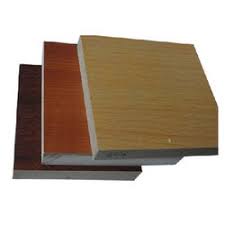
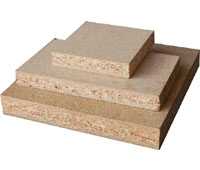
Particle board, or Particleboard is an engineered wood product manufactured from wood particles, such as wood chips, sawmill shavings, or even saw dust, and a synthetic resin or other suitable binder, which is pressed and extruded. Particleboard is a composite material.Particleboard is cheaper, denser and more uniform than conventional wood and plywood and is substituted for them when appearance and strength are less important than cost. However, particleboard can be made more attractive by painting or the use of wood veneers that are glued onto surfaces that will be visible. Though it is denser than conventional wood, it is the lightest and weakest type of fiberboard, except for insulation board. Medium-density fibreboard and hardboard, also called high-density fiberboard, are stronger and denser than particleboard. A major disadvantage of particleboard is that it is very prone to expansion and discoloration due to moisture, particularly when it is not covered with paint or another sealer. Therefore, it is rarely used outdoors or places that have high levels of moisture, with the exception of some bathrooms, kitchens and laundries, where it is commonly used as an underlayment beneath a continuous sheet of vinyl floor coverings.
 Write a Review
 Sandeep Lathwal (Wood Panel India.com)
 F-1118 Lgf Chittaranjan Park New Delhi - 110019 India
 Share us via








