Write a Review
Our Products
We are leaders in the market for providing best range of Bitumen and Rubber Process Oil
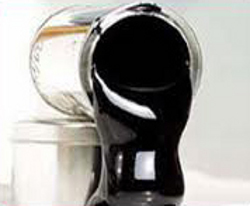
Bitumen is a mixture of Organic Liquids that are highly Viscous, Black, Sticky, Entirely Soluble in Carbon Disulfide, and composed primarily of highly condensed Polycyclic Aromatic Hydrocarbons.
Naturally occurring or crude bitumen is a sticky, tar-like form of petroleum which is so thick and heavy that it must be heated or diluted before it will flow. At room temperature, it is much like cold molasses. Refined Bitumen is the residual (bottom) fraction obtained by fractional distillation of crude oil. It is the heaviest fraction and the one with the highest boiling point, boiling at 525 C (977 F).
Most bitumen contains sulfur and several heavy metals such as Nickel, Vanadium, Lead, Chromium, Mercury and also Arsenic, Selenium, and other Toxic Elements. Bitumen can provide good preservation of plants and animal fossils.
In British English, the word 'Asphalt' refers to a mixture of mineral aggregate and bitumen (or tarmac in common parlance). The word 'Tar' refers to the black viscous material obtained from the destructive distillation of coal and is chemically distinct from bitumen. In American English, Bitumen is referred to as 'Asphalt' or 'Asphalt cement' in engineering jargon. In Australian English, Bitumen is sometimes used as the generic term for road surfaces. In Canadian English, the word bitumen is used to refer to the vast Canadian deposits of extremely heavy crude oil, while asphalt is used for the oil refinery product used to pave roads and manufacture roof shingles. Diluted Bitumen (diluted with Naphtha to make it flow in pipelines) is known as dilbit in the Canadian Petroleum industry, while bitumen upgraded to synthetic crude oil is known as syn crude and syn crude blended with bitumen as syn bit.
Bitumen is primarily used for paving roads. Its other uses are for Bituminous Waterproofing Products, including the use of bitumen in the production of roofing felt and for sealing flat roofs.
We would like to serve your esteem company with our competitive prices and committed services.
Rubber process oils can be broadly classified into three basic groups depending on the physical arrangement of the carbon atoms namely , parafinics , napthenics and aromatics. all petroleum oils are mixtures of various hydrocarbon groups and their classification is arbitrary and is based on the predominance of a particular hydrocarbon group.
Rubbers, both synthetic and natural are commercially used to produce products from rubber bands to a toy to the giant tyres for various vehicles including aircrafts. Rubber Process Oils are used during mixing of rubber compounds. These help in improving the dispersion of fillers and flow characteristics of the compound during further processing. IPOL Rubber process oils are specially developed taking into consideration the type of rubber and the end product applications. The range of IPOL Rubber Process Oils is broadly divided in following three catagories.
Naphthenic are a class of hydrocarbons also referred to as cycloparaffins. Though their structure is similar to the aromatic ring, these are single bonded thus having a stable structure. Several such hydrocarbon rings may be linked indicating a variety of available grades. Their unique colour stability, solubility and good thermal stability makes them ideal for moulded articles, slippers, LPG tubes, floor tiles, etc.
The primary characteristics of aromatic hydrocarbons are the presence of the double bonded mix ring carbon structure. Aromatic extracts procured from selected refineries and suitably blended to meet stringent specifications, are used for compounding batches to manufacture Tyres, calendared and moulded sheets, Tread rubber etc.
This class of hydrocarbons constitutes branched chain or straight linked hydrocarbon molecules of various viscosities. As the chain length increases, the viscosity increases and the rubber process oil becomes more viscous. They find extensive usage in EPDM, Butyl rubbers. IPOL grades include Paraffinic oils with high viscosity and high flash point for better shelf life of the end product. The high viscosity and high flash point IPOL paraffinic oils are extensively used in EPDM profiles for automotive applications.
We would like to serve you esteem company with our competitive prices and committed services.
 Mir Hyder Ali (Yakun Marketing Pvt. Ltd)
 305, Methodist Complex, Abids, Hyderabad, Telangana - 500001, India
 Share us via