 Write a Review
Our Products
We are leaders in the market for providing best range of Water Softener Resin and Ion Exchange Resin
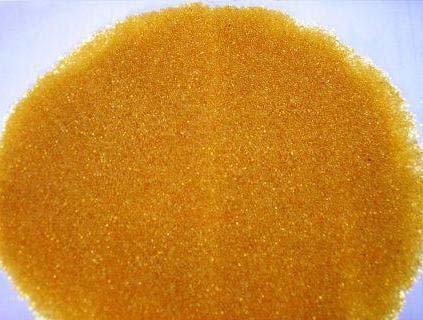
We are among the prime manufacturers and suppliers of Water Softener Resin. Water Softener Resin can be regenerated with either potassium chloride or sodium chloride salt. There is a misconception in the marketplace that certain water softeners are specifically designed for use with potassium salt to be more environmentally correct. This is a fallacy. All water softeners using a cation exchange resin can use either salt. Typically it requires about 10% more salt to regenerate with potassium chloride salt when compared to sodium chloride salt. The advantage of potassium salt is that it does not contribute to a high sodium diet and the backwash can be discharges onto a lawn or garden. Sodium chloride salt will kill plants so it must be discharged into a sewer system. USA made resins are made with sulfuric acid to sulfonate the resin versus imported resins that use a solvent based process. Both produce a good resin but the USA made resin won't have the solvent residue on startup that will be experienced with the imported resins. Newer 10% crosslink resins claim to have more resistance to breakdown from chlorine. There is some debate within the industry as to how much extra resin life will be obtained through use of the 10% crosslink water softener resins.
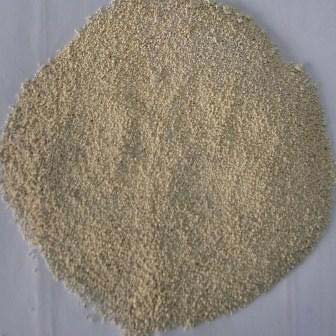
We are among the prime manufacturers and suppliers of Ion Exchange Resin. Ion Exchange Resin removes unwanted ions from a raw water by transferring them to a solid material, called an Ion Exchange Resin, which accepts them while giving back an equivalent number of a desirable species stored on the Ion Exchange Resin skeleton.
The Ion Exchange Resin has a limited capacity for storage of ions on its skeleton, called its exchange capacity; because of this, the Ion Exchange Resin eventually becomes depleted of its desirable ions and saturated with unwanted ions. It is then washed with a strong regenerating solution containing the desirable species of ions, and these then replace the accumulated undesirable ions, returning the exchange material to a usable condition. This operation is a cyclic chemical process, and the complete cycle usually includes backwashing, regeneration, rinsing, and service.
Polystyrene-divinylbenzene resins are still used in the majority of Ion Exchange Resin applications. Although the basic resin components are the same, the resins have been modified in many ways to meet the requirements of specific applications and provide a longer resin life. One of the most significant changes has been the development of the macroreticular, or macroporous, resin structure.
Ionizable groups attached to the resin bead determine the functional capability of the resin. Industrial water treatment resins are classified into four basic categories :
 Mr. Pinakin Gor (Yesha Technology)
 110 F F, Span Industrial Complex, Plot No. 84/4, Nr. Canara Bank, Gidc Vatva, Ahmedabad, Gujarat - 382445
 Share us via








